|  | | 
07-15-2010, 05:02 PM
| | Registered User el Jefe: Rude Mechtronics | | Join Date: Dec 2005 Location: Brisbane, Australia | | | Frequency analysis: pedal bypass edition
Sign in to disble this ad
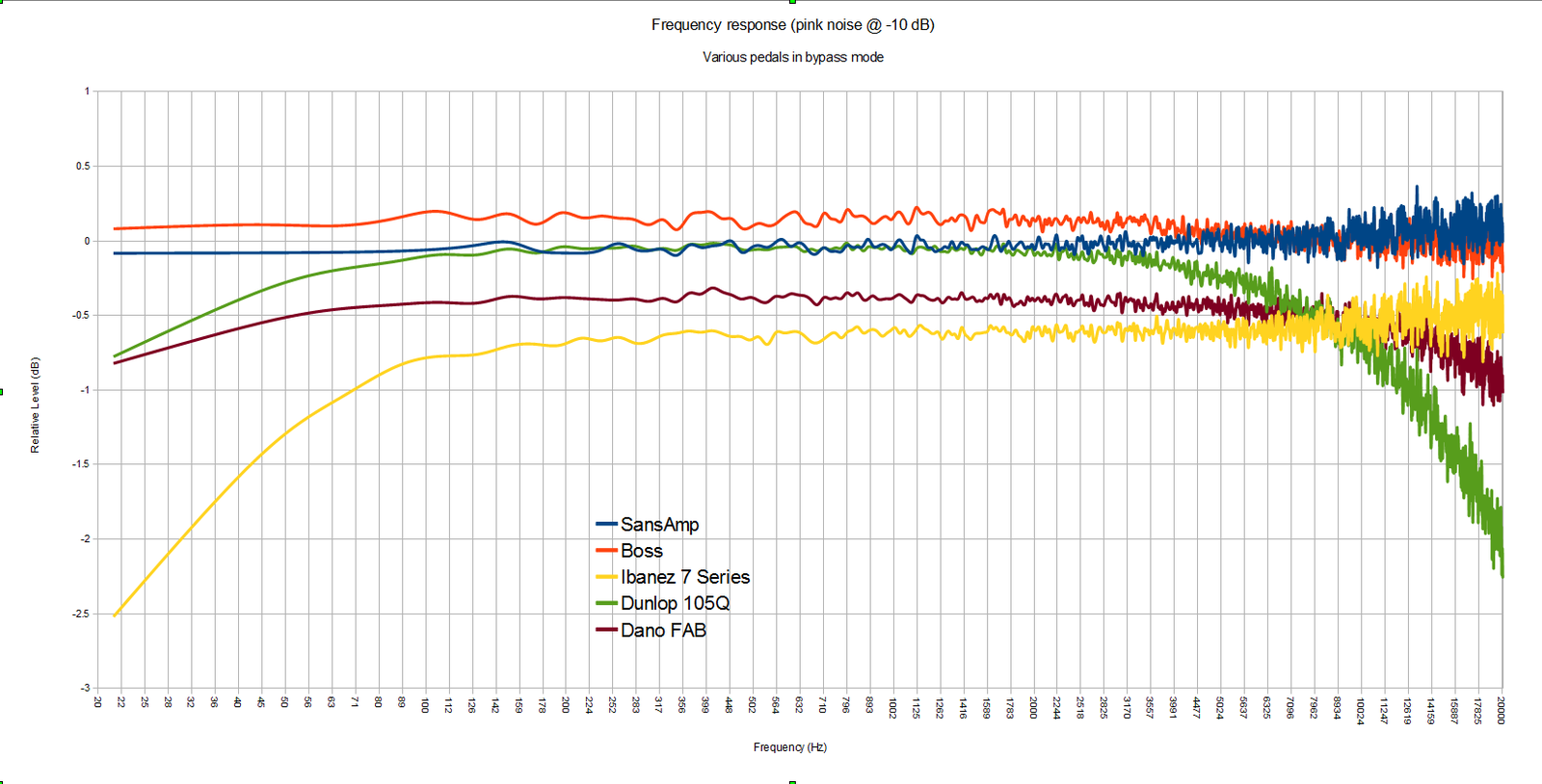
EDIT: Since I re-ran the tests with a different input level, the original post may skew reactions against certain manufacturers. So, before reading on, have a look at a more friendly graph!
ORIGINAL POST:
g'day guys,
I've been investigating a Guyatone BB-1 Flip Valve 'Bass Driver' for a buddy from Ozbass - he'd complained about a loss of bass. I got a little distracted when I noticed it had a vintage mechanical bypass system, so I ended up testing it alongside a few other pedals to see just what the various bypass types do to your signal.
I tested the following: - Boss LS-2, PS-2, RV-3
- SansAmp Paradriver DI
- Guyatone BB-1
- True Bypass loop
- True bypass Big Muff pi & Bassballs
I used the 'pink noise resample' method previously mentioned here in the Bass Driver DI & VT Bass threads: Play a pink noise sample back through your recording interface to establish a base level frequency response, then hook up a pedal and repeat. I used Audacity to generate Spectrum plots for each recording.
It's then a moderately simple process to fire up a spreadsheet, export the plots & subtract the plot for each pedal from your original 'through soundcard' recording. Graphing the results looks something like this:
X axis is 10 Hz - 20 kHz, Log scale; Y axis is dB (Open Office Calc struggles with labelling, unfortunately).
Yes - the single true bypass pedal measured above unity gain by between 0.1 and 0.2 dB - I chalk this up to the limited resolution of my soundcard and Line 6 Toneport, or possibly the multi-track offset in Audacity (how - I don't know. If you can figure it out, PM me!). Comparisons are still valid between the various plots, as the difference is greater than that margin of error anyway.
There are several things to note: - the BB-1 shows just how bad vintage bypassing can be!
- the Boss buffer is not much better than the vintage bypass,
- SansAmp pedals have great buffers,
- stacking true bypass pedals has a gentle effect on your tone, stacking Boss pedals does not.
Of course, for most of the frequency range you're seeing less than 1 dB of loss - it's the highs and lows that get hit the worst. What the Boss buffer does to the high end is quite bizarre.
I'm curious to see if more recent Boss pedals have a better bypass - lots of people suggest using a Line Selector or TU-2 as a buffer at the start of your signal chain, but I'd be hesitant to recommend that anymore!
On my 'to-test' wishlist: Ibanez 10 & 7 series pedals, vintage Crybaby, Danelectro FAB pedal (I'm sure mine boosts in bypass!) plus whatever else I can dig up
c-

__________________
This space left intentionally blank.
Last edited by idoru : 07-16-2010 at 07:34 AM.
| 
07-15-2010, 05:18 PM
| | | | If I understand correctly, the variation in the boss is all over the place (really weird), but if you were to normalize these results into a single curve, it'd probably be almost worse than the vintage BP. I do notice some tonal difference between using my pedalboard (LS-2 plus a lot of other pedals, some TB, some not) and going straight to amp, but it's hardly something that would make me want to *not* use the pedals, which are an essential part of my sound.
__________________
#27 Official SansAmp VT-Bass Owners Club!
| 
07-15-2010, 05:53 PM
| | Registered User el Jefe: Rude Mechtronics | | Join Date: Dec 2005 Location: Brisbane, Australia | | Quote:
Originally Posted by takfar If I understand correctly, the variation in the boss is all over the place (really weird), but if you were to normalize these results into a single curve, it'd probably be almost worse than the vintage BP. | Yep - eyeball a line through the middle of the Boss squiggle-fest, and you can see that although it doesn't roll the highs off as steeply as the vintage bypass, it has a lower cutoff point. The amount is not so drastic that a single Boss pedal can't be adjusted for at the amplifier, however (ie: using an LS-2 as a bypass loop). If you were using the 6 slot pedalboard with all Boss pedals though, I don't think the resulting graph would look too pretty.
c-
__________________
This space left intentionally blank.
| 
07-15-2010, 05:59 PM
| | | Quote:
Originally Posted by idoru Yep - eyeball a line through the middle of the Boss squiggle-fest, and you can see that although it doesn't roll the highs off as steeply as the vintage bypass, it has a lower cutoff point. The amount is not so drastic that a single Boss pedal can't be adjusted for at the amplifier, however (ie: using an LS-2 as a bypass loop). If you were using the 6 slot pedalboard with all Boss pedals though, I don't think the resulting graph would look too pretty.
c- | Yea, on the whole, it's slightly less uneven than the vintage bypass, so you lose all frequencies at a closer rate. Which is more or less what I notice when running my board: a slight overall volume decrease and a slight loss of highs (which I don't care that much about, to begin with - I'm not much into playing with super-bright strings or slapping a lot, or at all)
__________________
#27 Official SansAmp VT-Bass Owners Club!
| 
07-15-2010, 07:00 PM
|  | OVNIFX EXAR pedals rep for North & Central America | | Join Date: Oct 2005 Location: PDX, OR | | | Good stuff, thanks for doing that.
I have promised to do a ton of spectrum testing of cables and such, but it's been one roadblock after another, getting the system to operate. I have a new computer now, so here's hoping it gets easier. | 
07-15-2010, 07:05 PM
| | Registered User | | Join Date: Jan 2003 Location: Saskatoon, Canada | | | Cool thread!
__________________
It is far better to grasp the universe as it really is than to persist in delusion, however satisfying and reassuring. - Carl Sagan
| 
07-15-2010, 07:34 PM
|  | Registered User Designer/Owner of FEA Labs | | Join Date: Apr 2009 Location: Syracuse, NY | | | Some of the HF noise on the graphs may be due to the pedals distorting from lack of headroom. If you feed this somewhat hot 0dBv signal into a 9V pedal with any gain in the circuit at all, the potential to clip is great. Many pedal designs have substantial gain in higher frequencies to overcome circuit noise. Then the highs are filtered at the output to bring the output back to a flat response.
0dBv is approx. 2.8Vp-p, a fairly hot input signal for a guitar pedal. Even though I have measured the raw output of active basses in this neighborhood, it was in the frequencies less than 500Hz, with the tone controls dimed using aggressive slapping and popping. The frequencies between 500Hz and 1KHz barely hit 1Vp-p and the amplitude of the frequencies above 1KHz were far less than 1Vp-p.
I would suggest using a test signal of -10dBv to overcome the limitations of the circuits headroom.
-Frank | 
07-15-2010, 07:37 PM
| | Registered User | | Join Date: Feb 2009 Location: Western Pennsylvania | | | Interesting how Boss makes the high end go crazy.
Can you elaborate a bit on how you obtain spectrum graphs, I'm interested. | 
07-15-2010, 07:42 PM
| | Registered User el Jefe: Rude Mechtronics | | Join Date: Dec 2005 Location: Brisbane, Australia | | Quote:
Originally Posted by boomertech I would suggest using a test signal of -10dBv to overcome the limitations of the circuits headroom.
-Frank | Excellent suggestion! When I can stand to do this again I'll jump right on it
c-
__________________
This space left intentionally blank.
| 
07-15-2010, 07:42 PM
|  | Seer of all that is done there Accessories Sales Associate, Guitar Center Rancho Cucamonga, CA | | Join Date: Apr 2007 Location: Upland, California | | Interesting thread. I knew that stacking TBP pedals would eventually add up in cable capacitance, but I had no idea that stacking BOSS (or other buffered bypass pedals) had such a negative effect.  | 
07-15-2010, 07:43 PM
| | Registered User el Jefe: Rude Mechtronics | | Join Date: Dec 2005 Location: Brisbane, Australia | | Quote:
Originally Posted by DerHoggz Interesting how Boss makes the high end go crazy.
Can you elaborate a bit on how you obtain spectrum graphs, I'm interested. | Sure - I posted this in detail on my blog. Of course, now I have to go back and re-test with a lower signal level, but the process is the same.
c-
__________________
This space left intentionally blank.
| 
07-15-2010, 10:17 PM
| | Registered User el Jefe: Rude Mechtronics | | Join Date: Dec 2005 Location: Brisbane, Australia | | Quote:
Originally Posted by idoru Excellent suggestion! When I can stand to do this again I'll jump right on it
c- | And I'm glad I did - sure enough, for some pedals, the response is different when they aren't being slammed with too hot a signal:
I can see the Boss pedal does start rolling off the highs around 3.5 kHz, so comments about stacking too many of them definitely still apply (unless you use flatwounds like me). Big surprise to me is the 7-series Ibanez and Dunlop 105Q responses.
What we _can_ take from my stuff-up is that there are some pedals where you want to be careful of running too big a boost in front of, or putting in your amp's fx loop if it doesn't have a trim level.
c-
__________________
This space left intentionally blank.
| 
07-15-2010, 10:40 PM
| | Registered User | | Join Date: May 2006 Location: Lismore, NSW, Australia | | | The Boss is looking much healthier now! That was a shocker in the previous graph.
__________________ EFFECTS ADDICT #5 | 
07-16-2010, 12:35 AM
|  | Registered User | | | | | Fascinating. Thank you for posting this. | 
07-16-2010, 12:40 AM
| | Registered User | | Join Date: Sep 2005 Location: Ribwich, ZF | | | Neat. Cheers for this.
__________________ Chaos reigns. | 
07-16-2010, 02:34 AM
|  | - Owner/designer [sfx] | | Join Date: May 2006 Location: London - UK | | Thanks for your work idoru.
It looks like we have further proof that, in spite what some people think, true-bypass is not that important for the quality of a pedal. (A interesting program for frequency analysis that you may find usefull is HOLMImpulse)
__________________ [sfx] To contact me at [sfx] please do not send me private messages on Talkbass. Please send emails. Thanks. | 
07-16-2010, 03:10 AM
| | Registered User | | Join Date: Jan 2003 Location: Saskatoon, Canada | | | While helpful, frequency response does not tell the whole story. Buffers can also add other types of unwanted distortion/noise to the signal. While I've seen graphs showing that the bypass in the VT Bass is nearly ruler flat, a signal passing through still loses a noticeable amount of clarity when compared to a true-bypassed signal.
__________________
It is far better to grasp the universe as it really is than to persist in delusion, however satisfying and reassuring. - Carl Sagan
| 
07-16-2010, 03:23 AM
| | Registered User | | Join Date: Sep 2006 Location: Birmingham, UK | | | Ace stuff! I'm gonna use TBP loops more!
__________________
Every ding has a story. Team Trace Elliot #3 Christian P&W bassist #97 EHX club #23 Boss rocks! club #17 British bassist #68 Quote:
Originally Posted by Relic That's your masterly-bated fish hook. | | 
07-16-2010, 03:24 AM
|  | Registered User Designer/Owner of FEA Labs | | Join Date: Apr 2009 Location: Syracuse, NY | | Quote:
Originally Posted by idoru And I'm glad I did - sure enough, for some pedals, the response is different when they aren't being slammed with too hot a signal:
I can see the Boss pedal does start rolling off the highs around 3.5 kHz, so comments about stacking too many of them definitely still apply (unless you use flatwounds like me). | From the new graph, the BOSS (orange plot) is only down approx -0.1dB at 20KHz. If you assume that all BOSS pedals have the same freq response, then stacking ten pedals would only result in a -1dB loss at 20KHz. IMHO I don't think -1dB is a significant loss for 10 pedals.
-Frank | 
07-16-2010, 03:42 AM
| | | Quote:
Originally Posted by idoru What we _can_ take from my stuff-up is that there are some pedals where you want to be careful of running too big a boost in front of, or putting in your amp's fx loop if it doesn't have a trim level.
c- | Hmmm. iiintewestiing... vewy diffewent, veewy intewesting.
How can we know which input strength is closer to what we are usually dishing out on one particular bass?
__________________
#27 Official SansAmp VT-Bass Owners Club!
| | Thread Tools | Search this Thread | | | |
Posting Rules
| You may not post new threads You may not post replies You may not post attachments You may not edit your posts HTML code is Off | | | |