
The bass is an Epi EB-0 with stripped screw holes in the neck. I decided to install 10/32 threaded insert nuts from ACE Hardware to make it mount securely. There was very little room between the screw holes and the sides of the neck, but I thought I could make it work. Some of the ideas in this come from this thread at another forum: http://www.unofficialwarmoth.com/index.php?topic=5997.0
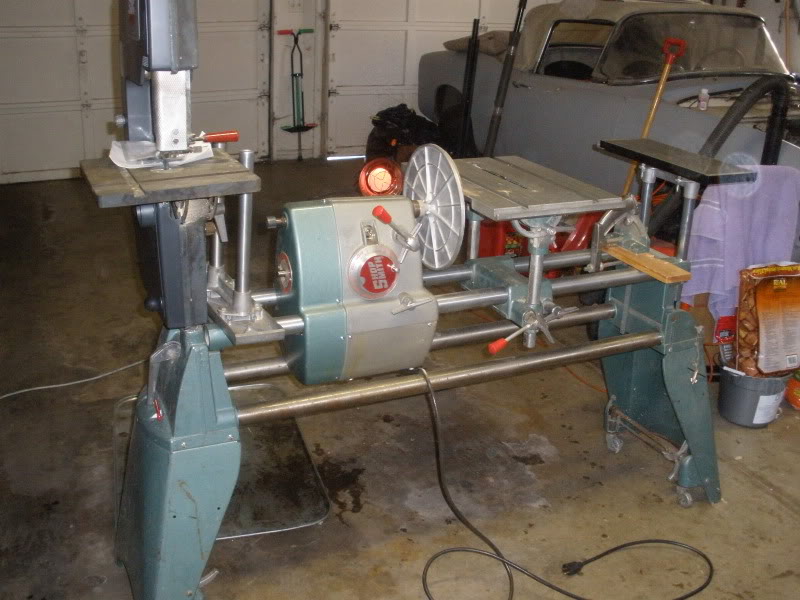
Here's the primary tool I used: a 1954 Shopsmith Mark V - which in its basic form is a table saw, disc sander, lathe and drill press. Some of you are familiar with it, others not. I needed the drill press function to drill holes for the insert nuts. The Shopsmith is basically a motor on a chassis and rails; the motor has drive shafts extending out each end, and accessories either mount on the shaft with one set screw, or use a PTO arrangement.
As you see it here, there's a bandsaw mounted on the left side and the disc sander is visible on the right side of the motor...I removed them for the next step.
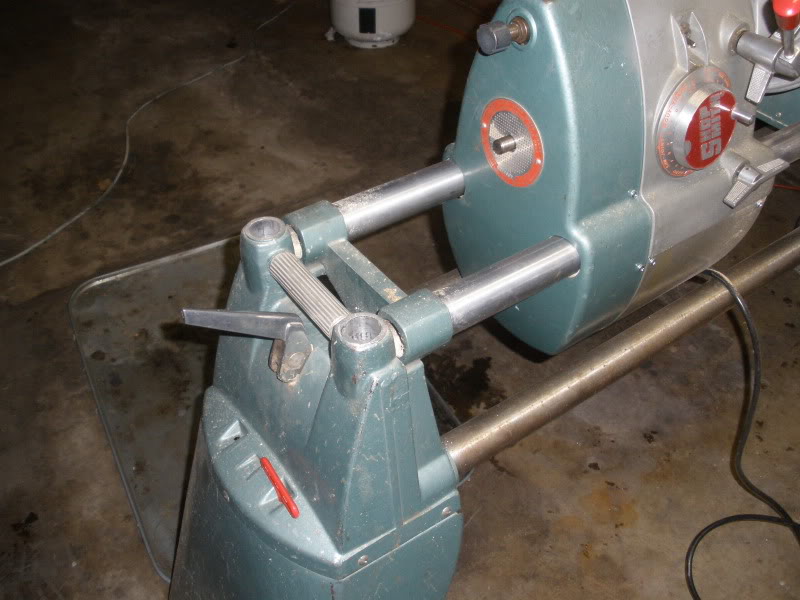
With unused accessories removed, there's a lever to flip on the left end of the chassis, allowing me to tilt the entire motor and mounting rails up to vertical, where they lock in place. Here's the lever flipped up:
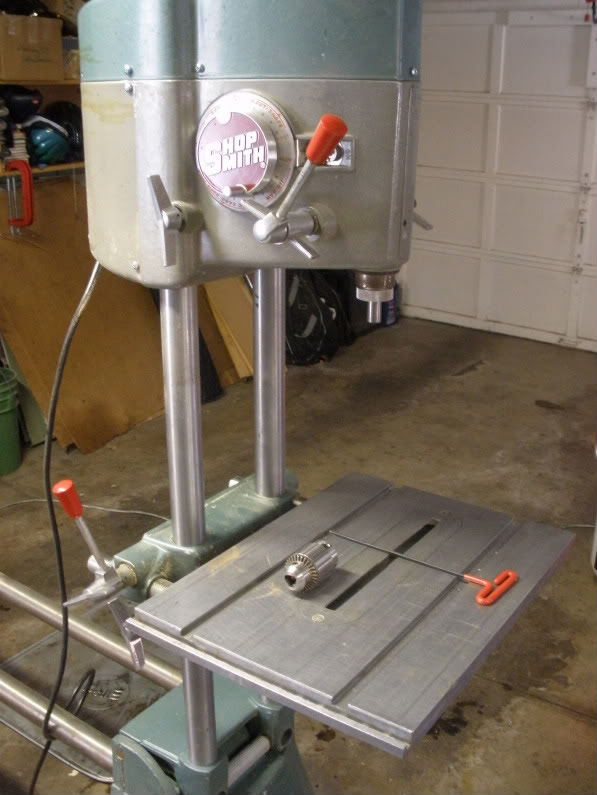
Here's the motor and rails in drill press position. The table which is the work surface for the table saw function swivels 90 degrees and becomes the working surface/support for the drill press. The 1/2" drive chuck for the drill press is sitting on the table - it connects to the power shaft with one set screw.
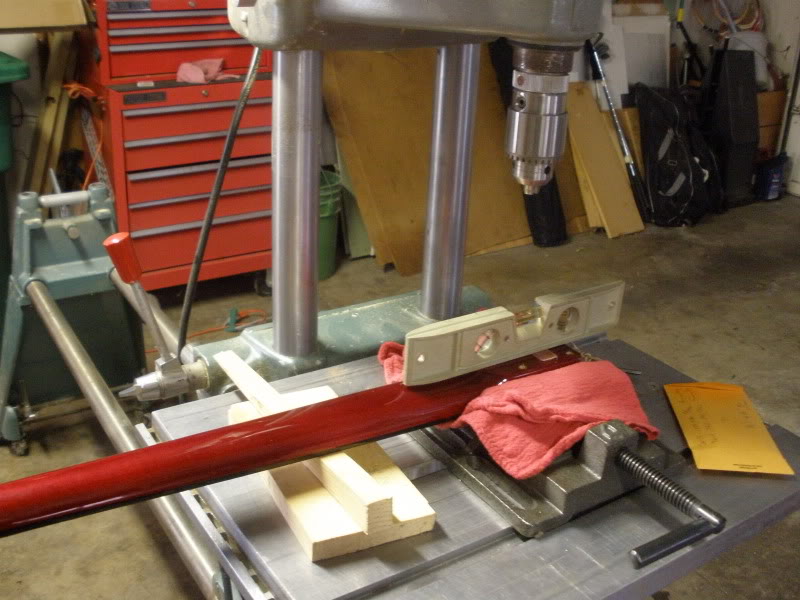
Here's the neck on the work table. It's in a machinist's vise with padded jaws. There's a level sitting on the neck mounting surface to help me assure that the neck is level up/down/left/right. On the left side of the table you see a block of lumber and a wedge between it and the neck. By sliding the wedge back and forth I was able to apply fine adjustments to leveling the neck down its length.
This hole is being drilled...

before drilling each hole, I re-positioned the neck and checked it for level in all directions.
Three out of four holes drilled....only the near hole on the left remaining.
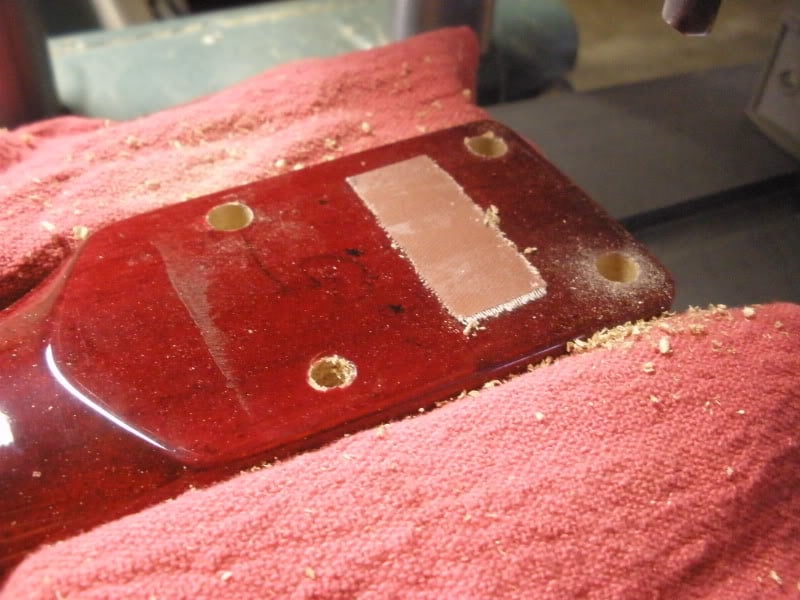
Here's an insert sitting on a block of paraffin. It's a good idea to lube any screw or insert before intstalling it in wood - I like to keep a block of good old paraffin, same as used for canning. It was about 30 degrees in this shop even with a heater going, so the paraffin didn't stick to the insert very well.

These inserts used a hex key drive to install, so I chucked up a bit driver extension in the drill and inserted the appropriate bit. I didn't use the motor on the Shopsmith to install this - it would have been uncontrollable. I just grasped the chuck and turned it manually while using the drill press handle to apply slight downward pressure to force the nut to start.
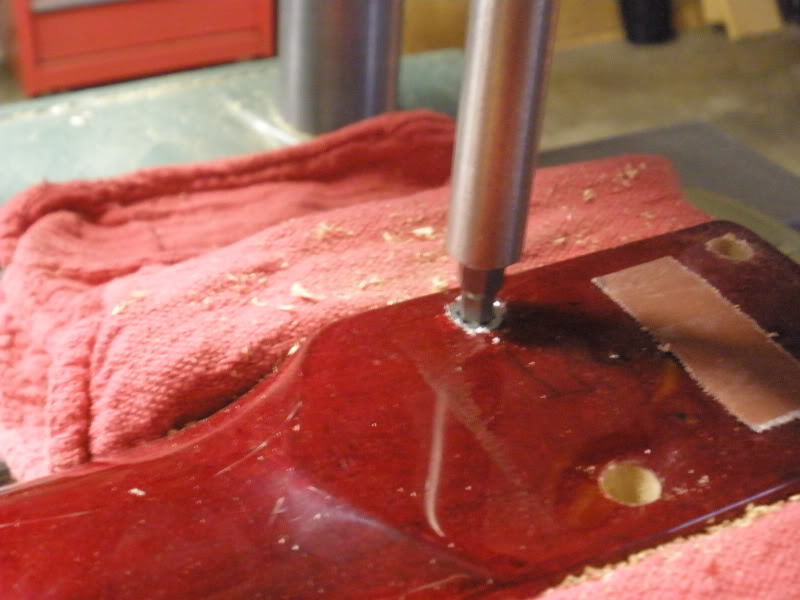
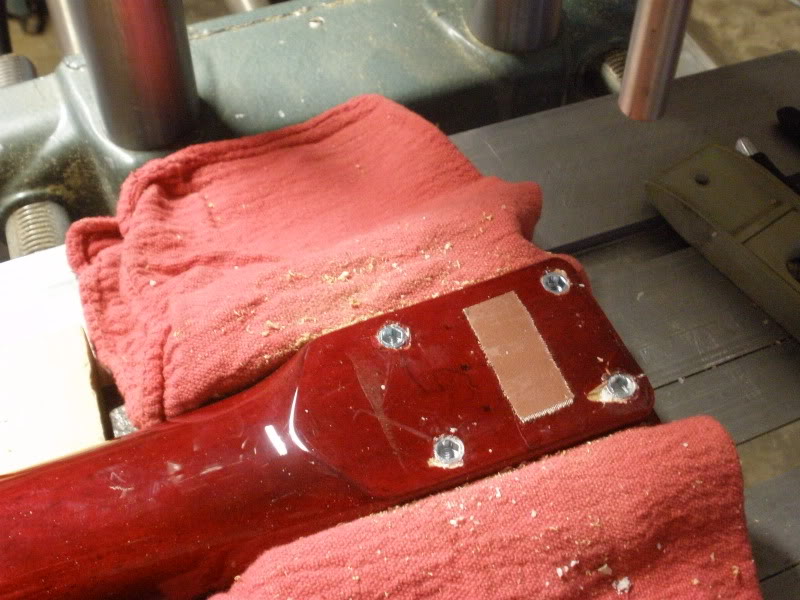
Four inserts installed. The bottom right one chipped the finish visibly, and created a slight crack on the edge of the neck. However, given that this area is not visible when the bass is assembled, I can live with it.
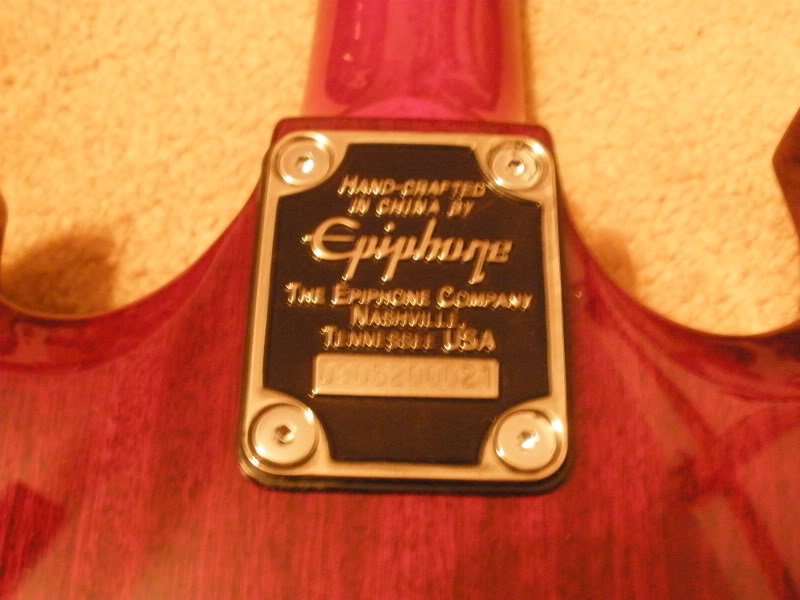
The neck plate for the Epi required V-head screws, therefore I needed V-head bolts to mate with it. ACE had chrome-plated 10/32 machine bolts with hex-head drives, and at $2.70 each they weren't cheap but they were a great fit. I used 1.5 inch bolts and the length was perfect; if not, I would have cut them down to length. This is a a serious consideration because you can't drill into the neck very far past the depth needed to install the insert nut, and you cannot have the bolt stick through the nut and into the wood beneath the fretboard.
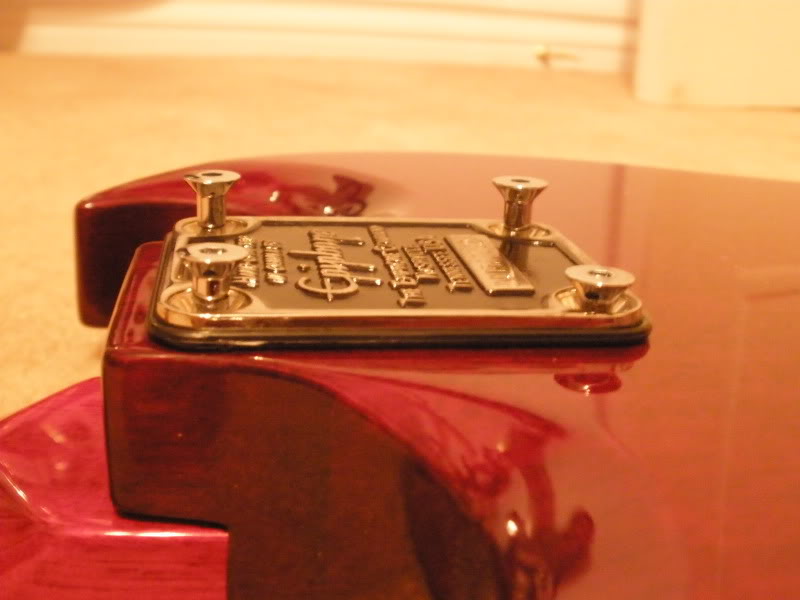
The final product - looks factory clean, and that neck is held in place more firmly than any wood screws could secure it.
Here's the primary tool I used: a 1954 Shopsmith Mark V - which in its basic form is a table saw, disc sander, lathe and drill press. Some of you are familiar with it, others not. I needed the drill press function to drill holes for the insert nuts. The Shopsmith is basically a motor on a chassis and rails; the motor has drive shafts extending out each end, and accessories either mount on the shaft with one set screw, or use a PTO arrangement.
As you see it here, there's a bandsaw mounted on the left side and the disc sander is visible on the right side of the motor...I removed them for the next step.
With unused accessories removed, there's a lever to flip on the left end of the chassis, allowing me to tilt the entire motor and mounting rails up to vertical, where they lock in place. Here's the lever flipped up:
Here's the motor and rails in drill press position. The table which is the work surface for the table saw function swivels 90 degrees and becomes the working surface/support for the drill press. The 1/2" drive chuck for the drill press is sitting on the table - it connects to the power shaft with one set screw.
Here's the neck on the work table. It's in a machinist's vise with padded jaws. There's a level sitting on the neck mounting surface to help me assure that the neck is level up/down/left/right. On the left side of the table you see a block of lumber and a wedge between it and the neck. By sliding the wedge back and forth I was able to apply fine adjustments to leveling the neck down its length.
This hole is being drilled...
before drilling each hole, I re-positioned the neck and checked it for level in all directions.
Three out of four holes drilled....only the near hole on the left remaining.
Here's an insert sitting on a block of paraffin. It's a good idea to lube any screw or insert before intstalling it in wood - I like to keep a block of good old paraffin, same as used for canning. It was about 30 degrees in this shop even with a heater going, so the paraffin didn't stick to the insert very well.
These inserts used a hex key drive to install, so I chucked up a bit driver extension in the drill and inserted the appropriate bit. I didn't use the motor on the Shopsmith to install this - it would have been uncontrollable. I just grasped the chuck and turned it manually while using the drill press handle to apply slight downward pressure to force the nut to start.
Four inserts installed. The bottom right one chipped the finish visibly, and created a slight crack on the edge of the neck. However, given that this area is not visible when the bass is assembled, I can live with it.
The neck plate for the Epi required V-head screws, therefore I needed V-head bolts to mate with it. ACE had chrome-plated 10/32 machine bolts with hex-head drives, and at $2.70 each they weren't cheap but they were a great fit. I used 1.5 inch bolts and the length was perfect; if not, I would have cut them down to length. This is a a serious consideration because you can't drill into the neck very far past the depth needed to install the insert nut, and you cannot have the bolt stick through the nut and into the wood beneath the fretboard.
The final product - looks factory clean, and that neck is held in place more firmly than any wood screws could secure it.