• TalkBass has been independent since 1998. Add your voice.
    Create a free account to reply to discussions, view embedded media, and browse with fewer display ads.
    Join freeLog in
    Want zero display ads or expanded classifieds tools? Compare plans.

Screw broke off inside headstock

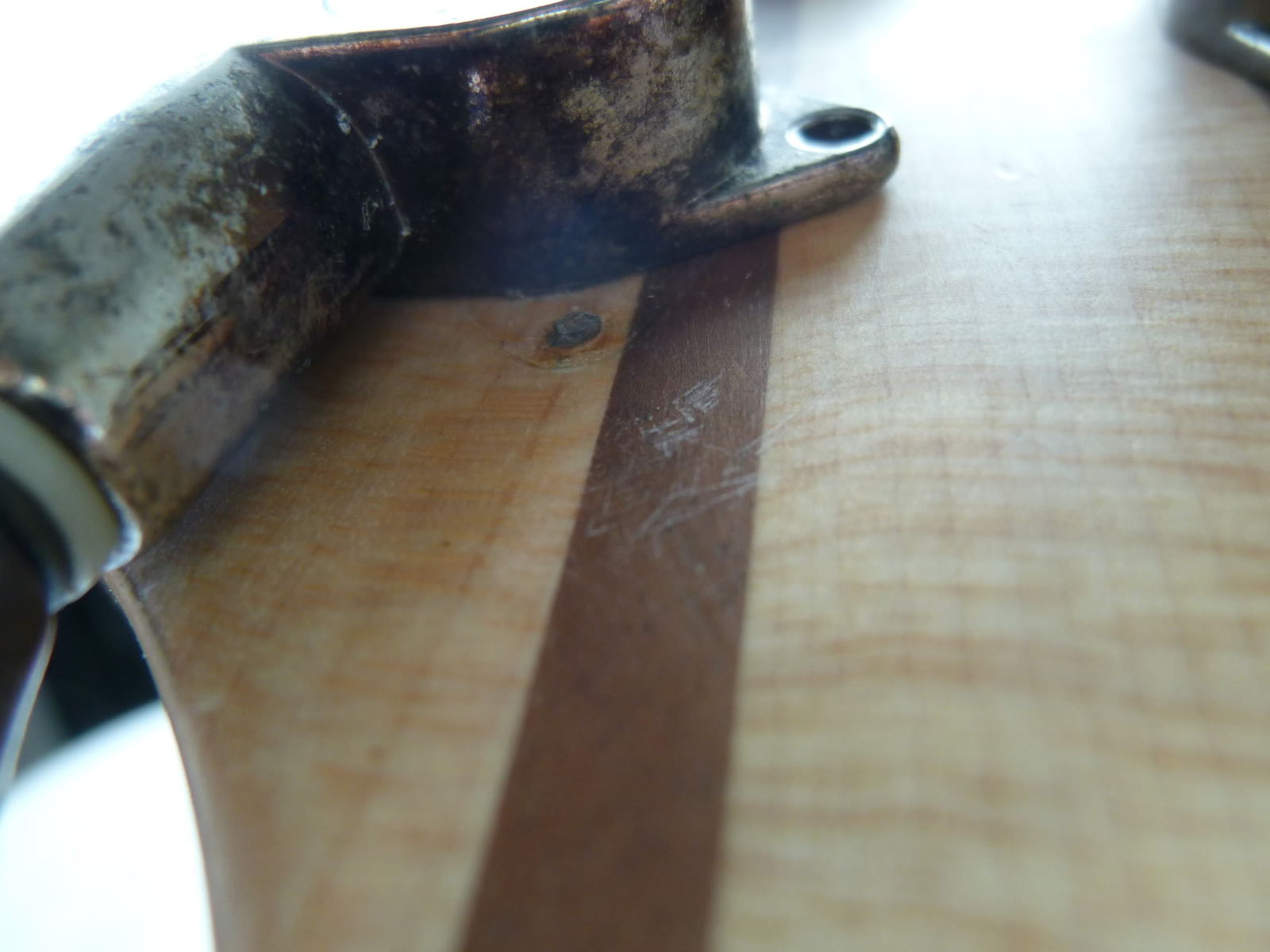
Alright so I was putting a little TLC into my 2001 Ibanez earlier today when disaster struck.

After removing the strings, I noticed that one of my tuning machines was visibly loose. Obviously, I attempted to tighten and it and it the head of the screw snapped right off :crying:

I know of things such as EZ-outs but I am looking for some tips/guidance.

Pics:
P1000213.jpg


P1000212.jpg


P1000211.jpg


I am definitely going to replace all of the tuning machine screws now, hopefully I don't experience something similar with the others..

The protruding piece is too little to grip with the pliers that I have.

Any thoughts on the best course of action?
 
In all likelihood, it's too small to get out. When this happened to me a couple of months ago (twice on the same headstock), I drilled a hole right next to it (almost touching it) and put a new screw in on a slight angle. Otherwise I was going to remove too much of the surrounding wood to get a grip on the broken-off screw.

Advisory: Do NOT use cheap screws; they are largely to blame for this. Drill a pilot hole for the new screw with a Dremel tool. Do not attempt to freehand it in.
 
Easy-outs can't get in there and there's not much chance of drilling a hole into the broken screw to insert an Easy-out anyway. There are OD stud removers, but I haven't seen any that small.

That looks like a #1 or at the biggest, a #2 screw.

I had this same problem in a very old, antique jewelry box of my mom's once and I cored it out.

I had a small piece of steel thinwall tubing and on one end I used a triangle file to create some teeth to cut around the broken screw - inside the wood.

I went down a bit until I had sufficient depth to break out the broken screw and a small diameter core of the wood itself.

I then hand carved a cylindrical plug to fit the hole and inserted it with Elmer's Yellow Woodworker's glue and when it was dry I drilled it out for the next - new screw.

Since you're dealing with such a small area to core out and it looks like the tuner base covers a lot of the wood surrounding the screw, you can prolly get away with this repair pretty easily.
 
I'm no luthier, but I'd grind a slot in the part that's left with a dremel tool cutting wheel and turn it out with a slot screwdriver....but wait for a profesional to show up here and tell you what to do. I'm just a mechanic type.

This is exactly what I did about a month ago with a broken string tree screw. It worked well for me. Using a good quality screwdriver will help.

Good Luck
 
Dremel attempt did not work. The tiny bit that was left was far too brittle.. It cracked off as soon as I started to turn the screwdriver.

Due to the lack of my woodworking experience and not having a woodshop on campus, can anyone recommend a good luthier in Philadelphia, PA?

I appreciate all the help thus far, and I would tackle it myself but I have little trust in my wood working skills. I would feel much comfortable with a professional doing the job.
 
I have the same problem. Right now I have a black zip tie holding it to the next tuner. I was told this trick by an old school metal head: get a tuner for the opposite side. The hole is on the opposite side of the tuner. Flip it around and bam! New spot for a new hole. Think I may try this...
 
I have the same problem. Right now I have a black zip tie holding it to the next tuner. I was told this trick by an old school metal head: get a tuner for the opposite side. The hole is on the opposite side of the tuner. Flip it around and bam! New spot for a new hole. Think I may try this...

This will work but the tuner rotation will be the opposite of the other tuners.

mech
 
This was actually pretty a pretty common repair when I worked in a shop many moons ago. We would just put drill out the screw on the drill press, plug the hole, re-drill a pilot and call it done.

I would file the broken top flat first for ease of drilling.

Trying all sorts of methods to remove a tiny little screw like that is a pain in the backside and rarely works.
 
I can live with that. Seems like the preferred method for me. If I had the cash, I would take it to a luthier, but I don't. Probably cheaper to buy one tuning machine.

Methinks the visual symmetry between the tuners would be knocked off. Additionally, everybody who ever picked up the bass after that would have to be aware of the contrary rotation of that tuner, lest you end up with a higher-than-usual incidence of over-tightened (read: broken) strings.

The only string I ever broke on any bass occurred in a similar manner.
 
Edward G. said:
Methinks the visual symmetry between the tuners would be knocked off. Additionally, everybody who ever picked up the bass after that would have to be aware of the contrary rotation of that tuner, lest you end up with a higher-than-usual incidence of over-tightened (read: broken) strings.

The only string I ever broke on any bass occurred in a similar manner.

Gotta look better than it does now with the zip tie. I imagine from the crowd it would go unnoticed. I can live with turning the tuner the other way. Anybody who picks up my bass gets beat so that's not a problem. Never gonna sell it so I'm not worried about resale value.
 
Easy-outs can't get in there and there's not much chance of drilling a hole into the broken screw to insert an Easy-out anyway. There are OD stud removers, but I haven't seen any that small.

That looks like a #1 or at the biggest, a #2 screw.

I had this same problem in a very old, antique jewelry box of my mom's once and I cored it out.

I had a small piece of steel thinwall tubing and on one end I used a triangle file to create some teeth to cut around the broken screw - inside the wood.

I went down a bit until I had sufficient depth to break out the broken screw and a small diameter core of the wood itself.

I then hand carved a cylindrical plug to fit the hole and inserted it with Elmer's Yellow Woodworker's glue and when it was dry I drilled it out for the next - new screw.

Since you're dealing with such a small area to core out and it looks like the tuner base covers a lot of the wood surrounding the screw, you can prolly get away with this repair pretty easily.

If you use a narrow piece of pipe (slightly larger than the screw diameter) and run your drill in reverse, the screw fragment may back itself out without having to remove an entire core. The teeth on your homemade drill rig have no orientation (CW vs. CCW) and, therefore, can be run in reverse with the same cutting efficacy. There's a good chance the bit will "catch" the screw and back it out before cutting too deeply.

Riis
 
This is a good idea: Invalid Link Removed

Unable to find the aforementioned metal tubing, I'm in the process of trying a more ghetto alternative method on a guitar I'm restoring, and I'll let you know if it works...

So I took a 1/16" drill bit and drilled a series of holes, in effect, a circle, around the broken screw. The drill holes didn't make a perfectly continuous circle so I chiseled out the wood in between them with a tiny flathead screwdriver. Then I grabbed the screw and twisted it out with needlenose pliers.

Then I filled the holes (screw hole with the drill holes all around it) with JB Weld steel epoxy. I let this cure over last night.

The plan is now to grind down the surface of the epoxy to be flush with the wood of the headstock, drill a new pilot hole in the epoxy and install new screws.

The JB Weld SAYS it's drillable, but I'm kind of doubtful that I'll be able to do this w/o breaking the new screws off too. The truth will come out....