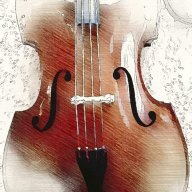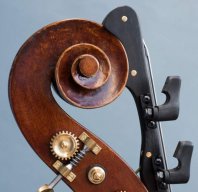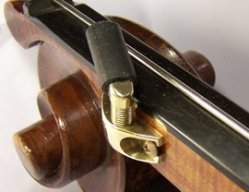
I've had this bass in the works for a while now, and it is still a work in progress, but after watching, enjoying, and learning a lot from all of the other builders here I figured it was time to start sharing some of my experiences in the process. Last year I posted a few images of it on my workbench; several folks were very supportive and on the other side of the spectrum, several of the thought police came down hard on me for it. I've also had a lot of very enthusiastic folks ask me to start a thread, show some photos, and try to contribute to the forum. I checked in with Chris and a couple of the other mods a while back and they gave me the go ahead, so her's my take....
Many of you know me from my work with the Guild of American Luthiers, my column in Mandolin Magazine, my finishing video over at finewoodworking.com, and a host of other (rather obscure) luthier's publication ramblings, the trade shows, and the host of folks I'm lucky enough to play and gig with regularly. My records are weak at best, but by my estimate, I can total about 350 new instruments that I've built or had major work into, along with countless repairs and partial builds. Is a top and neck replacement on a heavily damaged instrument a build with another subcontractor for the other 1/2 of the instrument, or is it a simple repair on someone else's greater repair. The new issue of Mandolin Magazine has an article I wrote on just those ideas working on vintage Loar and Fern era instruments.
Over the next while, I'll try to chronicle my efforts and experiences on this, my first bass build. It is not for sale, I don't want to sell it- having WAYYYYYYYY to much fun playing and learning from it, and I don't know if I can give up production time from the other instruments to actually build another one if someone even liked it. That said, I do fall into the commercial user posting a non-commercial intention forum nefarious zone.
Anyone wanting a candid report on the sound can check in with Eliott Wadopian. He and I goofed off and laughed about basses a few days ago over at his place and he gave it a good workout. He also helped me out and cursed me by letting me checkout his ancient Prescott and another bass which both have extensions- I've GOTTA have one now, so it is in the works (extension, not the old warhorse Prescott).
So far I've used hand tools for 99% of the build. I did use a giant resaw and thickness sander for the ribs and since I was in there, I took advantage of my buddy's ancient, but very precise 20" jointer and ran both the faces and the actual joint over the plates, before giving them a lot of hand work.
Outside of everything else, I'm a musician first. The luthier stuff luckily keeps me from having to get a job somewhere else (terrifying....). On any given week, you can find me giging with a nice late 50s jazz group, a Celtic trio, a gypsy swing project, and countless vegetarian hillbillies rockin' the newgrass sound in the Blueridge. I pitz; I arco; and I beat the daylights out of the thing in anyway possible to get that sound that makes folks dance like they are possessed. I've lived all over the world and like modern designs. Like a lot of other builders, I'm on the constant search to improve what I can to make the instrument work better from my point of view. Old crusty folks, beware. You will be seeing some ideas that may get you worked up over the course of this thread....
I've got another thread going on cedar soundposts, so I'll make my first images in regard to the post area and my new access panel.
After searching for about a year and getting all sorts of confusing information about finishes, I didn't really get anywhere. I wanted to do an oil varnish, but couldn't find enough solid unanimity among folks that I asked for information to get me to a confident place, so I stuck to what I know best- french polished / spirit varnished shellac. After all, I am the dork with the finishing video, and it works out well because I've got the technique down and I always have shellac mixed up in the shop, so I can touch up anytime I want.
These images show it with the current blonde sealer coats- about 3-4 coats, hand rubbed. I'll be posting more finish ideas and images later.
Right away, you'll notice my access panel opening. 'Sure to rub some crusty folks bad....but if you worked on other folks basses all of the time, you'd get sick of that ship-in-a-bottle game fast. Prior to this bass, I always carry my custom soundpost setting tools to every gig- and I use them regularly. No need now- a Swiss army knife takes the place.
The insert door is carefully cut with an extremely thin (approx 0.010: kerf) saw blade and then put back in place.
The day I cut this, I was a little nervous about the idea. 20 minutes later, someone else knocked a neck off a rack hanging on the wall and put about a four inch crack in the treble upper bout side, even reversing the bend of the wood. All I had to do was stick my arm in the panel opening, push it back into position (faced with a nice oversized caul), hit it with a bit of hide glue and a couple of cleats. Total time was about 15 minutes versus half a day going through the f hole. I was sold!!!
j.
Many of you know me from my work with the Guild of American Luthiers, my column in Mandolin Magazine, my finishing video over at finewoodworking.com, and a host of other (rather obscure) luthier's publication ramblings, the trade shows, and the host of folks I'm lucky enough to play and gig with regularly. My records are weak at best, but by my estimate, I can total about 350 new instruments that I've built or had major work into, along with countless repairs and partial builds. Is a top and neck replacement on a heavily damaged instrument a build with another subcontractor for the other 1/2 of the instrument, or is it a simple repair on someone else's greater repair. The new issue of Mandolin Magazine has an article I wrote on just those ideas working on vintage Loar and Fern era instruments.
Over the next while, I'll try to chronicle my efforts and experiences on this, my first bass build. It is not for sale, I don't want to sell it- having WAYYYYYYYY to much fun playing and learning from it, and I don't know if I can give up production time from the other instruments to actually build another one if someone even liked it. That said, I do fall into the commercial user posting a non-commercial intention forum nefarious zone.
Anyone wanting a candid report on the sound can check in with Eliott Wadopian. He and I goofed off and laughed about basses a few days ago over at his place and he gave it a good workout. He also helped me out and cursed me by letting me checkout his ancient Prescott and another bass which both have extensions- I've GOTTA have one now, so it is in the works (extension, not the old warhorse Prescott).
So far I've used hand tools for 99% of the build. I did use a giant resaw and thickness sander for the ribs and since I was in there, I took advantage of my buddy's ancient, but very precise 20" jointer and ran both the faces and the actual joint over the plates, before giving them a lot of hand work.
Outside of everything else, I'm a musician first. The luthier stuff luckily keeps me from having to get a job somewhere else (terrifying....). On any given week, you can find me giging with a nice late 50s jazz group, a Celtic trio, a gypsy swing project, and countless vegetarian hillbillies rockin' the newgrass sound in the Blueridge. I pitz; I arco; and I beat the daylights out of the thing in anyway possible to get that sound that makes folks dance like they are possessed. I've lived all over the world and like modern designs. Like a lot of other builders, I'm on the constant search to improve what I can to make the instrument work better from my point of view. Old crusty folks, beware. You will be seeing some ideas that may get you worked up over the course of this thread....
I've got another thread going on cedar soundposts, so I'll make my first images in regard to the post area and my new access panel.
After searching for about a year and getting all sorts of confusing information about finishes, I didn't really get anywhere. I wanted to do an oil varnish, but couldn't find enough solid unanimity among folks that I asked for information to get me to a confident place, so I stuck to what I know best- french polished / spirit varnished shellac. After all, I am the dork with the finishing video, and it works out well because I've got the technique down and I always have shellac mixed up in the shop, so I can touch up anytime I want.
These images show it with the current blonde sealer coats- about 3-4 coats, hand rubbed. I'll be posting more finish ideas and images later.
Right away, you'll notice my access panel opening. 'Sure to rub some crusty folks bad....but if you worked on other folks basses all of the time, you'd get sick of that ship-in-a-bottle game fast. Prior to this bass, I always carry my custom soundpost setting tools to every gig- and I use them regularly. No need now- a Swiss army knife takes the place.
The insert door is carefully cut with an extremely thin (approx 0.010: kerf) saw blade and then put back in place.
The day I cut this, I was a little nervous about the idea. 20 minutes later, someone else knocked a neck off a rack hanging on the wall and put about a four inch crack in the treble upper bout side, even reversing the bend of the wood. All I had to do was stick my arm in the panel opening, push it back into position (faced with a nice oversized caul), hit it with a bit of hide glue and a couple of cleats. Total time was about 15 minutes versus half a day going through the f hole. I was sold!!!
j.