• TalkBass has been independent since 1998. Add your voice.
    Create a free account to reply to discussions, view embedded media, and browse with fewer display ads.
    Join freeLog in
    Want zero display ads or expanded classifieds tools? Compare plans.

Double Bass Making a neck thicker?

To the luthiers on board as well as anyone with an idea:

I have a wilfer hybrid with the notorious thin neck. I really have developed a connection with this bass but the neck is starting to bother me a little. I was wondering about the possibility of adding a maple "firring" strip down the length of the neck to add a little girth. My idea is that the strip would be around 1/8" thick and about 1 1/4 "wide, fitted tight to the neck. Basically covering the area where your thumb would go, tapering( in thickness) gradually as it approaches the body of the bass.
Now I know this isn't the most elegant solution, but It's preferable, at least, to replacing the neck, which I can't afford. It would also be a reversible operation, since the strip could be hyde glued in place. It also could be tweaked for thickness once in place.

any Ideas about this?


phil

 
The most common approach I have seen to this is to add a strip of wood between the fingerboard and the neck.

That is, remove the fb, add the wood and replace the board. This modification also allows the geometry of the bass to be adjusted if desired, as the strip can be cut into a wedge to change the fb's angle to the body. I believe our own Ken Smith has a bass that has this treatment.

In your case a strip of even thickness would simply add depth to the neck.
 
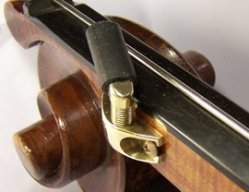
John Styklunas did this one for me. I have also played an Engelhardt that received similar treatment from John. I'm really pleased with the work though I may (or may not...) have a tiny bit of final shaping done at some point. I will have to post about all the changes to my bass at some point.

Peace,
S
 

Attachments

  • neck2.jpg
    neck2.jpg
    11.7 KB · Views: 230
If it were mine, I would probably replace the fingerboard with a new (thicker) ebony board. From an esthetics standpoint it can't be beat and it will add some stiffness to that thin neck. It is possible to put a strip of maple between the existing fingerboard and the neck, but old fingerboards don't always come off cleanly and getting everything lined up, glued and shaped properly is not the easiest job in the world.
 
BTW the shim on mine is maple and was added while replacing an old beveled rosewood fingerboard with a much thicker radiused ebony board. At least 1/4" was removed from the back of the neck, which had a sharp V profile in order to get a more C shaped profile. He also had to fit a new top bridge half onto the old legs and adjusters. The adjusters were already too far out and the neck/fb mods took things way out of the range. All worth it in the end as these plus all the other updates have added up to a much better instrument in both feel and sound.

Peace,
S
 
KSB - Ken Smith said:
Bob, Biase removed the Maple shims that were in there already, 3 of them overlapping. The tone is much better now.

OK Ken. We all know how much you like ebony. I don't know anyone else who would put ebony cheek plates on a bass. While we have no way of knowing now, the fact that you replaced THREE (3) overlapping maple shims with ONE has probably got more to do with it than being of ebony instead of maple. Maybe next time you can get Arnold to do a neck graft for you entirely of ebony. Talk about being strong:D
 
I'm just surprised that some people don't like working with ebony. Even more surprised that anyone would prefer maple for shaping/cutting/finishing. Now, I have spent most of my shop life shaping light metal, acrylic and specialized model-making composites than wood, but I find ebony to be the most dimensionally stable, predictable, and non grain-centric wood I have ever worked with.
Robobass
 
robobass said:
I'm just surprised that some people don't like working with ebony. Even more surprised that anyone would prefer maple for shaping/cutting/finishing. Now, I have spent most of my shop life shaping light metal, acrylic and specialized model-making composites than wood, but I find ebony to be the most dimensionally stable, predictable, and non grain-centric wood I have ever worked with.
Robobass

Two possibilities I can think of but I am a non-luthier home hacker with more experience on metalwork and guitars than on fine woodwork and double basses.

1. From the standpoint of a customer - For something like a neck shim where a thick new ebony board is already to be installed, it gets expensive and adds a lot of weight. In my case with an inexpensive bass, I wanted to invest that money in other parts of the bass.

2. From working with guitar bridges in the past - I wonder if ebony is easier to work with certain tools meant for metal than with tools meant for less dense woods. I found myself wishing for a Bridgeport set on high speed more than once when trying to shorten an ebony or rosewood guitar bridge. Time is money and tools cost money too.

Peace,
S
 
KSB - Ken Smith said:
Bob, same money as yours. Just a bunch of dead Presidents.
It's not the quality of the money Ken, it's the quantity :)

I'm quite sure Ken knows that our objection to the all that ebony is the WEIGHT. Ken does not believe that adding extra weight to the neck has any consequences as far a sound is concerned. I happen to believe otherwise. And... before he comes back with the "you've got to play this bass and hear how great it sounds" argument, I have to say that it is a testament to the quality of the bass that it sounds so good INSPITE of all that extra, unnecessary weight.
 
Is there really a huge difference in weight between maple and ebony? For a 1/4" thick neck shim, are we talking more than 100 grams?

As to shaping issues, perhaps maple is nicer if you are using hand planes, but if you are talking about disc sanders, etc., and you are having problems with ebony, you might not be using the best abrasive media. Check out Klingspor at http://www.sandingcatalog.com/
The stuff they sell at home depot is real crap, and not cheaper.
I keep myself stocked with top quality sandpaper, and replace discs and belts often. It's a small price to pay.
Robobass
 

Latest posts