Gentlemen; I would appreciate some advice.
I bought a new, in-the-white bass, in parts, from an eBay seller in China.
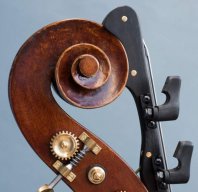
The seller, incidentally, is lankuishuang; and his eBay shop is the Charming Song Violin Store. The process of buying/shipping from him was painless; and I am impressed with the quality of what I received - a body of hybrid construction, with nice carved spruce top and beautifully figured flame maple back and ribs; a neck/scroll of reasonable quality maple, and a fingerboard in very nice, dark (undyed) ebony.
The parts required sanding and finishing, machine heads fitting, nut and fingerboard fitting, drilling for endpin, and varnishing. So far I have completed all of these jobs without any problem - I've done a fair bit of woodwork and (if it doesn't offend to mention it here) have done a lot of maintenance/repairs on guitars and bass guitars.
Particular thanks must go incidentally to the member of this forum who recommended Tru-oil, which hitherto I've only used for rifle and shotgun stocks, but which gave a very nice finish - I applied 8 coats in all to the body, using fingertips, and cut it back with well-worn 600 grit paper to give a very nice semi-satin finish that I am quite pleased with. The neck and scroll will be finished after being fitted.
Now to the question. The parts arrived with the neck 90% fitted, and after much patient work with thumb plane, scraper and sanding block I now have the neck-body joint so that it is a perfect, tight dry fit, and when assembled dry the neck is perfectly aligned.
I'm proposing to construct a support/cramp for the gluing using a scaffolding plank and some old bookshelf brackets I have lying around. I do have some long sash cramps but they are heavy beasts and I think my idea will work better.
I'm proposing to use Titebond liquid hide unless someone gives me a good reason not to. I have neither the experience of nor equipment for "proper" animal gluing.
Most of all, having already invested considerable money and time so far, without breaking anything, I want to get this part of the job right.
Hence I'd appreciate it if any experienced members could give me some "pointers", as my palms are beginning to sweat!
Many thanks in advance,
Adrian
I bought a new, in-the-white bass, in parts, from an eBay seller in China.
The seller, incidentally, is lankuishuang; and his eBay shop is the Charming Song Violin Store. The process of buying/shipping from him was painless; and I am impressed with the quality of what I received - a body of hybrid construction, with nice carved spruce top and beautifully figured flame maple back and ribs; a neck/scroll of reasonable quality maple, and a fingerboard in very nice, dark (undyed) ebony.
The parts required sanding and finishing, machine heads fitting, nut and fingerboard fitting, drilling for endpin, and varnishing. So far I have completed all of these jobs without any problem - I've done a fair bit of woodwork and (if it doesn't offend to mention it here) have done a lot of maintenance/repairs on guitars and bass guitars.
Particular thanks must go incidentally to the member of this forum who recommended Tru-oil, which hitherto I've only used for rifle and shotgun stocks, but which gave a very nice finish - I applied 8 coats in all to the body, using fingertips, and cut it back with well-worn 600 grit paper to give a very nice semi-satin finish that I am quite pleased with. The neck and scroll will be finished after being fitted.
Now to the question. The parts arrived with the neck 90% fitted, and after much patient work with thumb plane, scraper and sanding block I now have the neck-body joint so that it is a perfect, tight dry fit, and when assembled dry the neck is perfectly aligned.
I'm proposing to construct a support/cramp for the gluing using a scaffolding plank and some old bookshelf brackets I have lying around. I do have some long sash cramps but they are heavy beasts and I think my idea will work better.
I'm proposing to use Titebond liquid hide unless someone gives me a good reason not to. I have neither the experience of nor equipment for "proper" animal gluing.
Most of all, having already invested considerable money and time so far, without breaking anything, I want to get this part of the job right.
Hence I'd appreciate it if any experienced members could give me some "pointers", as my palms are beginning to sweat!
Many thanks in advance,
Adrian
 . I'll source some of the proper stuff, and do some reading on the subject and experimenting on scraps before I attempt the real assembly.



 . The look on her face was something to behold.