

Enjoy the benefits of a premium membership!
Upgrade Account
-
TalkBass has been independent since 1998. Add your voice.
Create a free account to reply to discussions, view embedded media, and browse with fewer display ads.
Join free Log in
Want zero display ads or expanded classifieds tools? Compare plans.
You are using an out of date browser. It may not display this or other websites correctly.
You should upgrade or use an alternative browser.
You should upgrade or use an alternative browser.
My Mesa d180...
- Thread starter dazminiimp
- Start date
More options
Who Replied?

Just wanted to let you guys know about an experiment that I did recently. I put EVM15L speakers in 2 bag end S15D cabs, really dig the sound with the Mesa D-180. Reason I did that was because I am under the impression that those were the speakers that mesa designed the D-180 to be used with. I really like the sound. Not much low end bass, but enough low mids/mids/highs to sound glorious. I run them with the bass knob pulled out and at about 8. I also pull the 2nd volume knob out. I am really liking my sound now. I do find myself playing a lot of sonic youth bass lines for some reason.
I got an M-180 (for $400) that I paired up with an Alembic F2B (for $300). Sounds like a Fender Showman with a little more umph. I'd still like a D-180 though, more preamp tubes.
Gale
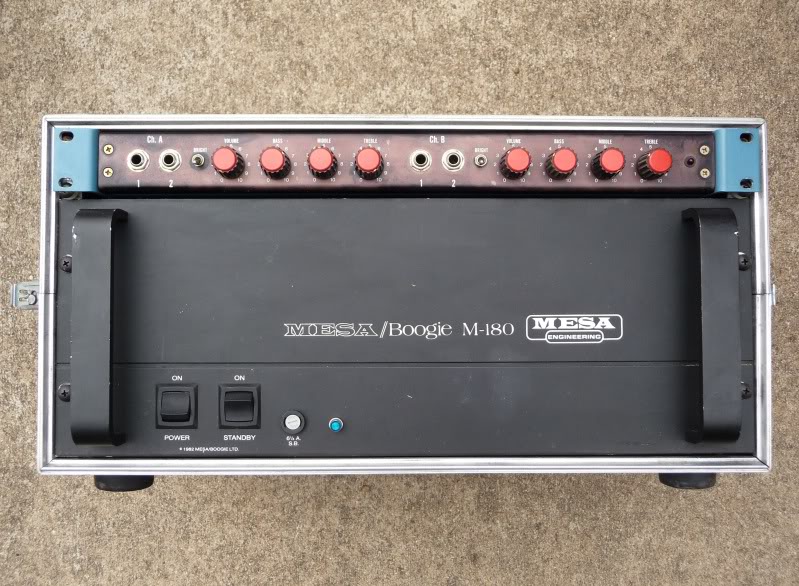
Nice combination 
I sold an early Alembic F2B, like yours, to Peter Fredette about 12 years back. He hauled it all over the place in his live rig until he offered it up for sale late last year. I found the ad on kijiji & jumped on it along with one of his 2x15" Gauss cabs. I bridged my Bryston 4B in between .......then & my jaw dropped!
An awesome preamp & I love the fact I lucked out & got mine back
Don't worry.... My Mesa D-180 aint going anywhere


I sold an early Alembic F2B, like yours, to Peter Fredette about 12 years back. He hauled it all over the place in his live rig until he offered it up for sale late last year. I found the ad on kijiji & jumped on it along with one of his 2x15" Gauss cabs. I bridged my Bryston 4B in between .......then & my jaw dropped!
An awesome preamp & I love the fact I lucked out & got mine back
Don't worry.... My Mesa D-180 aint going anywhere
Last edited:
hi! i'm new one here, sorry for my english...
last month a get mesa d-180 amp with graphic eq 230v type. My issue is every time when i push "stand-by" in On, slo blo main fuse is burning imidiately! =( even if i don't push stand by on, slo blo will burn after 2 minutes((. I verified all tubes, they are ok. anode is 475 v. and negative power is -50 v. i disconect output transformer anode cable from stand by switch, and choke cable i broke, it's ok.
Amp was modified by someone from 115 to 230 v, and made changes in power supply cable conections PCB. i find schematic of 400 series but there is different conections are they the same to d180? I found on your forum photos of pcb but quality is poor. on my photos you can see varistors are missing, strange cable conections and two cables black/red-black/yelow together, yours are the same?
So, can you help me please with information, photos of pcb or schematic? any info will help!
thx a lot!!
last month a get mesa d-180 amp with graphic eq 230v type. My issue is every time when i push "stand-by" in On, slo blo main fuse is burning imidiately! =( even if i don't push stand by on, slo blo will burn after 2 minutes((. I verified all tubes, they are ok. anode is 475 v. and negative power is -50 v. i disconect output transformer anode cable from stand by switch, and choke cable i broke, it's ok.
Amp was modified by someone from 115 to 230 v, and made changes in power supply cable conections PCB. i find schematic of 400 series but there is different conections are they the same to d180? I found on your forum photos of pcb but quality is poor. on my photos you can see varistors are missing, strange cable conections and two cables black/red-black/yelow together, yours are the same?
So, can you help me please with information, photos of pcb or schematic? any info will help!
thx a lot!!
Attachments


My first Bass 400 non-plus would blow the fuse if the power tubes came loose in transport, so I'd always manually check them any time I moved the head. That could be a possibility. Dunno about the voltage conversion stuff.
Oh man it sucked when I had that problem.
Once we were getting set up for a show and Burton C Bell & crew suddenly turn up at the venue! They had just finished their gig at a major venue down the street. I thought it was the coolest thing because I rocked tons of Fear Factory back in the day like 1999. Then my fuse blew.
Oh man it sucked when I had that problem.
Once we were getting set up for a show and Burton C Bell & crew suddenly turn up at the venue! They had just finished their gig at a major venue down the street. I thought it was the coolest thing because I rocked tons of Fear Factory back in the day like 1999. Then my fuse blew.
Your pics add up to about 1/3 of my daily data allowance, but if you go up the thread I posted the factory voltage swapping instructions.hi! i'm new one here, sorry for my english...
last month a get mesa d-180 amp with graphic eq 230v type. My issue is every time when i push "stand-by" in On, slo blo main fuse is burning imidiately! =( even if i don't push stand by on, slo blo will burn after 2 minutes((. I verified all tubes, they are ok. anode is 475 v. and negative power is -50 v. i disconect output transformer anode cable from stand by switch, and choke cable i broke, it's ok.
Amp was modified by someone from 115 to 230 v, and made changes in power supply cable conections PCB. i find schematic of 400 series but there is different conections are they the same to d180? I found on your forum photos of pcb but quality is poor. on my photos you can see varistors are missing, strange cable conections and two cables black/red-black/yelow together, yours are the same?
So, can you help me please with information, photos of pcb or schematic? any info will help!
thx a lot!!
thx for answers) yes, a verified my conections for 230 v. refering to instructions, it's ok!!! thx! varistors for 230 should be the same 130 v?
is there true schematic of the psu d180- 400 series from my previous message? all i need is primary conections to transformer for 230 v
is there true schematic of the psu d180- 400 series from my previous message? all i need is primary conections to transformer for 230 v


yes, is this schematic the same for d180?This...?
also i found 400 plus schematic, witch is near to yours (see attach)
can anyone please open his amp to make different photos of supply?
Attachments


Input 1 goes into a tube stage voiced for guitar. There is a .005uF cap the signal goes through. This strips low end from the signal. The gain is set by the values of the plate and cathode resistor, and Mesa used standard Fender type values. The cathode resistor is bypassed with a .47uF cap. The bypass cap boosts certain frequencies. Standard values used are 22-25uF which boosts all frequencies. Anything 10uF and above pretty much boosts all frequencies.
But the use of a small cap like the .47uF, boosts higher frequencies. The size of the cap determines where the boost starts. A small cap starts boosting pretty high.
This is why input 1 sounds bright compared to input 2. It is meant to boost higher frequencies to make the amp workable for guitar, and give the amp the ability to produce preamp distortion that sounds OK with guitar.
You could add parallel caps to these two caps to increase the low end. Adding caps in parallel adds the value together. If you put a cap in parallel with the .005uF coupling cap, you will let more low end through into input 2's stage. I'd start by adding another .005uF cap, or a .01uF cap and try it.
You could add a cap to the .47uF cap to lower the frequency stage boosts. I'd start with 4.7uF, or 10uF.
As you add more low end, distortion may become farty or flubby. It would take some experimentation to find the right values.
But the use of a small cap like the .47uF, boosts higher frequencies. The size of the cap determines where the boost starts. A small cap starts boosting pretty high.
This is why input 1 sounds bright compared to input 2. It is meant to boost higher frequencies to make the amp workable for guitar, and give the amp the ability to produce preamp distortion that sounds OK with guitar.
You could add parallel caps to these two caps to increase the low end. Adding caps in parallel adds the value together. If you put a cap in parallel with the .005uF coupling cap, you will let more low end through into input 2's stage. I'd start by adding another .005uF cap, or a .01uF cap and try it.
You could add a cap to the .47uF cap to lower the frequency stage boosts. I'd start with 4.7uF, or 10uF.
As you add more low end, distortion may become farty or flubby. It would take some experimentation to find the right values.

Man, you know your stuff.This is why input 1 sounds bright compared to input 2. It is meant to boost higher frequencies to make the amp workable for guitar, and give the amp the ability to produce preamp distortion that sounds OK with guitar.
I thought that Input 1 had a high pass filter at like 80 or 100 Hz.
You can get such a nasty searing gain tone for guitar out of Input 1. The low mids/low end never breaks up though (which makes sense since it's a bass amp, you want headroom down there). It's like the top end is mainly affected.
Yeah, that's what I've noticed. And channel 1 definitely sounds like it has a HPF to me. I don't really use it, as it's twangy and fizzy for bass use, for me, and is slightly less gain than I want with guitar.Man, you know your stuff.
I thought that Input 1 had a high pass filter at like 80 or 100 Hz.
You can get such a nasty searing gain tone for guitar out of Input 1. The low mids/low end never breaks up though (which makes sense since it's a bass amp, you want headroom down there). It's like the top end is mainly affected.
Channel 2 has all the grind I need.

Has anyone tried replacing the master volume pot with one that has a different taper? I just purchased a D180 with a slightly bent master volume pot, and since it needs to be replaced anyway, I was thinking of using one with different taper characteristics so that this control would be easier to set to different sounds. Thanks.
Here's the new (to me) amp--should be arriving soon! A little dusty, but supposed to be in perfect working order.


Man do I love the D180!! My sweetest sounding rig to date! Guitar buddy plugged in one night, now he wont stop talking about it!!!
What power tubes do yall like? Mine has Sovtek 5881wxt in. Not sure if they are original or not. Love the sound, just wondering what is being used out there.
What power tubes do yall like? Mine has Sovtek 5881wxt in. Not sure if they are original or not. Love the sound, just wondering what is being used out there.
Attachments

Last edited:
Latest posts
-
-

-

-
 Post a funnier picture than the one above - Parallel Universe Edition
- Latest: Richland123
