• TalkBass has been independent since 1998. Add your voice.
    Create a free account to reply to discussions, view embedded media, and browse with fewer display ads.
    Join freeLog in
    Want zero display ads or expanded classifieds tools? Compare plans.

1979 Acoustic EKO B.A/6 purchased ABG - Anyone familiar with it?

Apr 7, 2017
11
14
Cumming GA
Disclosures
I love the bass and other strings
This is my first post here. I was considering which forum would be best, and at first glance did not see a forum for acoustic bass guitars, could have missed it...considered the Humor forum.... :)

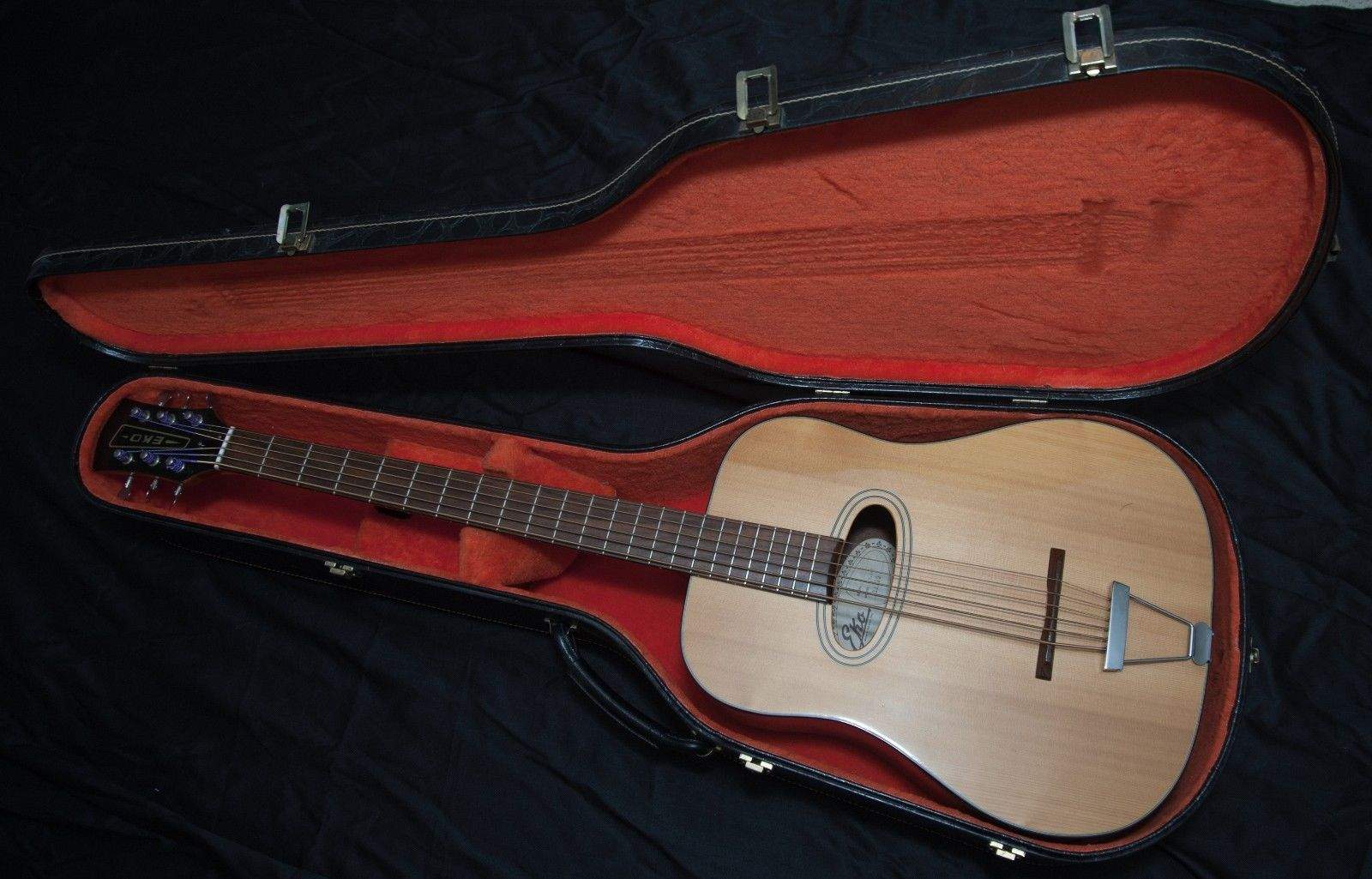
I just purchased a like new looking 1979 TKO AB6 made in Italy acoustic Bass guitar not cheap. Pic attached.
s-l1600.jpg
Have wanted one for years, but never played one I would like to own, and I had long term concerns with glued down wooden bridges peeling or Spruce warping etc. I normally play the upright. So I decided to look for an old style metal suspension bridge set up that screwed to the bottom of the body. I had no luck, until this month.

The odd thing is, it has 6 strings. I was not expecting that, but I had waited long enough, and just got it. As much research as I have done on the internet reveals very little. I am just now getting comfortable with the 6 vs 4 string configuration and am getting many cool sounds out of it with the Alembic light strings it came with.

Once I am thoroughly familiar with the bass, I may consider a few things and am looking for any guidance you may have to offer.

1.) Anyone familiar with this bass? Pro's and con's?
2.) Considering installing a pick up. Not one that fits under the bridge which would potentially reduce acoustic sound quality...and this has that! Any advise? Preferences? Looking for as natural sound as possible.
3.) String preferences? Are the Thomastiks worth $120? Other choices?

So that is it for now. Thank you all in advance.
trobitaille
 
This is my first post here. I was considering which forum would be best, and at first glance did not see a forum for acoustic bass guitars, could have missed it...considered the Humor forum.... :)

I just purchased a like new looking 1979 TKO AB6 made in Italy acoustic Bass guitar not cheap. Pic attached. View attachment 1176317 Have wanted one for years, but never played one I would like to own, and I had long term concerns with glued down wooden bridges peeling or Spruce warping etc. I normally play the upright. So I decided to look for an old style metal suspension bridge set up that screwed to the bottom of the body. I had no luck, until this month.

The odd thing is, it has 6 strings. I was not expecting that, but I had waited long enough, and just got it. As much research as I have done on the internet reveals very little. I am just now getting comfortable with the 6 vs 4 string configuration and am getting many cool sounds out of it with the Alembic light strings it came with.

Once I am thoroughly familiar with the bass, I may consider a few things and am looking for any guidance you may have to offer.

1.) Anyone familiar with this bass? Pro's and con's?
2.) Considering installing a pick up. Not one that fits under the bridge which would potentially reduce acoustic sound quality...and this has that! Any advise? Preferences? Looking for as natural sound as possible.
3.) String preferences? Are the Thomastiks worth $120? Other choices?

So that is it for now. Thank you all in advance.
trobitaille
If you ever decide to sell it... ;););)
 
  • Like
Reactions: HaphAsSard
You may want to correct title and post, in order to attract the attention of experts (@cdef, @GretschWretch): it should be "BA.6" - basso acustico, 6 (corde) - and obviously "EKO".

Here are some links (you must be very familiar with all of them, but just for the passers-by):
Italian EKO Six (6) String Acoustic Bass Model B.A/6 Serial #191179 Very Rare! | eBay
Eko acoustic basses - Fetishguitars.com
Link Removed
Link Removed (only site with a mention and a pic of the 6-string version, and I believe it's the very same specimen you've bought)

Anyway: I love it!
What's the scale length?
Is it tuned BEADGC or EADGBE currently?
What's the string spacing at the nut and bridge?
Thomastik-Infeld Acousticore strings (as you know the 6-string, modern B-c standard tuning set is the AB346) are well-regarded here.
If you're interested in nyloncore strings specifically and you're willing to consider bass-VI tuning (E-e) as an option, you could look into classical contrabass guitar sets (silver-plated copper -wound, as opposed to T-I's which are phosphor bronze). If it's long scale, here's one:
Invalid Link Removed
This one is way cheaper and *should* also fit (the [Invalid or Expired Link Removed] also specifies says it's long scale - 85cm - but at least [Invalid or Expired Link Removed] says instead that it's 75cm like the 4-string version):
Invalid Link Removed
Another option is to get the Savarez 4-string set and add two classical guitar extra-light (D and A) wound strings (hoping they're long enough, which may or may not be the case):
Invalid Link Removed

If the instrument is short scale consider these instead (this time in ascending price order):
Invalid Link Removed
Pyramid Double Bass Guitar Stringset
Invalid Link Removed
 
Last edited:
As an eBay Associate, TalkBass may earn a commission from qualifying purchases.
You may want to correct title and post, in order to attract the attention of experts (@cdef, @GretschWretch): it should be "BA.6" - basso acustico, 6 (corde) - and obviously "EKO".

Here are some links (you must be very familiar with all of them, but just for the passers-by):
Italian EKO Six (6) String Acoustic Bass Model B.A/6 Serial #191179 Very Rare! | eBay
Eko acoustic basses - Fetishguitars.com
Link Removed
Link Removed (only site with a mention and a pic of the 6-string version, and I believe it's the very same specimen you've bought)

Anyway: I love it!
What's the scale length?
Is it tuned BEADGC or EADGBE currently?
What's the string spacing at the nut and bridge?
Thomastik-Infeld Acousticore strings (as you know the 6-string, modern B-c standard tuning set is the AB346) are well-regarded here.
If you're interested in nyloncore strings specifically and you're willing to consider bass-VI tuning (E-e) as an option, you could look into classical contrabass guitar sets (silver-plated copper -wound, as opposed to T-I's which are phosphor bronze). If it's long scale, here's one:
Invalid Link Removed
This one is way cheaper and *should* also fit (the [Invalid or Expired Link Removed] also specifies says it's long scale - 85cm - but at least [Invalid or Expired Link Removed] says instead that it's 75cm like the 4-string version):
Invalid Link Removed
Another option is to get the Savarez 4-string set and add two classical guitar extra-light (D and A) wound strings (hoping they're long enough, which may or may not be the case):
Invalid Link Removed
If the instrument is short scale consider these instead (this time in ascending price order):
Invalid Link Removed
Pyramid Double Bass Guitar Stringset
Invalid Link Removed

Wow! This is GREAT information...Thank You. I will need to study this some more. I will do my best to correct my mis-information. Thank you for that as well. My first time, I must have been nervous...

The scale length, from nut to bridge is ~34" (~86cm) It is currently tuned BEADGC; but your string recommendations I may switch to std. guitar strings and tuning. In many ways this is much like a guitar, in terms of sound properties, just deeper, lower and has more presence. A different sound ultimately.

Thank you again
trobitaille
 
As an eBay Associate, TalkBass may earn a commission from qualifying purchases.
  • Like
Reactions: HaphAsSard
Wow! This is GREAT information...Thank You. I will need to study this some more. I will do my best to correct my mis-information. Thank you for that as well. My first time, I must have been nervous...

The scale length, from nut to bridge is ~34" (~86cm) It is currently tuned BEADGC; but your string recommendations I may switch to std. guitar strings and tuning. In many ways this is much like a guitar, in terms of sound properties, just deeper, lower and has more presence. A different sound ultimately.

Thank you again
trobitaille
My pleasure! A couple points:

1), type of strings. I must stress that you are not limited in your choice of strings - you can choose any kind of string available for bass guitar, thanks to the standard long scale (there's simply way more stuff out there than for shorties or middies) and floating bridge (while intonation of the middle strings may not be spot on, at least you don't have to be limited by a bridge placement optimised for steel-core only or nylon only strings, and within the first group you can adjust for different gauges and types - e.g. roundwound vs. flatwound vs. black nylon -wrapped AKA tapewound). Electric strings, "normal" acoustic strings (steel-core bronze), 1/8 size double bass strings, even rockabilly weed wackers, whatever you may fancy.
I discussed nylon-core string options above because I use them and because you mentioned Thomastiks. As for the latter point, I now notice that you might have meant their Jazz Bass flatwounds (JF346), which do go for about 120 dollars, and not the Acousticores as I assumed. If so I generated quite a lengthy unsolicited digression there! Oh well, might as well keep at it...
As I said, I use nylon-cores (a Savarez 4-string set for 82cm scale, to be specific) and like suggesting them to ABG players, because I like them a lot and especially because they're really inexpensive to try. Also, rather than seeing them as the poor man's Acousticores and an outright cheap alternative thereto, they could serve as a gateway solution: if you end liking the 20 buck set, you may be more comfortable with spending 6 times as much for a respected company's product which is probably worth every penny but with no guarantee and no way to know in advance (apart from Youtube videos) if it is for you or not.
_____

2), tuning. The EADGBE option came to mind for two reasons.
First off, and banally, the Thomastik-Infeld set is the only low B option for nylon-core strings, so the gateway/ersatz plan would entail putting off modern standard 6-string tuning for the time being.
The other reason is that, in the context of the history of long-scale 6-string basses, your instrument is a really interesting oddball even if we disregard the fact that it's acoustic: it's close in time (and possibly neck specs?) to Anthony Jackson's first BEADGC sixer, built by Carl Thompson in 1975. In fact I wonder how many other long-scale ones, bespoke or small production, came out that early. If we talk E-to-e there were Danelectros and the Fender Bass VI and others of their ilk, but they were uniformly short-scale, with the lone exception of the Rickenbacker 4005/6 (standard long Rick scale i.e. 33.75"). Octave-down guitar tuning was, in any case, the closest thing approaching a standard in those times, before players and builders adopted the low B pioneered by Anthony Jackson - and also Jimmy Johnson and Tony Bunn with their respective 5-stringers.

Hence my questions about the tuning, and also string spacing at nut and bridge. À propos, seriously, could you please measure them for me? I'm really really curious. :D
So, while I tune my bass-VI type guitar E to e myself, it's not like I go around trying to convince anyone to adopt it instead of the current standard, far from it.

Now: if, after all the clarifications, you do find the EADGBE option worth exploring regardless, a word of caution about the natural temptation to approach it as a giant standard guitar: just as pianists rarefy chord voicings the more leftward they go on the keyboard, chordal work on a bass, be it tuned like a guitar only an octave down or not, requires putting increasing distance (a sixth, a seventh, an octave) between the lowest two voices the lower you go on the fretboard. In practice you will find it's often better to leave the second lowest string in a chord-shape unplayed especially in the lowest positions (some attention may be needed in the middle strings as well in order to clean up the voicing).
The reason is a physio-acoustic phenomenon called "critical bands". In short, every pitch projects a virtual buffer zone above and below it: any other concomitant pitch that falls within such area will be partly masked and the result is usually perceived as muddy-ish. These minimal distances increase, in relative terms, the lower you go in the audible spectrum, to the point that even perfect 5th intervals - "power chords" in rock guitar parlance - start sounding muddy beyond a certain point, no matter the instrument. My personal threshold as regards 5th intervals is, avoid them altogether below A1+E2; your mileage may vary of course.
 
Last edited:
  • Like
Reactions: Wyrdlow
Wow again! Man. If you have not written a book on this you should! I'll be first in line. Thank you ... you have convinced me to start cheap w/ an Ee arrangement. Your piano analogy sure made sense. The high half sure does ring w/ color. And how do you know the middle strings can sound off on occasion...is it the floating bridge set up?

I measured the nut and bridge string intervals: Nut = 9mm; Bridge: 13mm.

Thank you, I must study both of these emails further.
 
  • Like
Reactions: HaphAsSard
Wow again! Man. If you have not written a book on this you should! I'll be first in line. Thank you ... you have convinced me to start cheap w/ an Ee arrangement. Your piano analogy sure made sense. The high half sure does ring w/ color. And how do you know the middle strings can sound off on occasion...is it the floating bridge set up?

I measured the nut and bridge string intervals: Nut = 9mm; Bridge: 13mm.

Thank you, I must study both of these emails further.
He he, thanks. A lot of it is just regurgit-/ ahem, reprocessed and parroted TB knowledge.

Nice to know about the nylon-cores. I'd start with the Invalid Link Removed, maybe giving StringsByMail a call beforehand to confirm if the packet has indeed "85cm" written on.
In the meantime buy a pair of single classical guitar strings (if you want you can already get extra-light D and A) and verify if they are long enough to fit on the instrument, tailpiece to tuning post; if they do, you'll know that the Invalid Link Removed + 2 extra strings is also a workable option.
If you end up hooked, you may consider trying the Hannabach and/or the Thomastik Acousticores down the line.
(You may be pleased to know, and I forgot to mention, that if you find a set that works you won't *need* to swap it off too soon: silver-plated strings are fairly durable in my experience.)

As regards the middle strings and intonation, it's inherent in the straight saddle bridge config. If you do an image search of 6-string electric bass bridges you'll notice how the adjustable saddles form a slanted line but, more often than not, not exactly a straight one. The rigidity of metal strings, and thus their need for a specific saddle compensation, can go in steps and the occasional leap (probably a jump in diameter of the steel core). A fixed bridge, like on acoustic guitars, means you're more or less stuck with not-OK (or just-OK, not-great) intonation unless you use a string set that happens to intonate fine with that bridge position. (Well, it's not so drastic: you can fiddle with the neck curvature through the truss rod, and also different saddle bone heights, and arrive at a decent set up.)
A floating bridge, on the other hand, allows you to set the intonation of the two outer strings pretty precisely, but unless you're lucky the inner ones will be a compromise. You can improve the result by having a compensated saddle made (with individual segments carved a little forward or back for each individual string - you do need, first, to choose one commercially available set you're gonna use, and have it on the instrument, for the luthier to make and fine-tune the thing), or experiment with slightly different gauges of the same string type (doable if you're using something easily available in singles of many gauges, like D'Addario nickel-plated steel rounds).

Thanks a metric ton for measuring. I'm even more jealous now, if possible: I already suspected the spacing was something in between classical guitar and super-narrow extended-range bass. And I totally love that! I'm going to adopt something very similar or identical if/when I get to having a couple conversions I have in mind made.
 
Last edited:
Thanks. I will correspond with you anytime. Sorry the pics I posted are all thumbnails...not sure why, maybe size, but full size did not seem to be highlighted as an option, though it was there. I should be able to fix that at some point, somehow.

I just ordered a Meyers gooseneck pickup/Mic to play with as well. Non-destructive clip-on.
 
  • Like
Reactions: HaphAsSard
Sorry to resurrect this thread, but I am doing some research about this guitar and was curious about this advice.

Nice to know about the nylon-cores. I'd start with the Invalid Link Removed, maybe giving StringsByMail a call beforehand to confirm if the packet has indeed "85cm" written on.

When visiting the La Bella website, they have the following message with these specific strings:

These sets are constructed for the instruments used in guitar ensembles and guitar orchestras. These strings are not suitable for acoustic basses or any other bass other than a classical contra bass.

Is that just them covering themselves for potential problems? Or are these strings not suitable for an EKO BA6?
 
Sorry to resurrect this thread, but I am doing some research about this guitar and was curious about this advice.


When visiting the La Bella website, they have the following message with these specific strings:


Is that just them covering themselves for potential problems? Or are these strings not suitable for an EKO BA6?
Very good question. I simply cannot fathom why La Bella contrabass guitar strings shouldn't be suitable for a (conventional, originally steel-stringed) ABG, other than

- happening not to be the correct length (read: clear the nut before taper and, for the E string, taper before the post - even then, the string may survive even if wound on the post at full thickness if it's flexible enough)
- being perceivably slacker than the original strings, to the point of throwing off your technique if you're not willing to adapt to a lighter touch for the plucking hand (however, they have a lower "sproing point", as in, they can be a lot lower in tension before they start to exhibit problems such as overly wide jumps in pitch upon the attack)
- rolling/twisting under the fingers (their nylon core is a lot proner to torsion)
- intonating a little flat, because they're more flexible and need less compensation at the bridge.

The latter is potentially the biggest problem, but it can be solved/mitigated with an intentionally heavier touch with your fretting hand, and/or higher action. Intonation will be tend to be acceptable in the money frets (1 to, say, 8?) anyway.
 
Thanks for the reply! You make some good points, all to be considered.

I am wondering also if it could be because the La Bella website only lists the Plain Ends (CB60-PE) which would indeed not be suitable for a bass guitar, whereas the Ball Ends (CB60-BE) should work fine but do not have their own page on the La Bella site.

Anyway, thanks for all the info you shared in this thread. I will (hopefully) be the proud owner of this bass and would also be planning on tuning it E-e, so will keep you posted.
 
  • Like
Reactions: HaphAsSard