• TalkBass has been independent since 1998. Add your voice.
    Create a free account to reply to discussions, view embedded media, and browse with fewer display ads.
    Join freeLog in
    Want zero display ads or expanded classifieds tools? Compare plans.

Mesa Walkabout Power Output Tests!

Well I finally got around to mounting some power resisters to run some power tests as decided in this thread:

http://www.talkbass.com/forum/f15/so-you-wanna-run-your-mesa-walkabout-scout-2-2-6-ohms-742327/

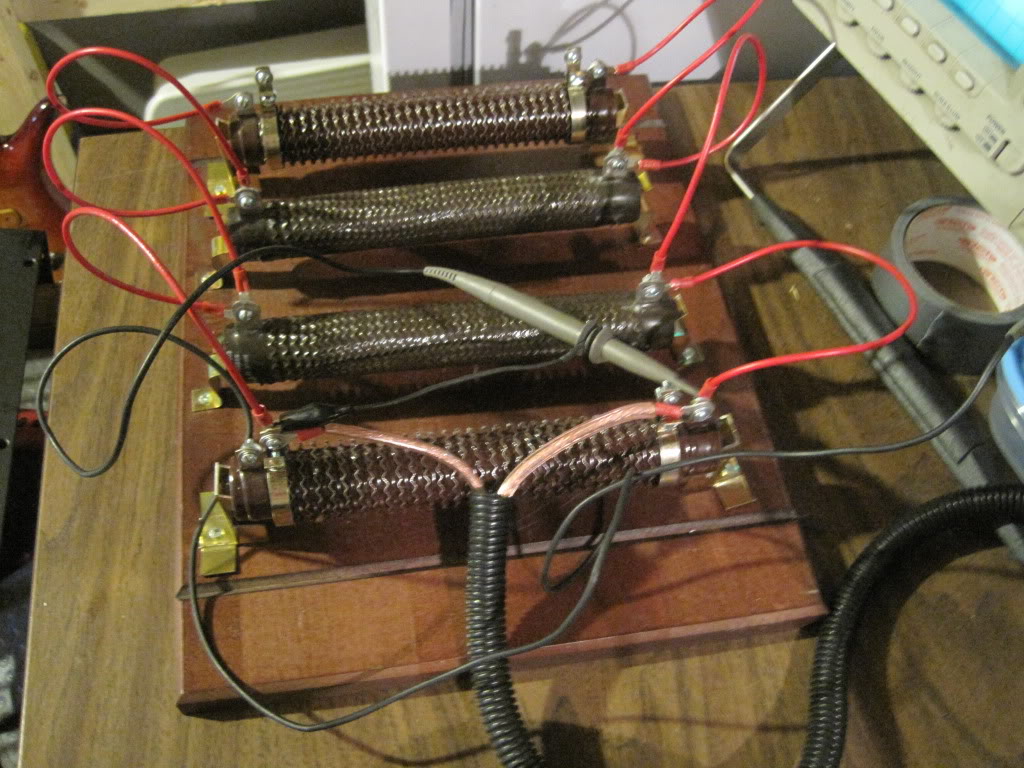
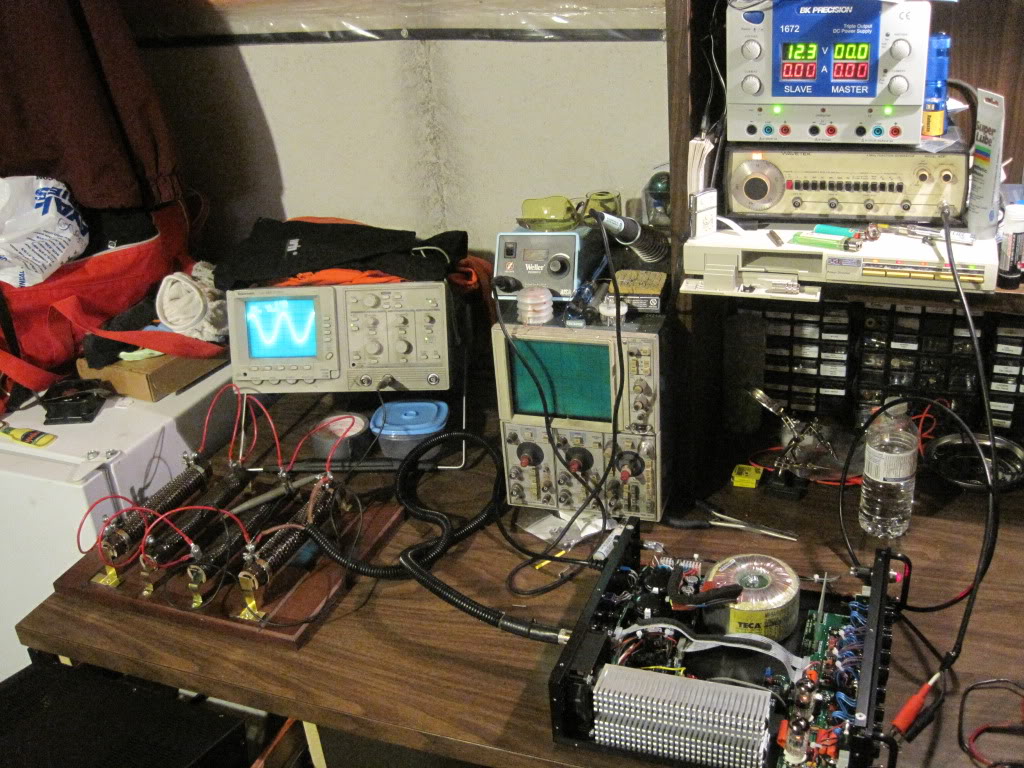
Here's my test station with my newly assembled resister board:
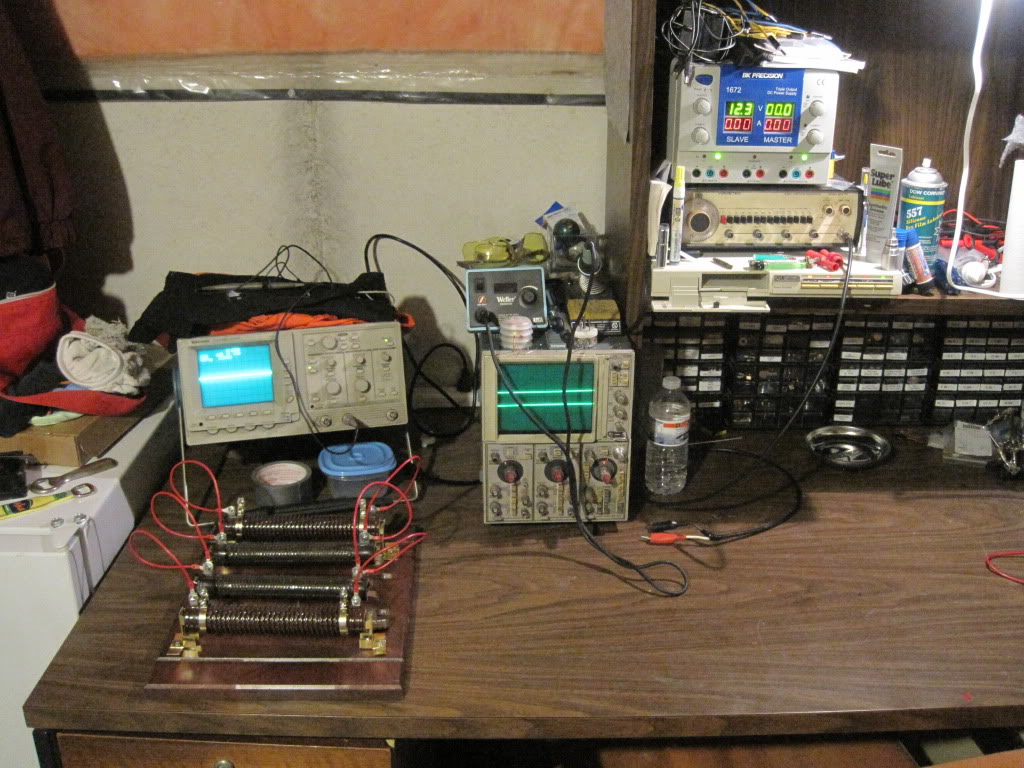
IMG_0634.jpg


8 Ohms each and 300Watt dissipation capability!
IMG_0651.jpg


IMG_0638.jpg


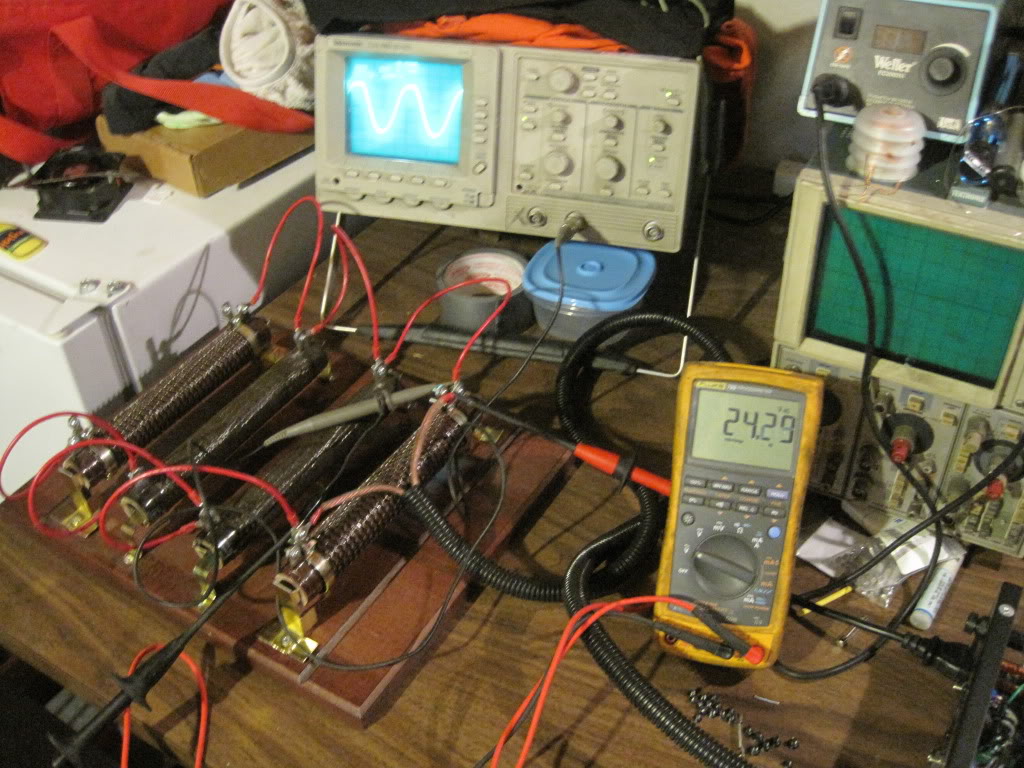
My results weren't what I expected so a week later I ran them again with the head removed and a different RMS multimeter:
IMG_0650.jpg


IMG_0652.jpg


The results were similar on both tests. Here's what I found using 1 KHz input signal and allowing 2-4% distortion based on the scope waveform:

2 Ohm = 484 Watts RMS

2.6 Ohm = 442 Watts RMS

4 Ohm = 338 Watts RMS

8 Ohm = 224 Watts RMS

I also read the peak value from the scope and multiplied it by 0.707. Then squared that value and divided by the load resistance. The values worked out to all be in the same ballpark.

I tired varying the frequency down to 100 Hz and up to 10 KHz and noticed a slight power drop at each end of the frequency spectrum so the 1 KHz values above are a best case scenario and not really real world power.

It's not quite the power I expected out but it does show that the Walkabout can put out much more than it's 300W rating. :hyper:

Perhaps the difference in the expected 550W output at 2 Ohms and 500W at 2.6 Ohms and this test is due to Mesa changing the design of the output board in the WA in 2005. See this post in the Mega thread:

http://www.talkbass.com/forum/f15/mesa-boogie-walkabout-part-5-a-740503/index25.html#post10819754
 
  • Like
Reactions: yakmastermax
Very nice. All science aside, all I know, (from real world experience) is that this little 13lb head can offer a serious wallop with enough speakers to allow it to. I have yet to be disapointed with anything, power, volume, and of course, that tone. Nice to be able to "see" it through your mad scientist set up.
 
Yer a nerd. And I mean that in the best possible way.

Thanks for this, it's really interesting. I always wondered how that was done, and this is a fascinating example. Well done.

LOL! No really, I'm cool!! I'm cool! I play the bass, style up the honeys, and party like a rock star:bassist:

But the nerd comes out every now and then just to keep things honest. Every now and then manufacturers list their power specs a little higher than they actually are. (Ahem SWR) They often do this through trickery via measurements with high distortion values that they don't list or even just as I have done through only inputing 1 KHz signal and not 20Hz-20KHz.

If you can read a spec'd power output at 0.01% distortion from 20 Hz to 20 KHz it's true clean real world power. I might have to run this test again with this kind of test limits and see what we'd get. From what I saw though, I'm pretty sure the Walkabout will still easily put out over 300Watts at 4 Ohms as spec'd by MESA.

Very nice. All science aside, all I know, (from real world experience) is that this little 13lb head can offer a serious wallop with enough speakers to allow it to. I have yet to be disapointed with anything, power, volume, and of course, that tone. Nice to be able to "see" it through your mad scientist set up.

Indeed this little 13 Lb wonder can pack a wallop. When you think about the infamous SVT being a solid 300 Watts at 90 Lbs, I have no doubt that this WA would be able to produce the similar results on one of those 810 beasts!
 
It's not quite the power I expected out but it does show that the Walkabout can put out much more than it's 300W rating.

Perhaps the difference in the expected 550W output at 2 Ohms and 500W at 2.6 Ohms and this test is due to Mesa changing the design of the output board in the WA in 2005.

I don't know if this is the case with the load resistors that you were using, but if they heated up when you were performing your tests, the resistance can change. It is always a good idea to verify the resistance at the operating temperature and use that in your calculations.

Also, if your resistors have some inductance, this could account for some of the differences between your result and that of the manufacturer.
 
I don't know if this is the case with the load resistors that you were using, but if they heated up when you were performing your tests, the resistance can change. It is always a good idea to verify the resistance at the operating temperature and use that in your calculations.

Also, if your resistors have some inductance, this could account for some of the differences between your result and that of the manufacturer.

At 2 Ohms the resister bank I built has a manufactured dissipation of 1200 Watts. They barely got warm when putting 484 into them. I personally don't think the resistance varied much from the intended 2 Ohms.

I never thought about my resisters having any inductance. I just thought that all manufacturers use these power resisters for their measurements because they are consistent and can be made to a standard. I'm not sure how else they would perform a power output test. I can't see them using speakers because of all the different makes, models, performance, ect.
 
I never thought about my resisters having any inductance. I just thought that all manufacturers use these power resisters for their measurements because they are consistent and can be made to a standard.

A resistive dummy load is what is normally used. Of the type that you have, there are normal, and there are non-inductive windings available. If you have a part number, you may be able to determine what type you have.

For power measurements on an amp, non-inductive resistors are used for an accurate result. There are many types that can be used, [Invalid or Expired Link Removed].
 
A resistive dummy load is what is normally used. Of the type that you have, there are normal, and there are non-inductive windings available. If you have a part number, you may be able to determine what type you have.

For power measurements on an amp, non-inductive resistors are used for an accurate result. There are many types that can be used, [Invalid or Expired Link Removed].

Thanks for the link and info! I'm going to do some measurements and see if I can apply a couple of capacitors to eliminate the minor bit of induction that is present in my resistors.

I'll then check the Walkabout again and see if my results vary.
 
Disclaimer: No offense or disrespect to MuthaFunk here. He obviously put a lot of effort and hard work into this. Just for a second opinion I showed this to a highly respected designer/tech [who shall remain unnamed] and I've copied his response below. Nothing earth shattering here and probably the same conclusion to be drawn. Slightly edited out of respect to Mr. Funk.

His math skill are wanting...
No such thing as RMS power only RMS voltage.
So, "power" is RMS voltage squared, divided by the impedance or pure DC
resistance (his dummy load).

power = 24.29^2/2

The meter he has is an RMS voltage reading meter.

24.29vac "squared", divided by 2 ohms is:
24.29 X 24.29 = 590
590 divided by 2 ohms = 295 watts.

I assume that is why it is really rated as a 300 watt amp!!!
 
Disclaimer: No offense or disrespect to MuthaFunk here. He obviously put a lot of effort and hard work into this. Just for a second opinion I showed this to a highly respected designer/tech [who shall remain unnamed] and I've copied his response below. Nothing earth shattering here and probably the same conclusion to be drawn. Slightly edited out of respect to Mr. Funk.

His math skill are wanting...
No such thing as RMS power only RMS voltage.
So, "power" is RMS voltage squared, divided by the impedance or pure DC
resistance (his dummy load).

power = 24.29^2/2

The meter he has is an RMS voltage reading meter.

24.29vac "squared", divided by 2 ohms is:
24.29 X 24.29 = 590
590 divided by 2 ohms = 295 watts.

I assume that is why it is really rated as a 300 watt amp!!!

No offence taken. I welcome any new information but I think your respected Tech/designer may not have looked at the thread in enough detail.

I used an RMS multimeter to read the RMS voltage and applied the power formula but I also read peak voltage off of my scope, multiplied by 0.707 to get RMS voltage, squared that value, then divided by the load. My work was double checked throughout the whole test.

The pictures are there for reference only to demonstrate what my setup was and that I used two different meters for the test. The values displayed on the meter when that pic was taken was not necessarily at the highest power output point of the test.

You may have noticed the volt meter in the first pic you'll see a value of 74.56 V RMS into what looks like 2 ohms!! I can't remember the circumstances at the time when I took those specific pics but the scope shows a clean wave so I can only assume that reading is actually 74.56 mV RMS. I don't think you could ever get that kind of real power out of the Walkabout.

I can tell you that without a doubt, the reported values were as accurate as I could get given the equipment I used displayed in the photos. My results were cross checked over again and again. I'm not sure where I may have gone wrong. If your tech has any questions on exactly how I performed the tests I can answer them no problem to remove any doubt. Just PM me. :)
 
I can't find it now, but, a user here, who was a Mesa employee at the time he posted said;
to the best of my recollection;

8ohm 185
4ohm 300
2.67 500
2 ohm 550
 
I A/B'd the WA to an SVT at 4 ohms and based on purely listening tests they seemed about equal in volume before audible distortion using an Ampeg Selector switch to quickly shift from one to the other

Very interesting tech testing though; thanks
 
  • Like
Reactions: Red Planet

Latest posts