• TalkBass has been independent since 1998. Add your voice.
    Create a free account to reply to discussions, view embedded media, and browse with fewer display ads.
    Join freeLog in
    Want zero display ads or expanded classifieds tools? Compare plans.

Epiphone blackbird action adjustment??

Hey guys,

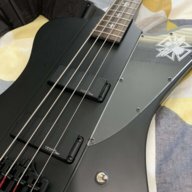
I have an Epiphone Blackbird and the action on it is pretty horrible. The closest tech who can fix it for me is the better part of a 2 hour drive from where I am living now and I want to fix the action myself.

This is something I have never done before (always used a tech when I was living near civilization) and was wondering if you guys could fill me in on all the ins and outs of doing this repair myself and how to do it properly i.e. what happens when I adjust the truss rod and how it relates to how I adjust the bridge, the intonation etc.

Sorry if this seems to be a stupid question, but I want to make sure I do it right whilst ensuring I dont damage my instrument! Any and all advice, especially from people who have actually done this on a blackbird before, is much appreciated!

Cheers,
Jordan

P.S. Hope I am posting this in the right forum!

 
Maybe I should add as well that the main problem I can see is that the saddles aren't adjustable - the whole bridge itself slots onto 3 adjustable bolts that lower/raise the entire bridge. Does anybody see any obstacles I may encounter with this??

Cheers,
Jordan
 
a friend from another board put this guide together:

1. Screw down the bridge evenly over all three screws till you have an action around the 15th and higher frets that is comfortable for you without any or too much buzz (some players don't mind a little buzz or even like it, that is a matter of taste). Keep the front stud a little higher for best string to saddle pressure. Retune the bass, don't worry about buzzing in the lower registers at this point.

2. Now you've got your bass retuned with a lower action at the high frets. Your lower frets will now either buzz (see 2a for the subsequent steps) or the action will still be too high even in the low registers (see 2b for the subsequent steps).

2a: Low Register buzzes: You need to loosen the truss rod. Take off the truss rod cover and insert an allen wrench in the allen nut (the cheaper Epis generally have allen nuts). Don't detune the bass for that, rather lift the A and the D string to the side to the slots of the G and E string to have room for turning the allen wrench. With the bass' butt resting on your toes (clean those sneakers!) and the strings/fretboard facing away from you, you - while standing up and looking down - will now turn the allen wrench <--- counterclockwise <---. Epi truss rods move easily (if noisily), turn it and immediately look to find out how the action of the bass has altered and buzzing has become less or disappeared. Don't be scared of overdoing it - it is impossible to break a truss rod by loosening it as you are releasing tension. That said, one or two "one third turns" counterclockwise should do it. sometimes you will need a few more of those to actually adjust the bass if the neck is too straight or even curved away from the fretboard.

2 b: Low Register has too much action: Same as 2a, except that you have too tighten the truss rod now which is done by turning the allen wrench ---> clockwise --->. You will also have to be more careful as you can break a trussrod by overtightening it. But Epi truss rods are hardy and can certainly survive one full turn or even more as your bass is probably a virgin as regards truss rod adjustment.

3. After a combination of either steps 1 and 2a or steps 1 and 2 b you should have a relatively or even totally buzz free bass with good to reasonable action. If there is still some persistent buzzing at some places then raise the bridge a little. Raising the front stud will raise all strings, raising the lower hind stud more the D and G string, raising the upper hind stud more E and A. No radical set ups please! (Like one stud real low and the other two very high.)

4. (optional) Is all buzzing just on one string (while the other strings are buzz-free) and you have to raise the bridge considerably to make it go away even though you could stay much lower if it were just for the other strings? Try this then: I assume that on your Epi too the saddles for the four individual strings do not all have the same height, but that there are two higher and two lower ones. If the persistently buzzing string is on a lower saddle, then exchange that saddle against a higher saddle.
 
Anyone came across this again? The above guide not really helping

Not the way I'd do it, either. Setting up an instrument requires a number of steps done in the proper sequence to achieve optimal results. The one obstacle with this particular instrument was the fixed radius bridge but it shouldn't be that big of a deal.

What issues have you encountered?

Riis