• TalkBass has been independent since 1998. Add your voice.
    Create a free account to reply to discussions, view embedded media, and browse with fewer display ads.
    Join freeLog in
    Want zero display ads or expanded classifieds tools? Compare plans.

Double Bass true oil finish vs oil varnish

james condino

Spruce dork
Commercial User
Sep 30, 2007
5,443
13,472
asheville, nc
www.condino.com
Time to open up a big can of worms with the community here. I've been looking at several different ideas for finishing a new bass. I'm not gumby to finish work; I've finished over 200 acoustic guitars and mandolins using nitrocellulose, french polished spirit varnishes, catalyzed polyurethanes, water based, and several of the UV cured modern systems that require fancy production booths. As well, I can shoot a fantastic sunburst or handrub a nice vintage Loar look. None of those are what I'm after for this instrument nor do I feel they are appropriate for a well made bass.

I can lay down the foundation and color fine, my interest is in the topcoat.

Has anyone had experience with Birchwood Casey true oil? A couple of folks have reccommended that over a traditional violin oil varnish. I've also been told that it is close to colorless and will not take a pigment dye very well. I've only used it to oil unfinished necks and that was a long time ago. I'm not looking to fire up the mad alchemist contraptions and cook my own formulas. Is there a good commercial formula that that I can use to achieve a nice warm finish with a bit of an aged look that won't cost several hundred dollars and will cure in a reasonable amount of time? I've got five weeks to finish the instrument on schedule.

Thanks for the input.

j.
www.condino.com
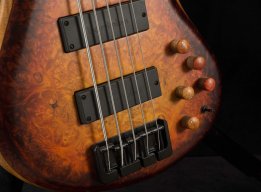
 
I am not sure if they still do, but Warrior Instruments used to finish their basses and guitars with the Birchwood Casey oil. I have owned a few of them that were finished with it and they have held up very well over the years. The fretless one had the fretboard finished with it and it has a great sound. I would recommend it for sure. I have two Smith basses that used varnish. One of the Smiths is about 8 years old now and it does not have near the shine or finish that the 1 year old one has. Hard to say, but from that comparison, the oil wins. On the other hand, the mojo of the Smith with varnish is quite nice too.
 
Tru-Oil is great stuff, but I think you'll need 20 coats or so to get adequate build. I guess you could apply 2 coats a day if you give the instrument a bath in U.V. or sunlight. I think you can get a better finish in a shorter time with an oil varnish like Hammerl. It needs to be brushed, of course. You could also seal and build with the oil varnish, then top coat with Tru-Oil, which requires little if any rub-out. Good luck!
 
Jake, that's the one. This isn't a refinish; it is for a new double bass that is currently sitting patiently in the corner of the shop with the construction completed, but naked as can be. I had never given true oil much thought, but everytime I spoke to folks who had a fair bit of oil varnish experience, it came up in the conversation. Two people reccommended it as their first choice.

If all of those other customers who keep paying good money for my funny looking mandolins would leave me alone for a bit, my new bass would have already been finished and strung up!

j.
www.condino.com
 
"Wiping varnish" is a varnish mixed with a thinner or solvent to make it easy to wipe on.
example; minwax wipe on poly.

An oil finnish is usually a varnish mixed with linseed oil, then "cooked" or heated to make
a finishing product. example; danish oil.
 
"Wiping varnish" is a varnish mixed with a thinner or solvent to make it easy to wipe on.
example; minwax wipe on poly.

An oil finnish is usually a varnish mixed with linseed oil, then "cooked" or heated to make
a finishing product. example; danish oil.


I thought danish oil was linseed oil with a drying agent added. No?
 
i once had a cheese danish, similar to what your talking about? i dont think id like the color smeared on a bass but different strokes for different folks i presume. haha, on a more serious note i have no clue but ive used danish oil for a table i made once and it looked pretty nice
 
Is'n't true oil just basically a thin wiping varnish?

Do we even have Tru-Oil in Canada? I've never seen it. The question comes up on the board here once a year or so. My understanding is it's a polymerized tung oil -- it's a had a special heat treatment and cures tougher and quicker. No resins, so not a varnish.

But I'm going on memory of a bit of internet research done 3 or 4 years ago...
 
hi just thought i would add my 2 cents i have a sukop bass and birchwood casey tru oil is the finish used, and recomended by sukop, it seems to let the bass breathe, and it sustains forever. good luck with whatever you choose. all the best steve.
 
Ah yes, polymerized linseed oil, not tung oil. Same concept, though: heat the oil in an oxygen-free process and it becomes a tougher, faster-curing oil.

The Tried & True products are basically the same as Tru-Oil, but two of the T&T products have natural additives to make them a bit different. The T&T products are either poly linseed oil without additive (what they call Danish oil), or poly linseed with beeswax (Original Wood Finish), or poly linseed with pine resins (the Varnish Oil). I've use their Varnish Oil on some furniture projects. You've gotta build up the layers but it makes a nice, natural-looking satin finish that's reasonably tough. I've also used straight poly tung oil from Lee Valley -- expensive but produced some beautiful results on pine.

When we've had similar conversations like this in the past, Arnold has often mentioned Waterlox as a product he's had some success with. Again, I think with that stuff you've got a tung oil with some resins added...
 
Can anyone comment on the odor of any of the finishes mentioned so far? I'd like to try out some, but we just got our second winter here last night. so it looks like I'm doing stuff inside for a while. And my wife is expecting, so I don't want any solvents in the house right now. If true oil is just a drying oil, that sounds like it won't have any turp. in it? Maybe? tried and true doesn't have any synthetic additives, but are they cut with turp. or any thing else ?
 
Tried & True doesn't have anything else in it; the Lee Valley polymerized tung oil is cut with turps. Don't know about Tru-Oil. Christian Becksvoort of Fine Woodworking is a big fan of T&T and did an article about his use of the varnish oil (I think it was the varnish oil, anyway) a few years back. If I'm remembering right, he was using the stuff exclusively at the time -- totally non-smelly, non-toxic, etc. I think there was a photo of him sticking his bare hand in the pot and slopping the stuff on with rags. It's quite thick stuff, too -- he warms his up gently as he's using it. I think the thickness is why Lee Valley cuts their poly tung oil with turps.