Apologies for being wordy. I would have done clips, but my octaver shoot-out showed that my computer cannot process lows very well. I got the Cubic on the tourbox and wanted to be thorough so I used a whole bunch of instruments.
In general:
The Cubic is a very cool octaver with a pretty wide variety of tonal options, though results are highly dependent on the instrument you put through it. The knobs are interactive (especially filter and the unlabeled knob) and there are lots of little quirks here and there. What I like most is that it blurs the line between octaver and octave down fuzz.
Testing equipment:
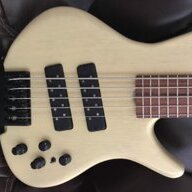
‘71 Gibson SB-300, ‘01 Ibanez Soundgear 885, Korg Monotribe, Cort acoustic guitar w/active electronics, unknown brands early ‘00s passive 4-string & active 5-string basses, and pipa, guqin, and cello with contact mics. Ampeg PF350 (set to true flat EQ) with unknown brand 4x10, Carvin matched bass amp and 1x15 (unknown model).
Attack:
The note attack with the Cubic is somewhat variable. Effected notes are gated (though more or less depending on the voice setting and your instrument). Having no specific control over this gate leads to a few interesting tricks and quirks. For starters, the gate allows for a very sharp attack, bolstered more on the sweet spots of the filter. With the right instrument and a light touch, I was able to get notes to swell in. It’s pretty much perfect for staccato synthy lines no matter what setting you’re in. The gate also makes the Cubic very low noise, and completely noise free in many settings. I got hiss on some settings when using noisy pickups, even blended 100% wet, but the noise floor was lower than in bypass. Sustain was not an issue for me, though I suspect some basses/players may have notes die out or warble/arpeggiate earlier than desired. This is a little annoying because IMO this pedal is perfect for doom and drone sounds otherwise.
Tone:
With the voice switch down it runs the gamut from a brighter, louder Blue Box to a muffled, louder OC-2 -- this mode pushes lots of air. With the voice switch up, tones are more like old school octave dividers, but get hairier as you turn up the clipping knob. The filter is primarily for smoothing, though it’s definitely not just a low pass filter -- there’s a sweet spot around 11 o’clock that lets in a lot more highs. Around 11:30 it’s back in high cut territory, eventually letting up enough to get pretty buzzy, especially in settings with the clipping knob turned up. With an active bass, sounds were a little sloppier (gating was less defined, notes were fuzzier), though this isn’t necessarily a bad thing. The differences in clipping and filter settings were much more subtle on active instruments, decreasing the number of inspiring/usable/ridiculous tones by about half.
Blend:
100% clean gets you most of the way back to your original tone. There is a hint of sub octave still, and some pretty substantial high cut. The biggest impact this had on my testing was that it was difficult to dial in slap and pop tones. On the other hand, this high cut brought down the hiss on basses with noisy pickups and made the blend more useful with synth and rock sounds, so whether this is good or bad depends on what you’re going to use it for. 100% wet leaves some clean signal in, though it’s hard to detect on a bass. Kind of annoying on basses with noisy pickups.
Tracking:
Low pitch tracking was excellent, maybe the best I’ve seen in an any octaver (analog or digital), though this is dependent on the instrument. On most volume/tone settings on passive basses, the Cubic was able to track smoothly down to a low G. The amp was barely able to reproduce that note (most likely just overtones), but still there wasn’t any pitch warbling. I was also able to hit this note on active basses if I didn’t boost mids too much.
Triggering the gate on higher pitches left something to be desired, though this varied by instrument. On all basses tried, notes above the highest A (A on the G string) required harder playing to trigger a note; on one bass with some dead spots in that area, getting notes out was difficult. This also played out on some of the acoustic instruments, though it was sometimes impossible to tell if the issue was impedance, volume, and/or pitch. This was especially disappointing because the bowed cello sounded incredible through the Cubic, but only worked for the lowest few notes. I could not play clean notes consistently above E on the A string of the acoustic/electric guitar. The Monotribe’s bass and snare drums triggered notes (which sounded fantastic), but the high hat did not; depending on synth settings, notes above the 8’ range did not trigger notes.
Volume:
Unlike most of the octave/octave fuzz boxes I would compare it to (OC-2, Blue Box, etc), the Cubic has plenty of available volume and can get way past unity gain on all combinations of other settings. Other controls will affect the volume (voice control especially, but also blend), though I never found a setting that I needed to turn the volume past 1 or 2 o’clock to hit unity.
With other pedals:
Before a Source Audio Bass Envelope Filter Pro
Envelope triggering was smooth and satisfying and low pass modes gave lots of rumble. Dialing in more aggressive tones/adding mids/highs with the Cubic made tweaking necessary on the BEF Pro’s band pass and multi-peak settings, but was definitely rewarding. Using the Hot Hand controller with some tweaking of both pedals yielded classic dubstep wobble sounds.
Before a DOD FX25 (gen 2)
With the sensitivity on the FX25 down, I got an awesome dub rumble, loud and resonant sounding, but not muddy and still responsive to quick playing. With sensitivity up to where I would typically set it for funk action and the Cubic in the sweet spot on its filter, I got some sinister synth-rock tones. All the tone of octave >> fuzz >> FX25, but with less mud and a much punchier attack.
After a DOD FX25 (gen 2)
With the Cubic’s blend at 100% wet, the FX25 had next to no effect, only occasionally messing up tracking when the filter was triggered. At about 60% dry I was able to dial in some super funky, extra low tones. The high cut makes it hard to do this clean, but it took the edge off the FX25’s more nasal settings.
After a buffer
I ran the Cubic after an LS-2 to see what a fairly typical pedal buffer and boost would do to tracking. The LS-2 made tracking and tone a bit looser than without, but not nearly as much as an active preamp. Boosting the volume significantly caused tracking to get worse, but I had to dime the volume on the LS-2 to get serious flubbing, and it was only slightly more noticeable than a preamp.
A/B’d with a Boss OC-2
The OC-2 seems to be the standard issue octaver for many bassists. There’s no accounting for taste, so I tested the Cubic to see how close I could get to the OC-2’s solo’d octave down voice. It turns out you can get very very close. It’s not quite the same -- the OC-2 tone sounds like it’s halfway between the two voice settings -- but close enough that it can sound nearly identical when used as a starting effect for heavily processed sounds. I should point out again that the Cubic is infinitely more tweakable than the OC-2, has none of the volume issues, and can achieve sounds similar to the square wave mod.
Favorite sound:
Does an awesome impression of “loud subwoofers in an old car”.
Verdict:
It’s an awesome and surprisingly versatile pedal with tracking issues that make it only really usable on bass guitars. If this unit is updated, I would like to see much more high end range plus some sort of impedance or input volume control so active instruments can hit the sweet spots of the gate or allow for some doom-y sustain. I recommend this if you’re looking for a gated fuzz or octaver, especially if you’re playing electronica, rap or hip-hop. With the blend up there are a lot really cool rock sounds too.
In general:
The Cubic is a very cool octaver with a pretty wide variety of tonal options, though results are highly dependent on the instrument you put through it. The knobs are interactive (especially filter and the unlabeled knob) and there are lots of little quirks here and there. What I like most is that it blurs the line between octaver and octave down fuzz.
Testing equipment:
‘71 Gibson SB-300, ‘01 Ibanez Soundgear 885, Korg Monotribe, Cort acoustic guitar w/active electronics, unknown brands early ‘00s passive 4-string & active 5-string basses, and pipa, guqin, and cello with contact mics. Ampeg PF350 (set to true flat EQ) with unknown brand 4x10, Carvin matched bass amp and 1x15 (unknown model).
Attack:
The note attack with the Cubic is somewhat variable. Effected notes are gated (though more or less depending on the voice setting and your instrument). Having no specific control over this gate leads to a few interesting tricks and quirks. For starters, the gate allows for a very sharp attack, bolstered more on the sweet spots of the filter. With the right instrument and a light touch, I was able to get notes to swell in. It’s pretty much perfect for staccato synthy lines no matter what setting you’re in. The gate also makes the Cubic very low noise, and completely noise free in many settings. I got hiss on some settings when using noisy pickups, even blended 100% wet, but the noise floor was lower than in bypass. Sustain was not an issue for me, though I suspect some basses/players may have notes die out or warble/arpeggiate earlier than desired. This is a little annoying because IMO this pedal is perfect for doom and drone sounds otherwise.
Tone:
With the voice switch down it runs the gamut from a brighter, louder Blue Box to a muffled, louder OC-2 -- this mode pushes lots of air. With the voice switch up, tones are more like old school octave dividers, but get hairier as you turn up the clipping knob. The filter is primarily for smoothing, though it’s definitely not just a low pass filter -- there’s a sweet spot around 11 o’clock that lets in a lot more highs. Around 11:30 it’s back in high cut territory, eventually letting up enough to get pretty buzzy, especially in settings with the clipping knob turned up. With an active bass, sounds were a little sloppier (gating was less defined, notes were fuzzier), though this isn’t necessarily a bad thing. The differences in clipping and filter settings were much more subtle on active instruments, decreasing the number of inspiring/usable/ridiculous tones by about half.
Blend:
100% clean gets you most of the way back to your original tone. There is a hint of sub octave still, and some pretty substantial high cut. The biggest impact this had on my testing was that it was difficult to dial in slap and pop tones. On the other hand, this high cut brought down the hiss on basses with noisy pickups and made the blend more useful with synth and rock sounds, so whether this is good or bad depends on what you’re going to use it for. 100% wet leaves some clean signal in, though it’s hard to detect on a bass. Kind of annoying on basses with noisy pickups.
Tracking:
Low pitch tracking was excellent, maybe the best I’ve seen in an any octaver (analog or digital), though this is dependent on the instrument. On most volume/tone settings on passive basses, the Cubic was able to track smoothly down to a low G. The amp was barely able to reproduce that note (most likely just overtones), but still there wasn’t any pitch warbling. I was also able to hit this note on active basses if I didn’t boost mids too much.
Triggering the gate on higher pitches left something to be desired, though this varied by instrument. On all basses tried, notes above the highest A (A on the G string) required harder playing to trigger a note; on one bass with some dead spots in that area, getting notes out was difficult. This also played out on some of the acoustic instruments, though it was sometimes impossible to tell if the issue was impedance, volume, and/or pitch. This was especially disappointing because the bowed cello sounded incredible through the Cubic, but only worked for the lowest few notes. I could not play clean notes consistently above E on the A string of the acoustic/electric guitar. The Monotribe’s bass and snare drums triggered notes (which sounded fantastic), but the high hat did not; depending on synth settings, notes above the 8’ range did not trigger notes.
Volume:
Unlike most of the octave/octave fuzz boxes I would compare it to (OC-2, Blue Box, etc), the Cubic has plenty of available volume and can get way past unity gain on all combinations of other settings. Other controls will affect the volume (voice control especially, but also blend), though I never found a setting that I needed to turn the volume past 1 or 2 o’clock to hit unity.
With other pedals:
Before a Source Audio Bass Envelope Filter Pro
Envelope triggering was smooth and satisfying and low pass modes gave lots of rumble. Dialing in more aggressive tones/adding mids/highs with the Cubic made tweaking necessary on the BEF Pro’s band pass and multi-peak settings, but was definitely rewarding. Using the Hot Hand controller with some tweaking of both pedals yielded classic dubstep wobble sounds.
Before a DOD FX25 (gen 2)
With the sensitivity on the FX25 down, I got an awesome dub rumble, loud and resonant sounding, but not muddy and still responsive to quick playing. With sensitivity up to where I would typically set it for funk action and the Cubic in the sweet spot on its filter, I got some sinister synth-rock tones. All the tone of octave >> fuzz >> FX25, but with less mud and a much punchier attack.
After a DOD FX25 (gen 2)
With the Cubic’s blend at 100% wet, the FX25 had next to no effect, only occasionally messing up tracking when the filter was triggered. At about 60% dry I was able to dial in some super funky, extra low tones. The high cut makes it hard to do this clean, but it took the edge off the FX25’s more nasal settings.
After a buffer
I ran the Cubic after an LS-2 to see what a fairly typical pedal buffer and boost would do to tracking. The LS-2 made tracking and tone a bit looser than without, but not nearly as much as an active preamp. Boosting the volume significantly caused tracking to get worse, but I had to dime the volume on the LS-2 to get serious flubbing, and it was only slightly more noticeable than a preamp.
A/B’d with a Boss OC-2
The OC-2 seems to be the standard issue octaver for many bassists. There’s no accounting for taste, so I tested the Cubic to see how close I could get to the OC-2’s solo’d octave down voice. It turns out you can get very very close. It’s not quite the same -- the OC-2 tone sounds like it’s halfway between the two voice settings -- but close enough that it can sound nearly identical when used as a starting effect for heavily processed sounds. I should point out again that the Cubic is infinitely more tweakable than the OC-2, has none of the volume issues, and can achieve sounds similar to the square wave mod.
Favorite sound:
Does an awesome impression of “loud subwoofers in an old car”.
Verdict:
It’s an awesome and surprisingly versatile pedal with tracking issues that make it only really usable on bass guitars. If this unit is updated, I would like to see much more high end range plus some sort of impedance or input volume control so active instruments can hit the sweet spots of the gate or allow for some doom-y sustain. I recommend this if you’re looking for a gated fuzz or octaver, especially if you’re playing electronica, rap or hip-hop. With the blend up there are a lot really cool rock sounds too.