

I used to have a bass with a great English extension. It's great for playing the low notes. After not playing for a while, I got a newer bass without an extension. I really missed being able to play the full range that is required for professional work.
Since I was playing lots of Baroque stuff with my church string ensemble there were many low D's required (violones being used back in "the good ole days" and all). So, I started using a low D tuning.
After about a year of changing from E to D where needed, I just decided to stay with the low D tuning. It took me about this long to be really comfortable and confident playing on the lower D string.
The Pro's are: 1) the sound of the bass improved as there was less pressure on the top and there was a nice D-A-D harmonic series which the bass seems to like; 2) I've found that most lower-than-E notes are either Eb or D anyway so they are readily available without the noise of a machine; 3) I already know where the notes are because there already is a D-string; 4) you don't have to buy another string; 5) you don't have people asking, "Why is there a piccolo attached to your scroll?"
The Con's are: 1) I find I had to refinger my basic "money-notes" range so now I play in 2nd and 3rd position most often now rather than 1/2 and 1st position; 2) going from Bb to Ab is quite a leap; 3) since the string is tuned down a tone, the tension is a bit floppy and is different from the other strings (I'm using Obligatos, which is an excellent string BTW, perhaps someone could suggest a little stiffer E-string)(note Oct. 2 - I'm using Dominants now which are stiffer ); 4) I have to think more when I'm playng, I've slammed down on a low F instead of a low G a few times because I was sightreading and was a bit tired; 5) I've had to relearn all those orchestral excepts I've played for eons. (Note Oct 2nd - Con 4 and 5 are no longer a problem.)
(note Oct 2nd - I'm now totally used to this tuning so I don't have to think of playing as relearning the fingering. As mentioned above Eb/D# or D seem to be the most common lower-than-E notes followed by low-C and C#/Db the least used. The Bb to Ab is still a reach but that is taken care of with pivot shifting.)
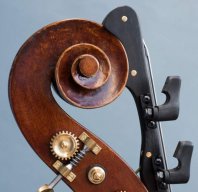
Over the Christmas break I had the luthier who build the bass put on a half extension to reach the low C. It is a finger-style extension. The rosewood fingerboard goes all the way up to the scroll for support but the string extends only about 2.5 inches above the nut. There there is a small ebony nut and a hole drilled through the fingerboard to go to the old A tuner (the A-string now tunes from the old E tuner).
There is no little wheel needed as the string (which is still a regular E-string) doesn't even bend 90 degrees. There is a small rosewood capo to close the string at the nut which is the low D. So, the only note I have to finger is a low C#.
I've found I can really whip around the lower-than-E notes with this arrangement and it didn't cost mega $ either. It is also silent to operate. If I had thought of it then I would have had the string go down to a low B and had a capo for the low C for that rare opportunity to play one. Or a low-B extension from KC strings with the string tuned down for a low-A!!
Since I was playing lots of Baroque stuff with my church string ensemble there were many low D's required (violones being used back in "the good ole days" and all). So, I started using a low D tuning.
After about a year of changing from E to D where needed, I just decided to stay with the low D tuning. It took me about this long to be really comfortable and confident playing on the lower D string.
The Pro's are: 1) the sound of the bass improved as there was less pressure on the top and there was a nice D-A-D harmonic series which the bass seems to like; 2) I've found that most lower-than-E notes are either Eb or D anyway so they are readily available without the noise of a machine; 3) I already know where the notes are because there already is a D-string; 4) you don't have to buy another string; 5) you don't have people asking, "Why is there a piccolo attached to your scroll?"
The Con's are: 1) I find I had to refinger my basic "money-notes" range so now I play in 2nd and 3rd position most often now rather than 1/2 and 1st position; 2) going from Bb to Ab is quite a leap; 3) since the string is tuned down a tone, the tension is a bit floppy and is different from the other strings (I'm using Obligatos, which is an excellent string BTW, perhaps someone could suggest a little stiffer E-string)(note Oct. 2 - I'm using Dominants now which are stiffer ); 4) I have to think more when I'm playng, I've slammed down on a low F instead of a low G a few times because I was sightreading and was a bit tired; 5) I've had to relearn all those orchestral excepts I've played for eons. (Note Oct 2nd - Con 4 and 5 are no longer a problem.)
(note Oct 2nd - I'm now totally used to this tuning so I don't have to think of playing as relearning the fingering. As mentioned above Eb/D# or D seem to be the most common lower-than-E notes followed by low-C and C#/Db the least used. The Bb to Ab is still a reach but that is taken care of with pivot shifting.)
Over the Christmas break I had the luthier who build the bass put on a half extension to reach the low C. It is a finger-style extension. The rosewood fingerboard goes all the way up to the scroll for support but the string extends only about 2.5 inches above the nut. There there is a small ebony nut and a hole drilled through the fingerboard to go to the old A tuner (the A-string now tunes from the old E tuner).
There is no little wheel needed as the string (which is still a regular E-string) doesn't even bend 90 degrees. There is a small rosewood capo to close the string at the nut which is the low D. So, the only note I have to finger is a low C#.
I've found I can really whip around the lower-than-E notes with this arrangement and it didn't cost mega $ either. It is also silent to operate. If I had thought of it then I would have had the string go down to a low B and had a capo for the low C for that rare opportunity to play one. Or a low-B extension from KC strings with the string tuned down for a low-A!!


 but the whole idea is great anyway!


