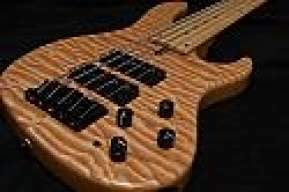
Okay, I've been meaning to do this one for awhile, and now that I have spent some time with each pedal, here we go! All samples recorded straight into the board using a passive Lakland Skyline Joe Osborn with month old DR Sunbeams, no EQ.
BJF Electronics Blue Berry Bass Overdrive:
Controls: Volume, Tone, Drive, On/off
Paid: $295.00 new
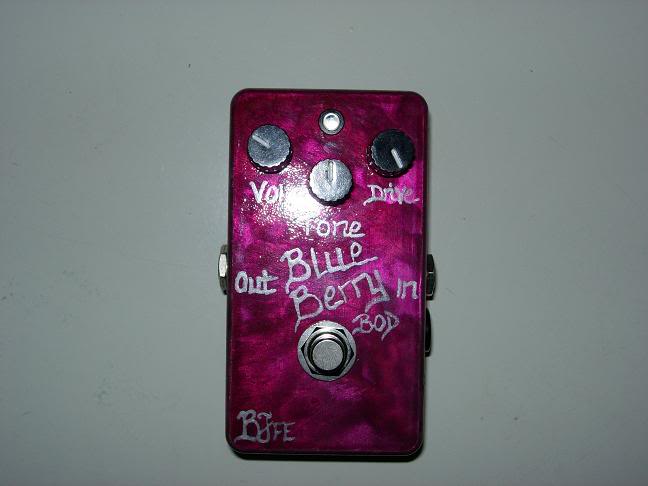
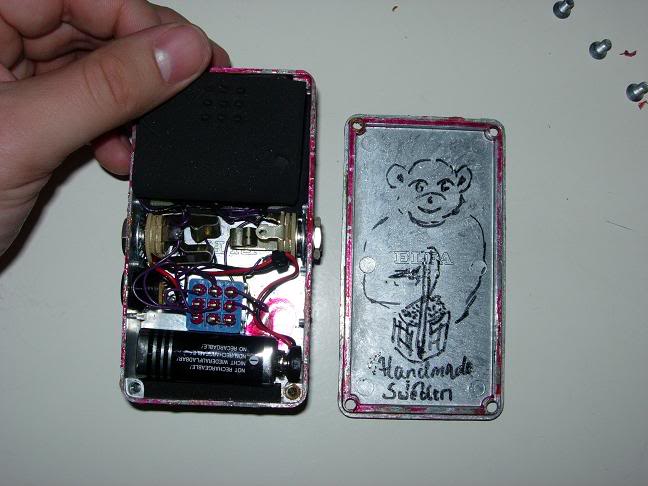
This pedal seems very basic, but a few things to note makes it more mysterious. Most importantly, it's expensive and nearly impossible to find. Second, even though there are only 3 knobs, it can be quite difficult to find what you want! The Tone control is a bit different in that while the center position is flat, rolling back adds lows but rolling up decreases highs (and maybe adds some mids, can't quite tell). Even in the center position some bite is missing, but otherwise much of the signal is retained. Finally, it's eerily heavy and you can't see what is going on inside, spoOoOoky! The Drive and Tone controls are very dependant on each other, and changes to one might mean chasing your sound down with the other. The manual recommends high settings of Drive dictate low settings of Tone, and vice versa. Most of the time, this is a good rule of thumb to go by when experimenting with tones. This pedal takes a lot of time to adapt to using, but the rewards of a natural, real sounding overdrive are very much worth it.
Samples:
Link Removed
Very natural sounding drive, the original signal is preserved a lot at this setting even with a little roll off on the high end.
Link Removed
With the tone flat, even with the Drive dimed it is still quite mellow, but...
Link Removed
This is where the cheese of this pedal is. I'm still not quite sure how the tone control works exactly, but this is the way to get the most overdrive out of it, and it sounds magnificent.
Fulltone Bass-Drive MOSFET:
Controls: Volume, Tone, CompCut/FM/Vintage, Overdrive, MOSFET/Standard, On/off, Boost/off
Paid: $179.99 new
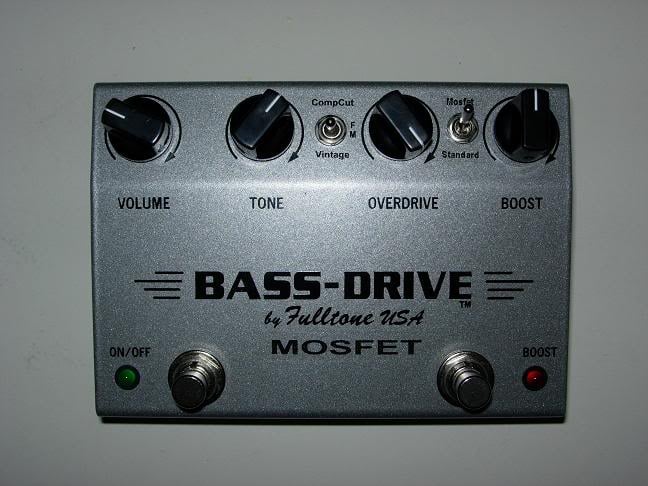

Lots of options and controls, but very intuitive. Does a great job at retaining the original signal. If your ears are really picky, you can tell that a slight bit of low end is lost, and the high end is slightly artificial (sounds like it gets put back rather than retained from the original signal), but in a double blind test you'd be extremely hard pressed to tell the difference, and that's with no other sounds around, like drums, guitars, vocals, trains, girlfriends, cats, etc. The difference between MOSFET and Standard settings is very subtle, MOSFET being a little warmer of the two. The difference between FM and Vintage modes is that the Vintage mode adds a lot of mids to the signal. Since this pedal overdrives mostly the mids, Vintage mode is quite a bit dirtier than FM, even at similar Gain settings. Boost channel does not work when pedal turned off, but adds a LOT of overdrive to the signal without screwing up volume levels too much. Almost as useful as adding a second overdrive pedal to your board, although there isn't much of a difference in overdrive character between FM and Vintage modes when using the Boost. CompCut mode is a clean boost, but I got it to overdrive relatively easily so I don't know how useful that is. I doubt I'll ever be using that mode anyhow.
Samples:
Link Removed
Much of the clean signal is retained, this pedal can be very subtle.
Link Removed
This pedal can definitely get nasty. Might be a little too thrashy, but you can back off on the tone control a bit to keep it in check (if you prefer).
More Fulltone samples found here.
HomeBrew Electronics Hematoma Bass Overdrive/Pre-Amp:
Controls: Gain, Tone, Level, EQ Shift, Pre-gain, Overdrive on/off (BO), Pre-gain on/off (BP)
Paid: $154.99 new
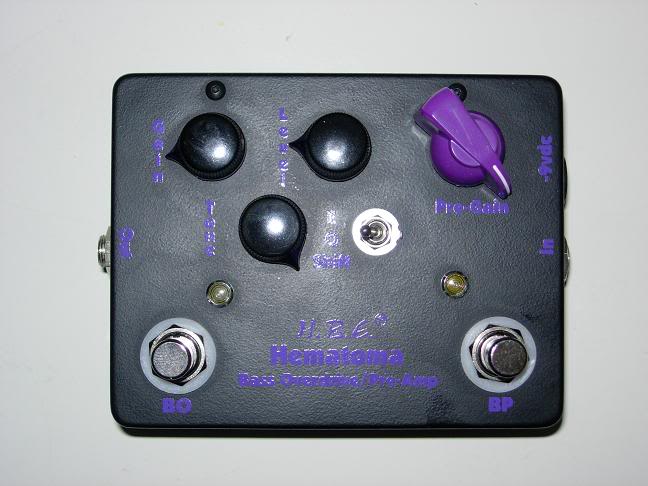
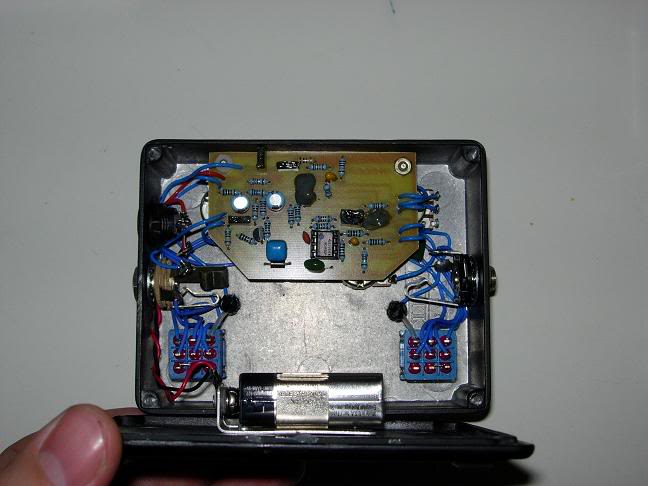
This pedal is quite versatile and very warm sounding. There is a lot of high end roll off even with the tone control cranked, but it always sounds pleasant so the compromise is worth it (and I'm a treble-crankin' tweeter blowin' type of dude). The Pre-Gain channel can be used as a clean boost separately from the Overdrive, or can boost the Gain before Overdrive (hence the term Pre-Gain). This is useful for going from mellow to wild overdrive, and/or a volume boost. Conversely, you can use this in reverse, if you set the Pre-Gain lower than the Volume, engaging this channel will lower the volume and gain structure. EQ shift is cool, it takes a little more highs off when switched to the right and changes the mid characteristic, sounds more vintage this way. The Tone knob almost works like a passive vintage tone control, and as such I keep it dimed nearly all the time. I use this one the most, as no matter what you do with it, it always sounds good.
Samples:
Link Removed
Even at low levels, this pedal colors quite a bit by removing highs and adding grind. Very warm sounding.
Link Removed
Even when pushing the upper end of overdrive, this pedal is still very warm sounding and never gets harsh or nasty. The high end roll off helps, but the overdrive always has a pleasant, smooth character to it.
Summary:
The Blue Berry sounds the best and most natural, but doesn't have a great variety of tones. Also can be difficult to work with, almost counterintuitive at times. Expensive and hard to find.
The Fulltone has a whole range of tonal variety, but sounds the worst (a little brittle and thin by comparison). Nice treble bite that the others don't have, but not very warm sounding. Everyone and their mother has one.
The Hematoma is the jack of all trades, master of none. Has plenty of options and always sounds good. Dark, but quite warm sounding. Inexpensive and a bit uncommon.
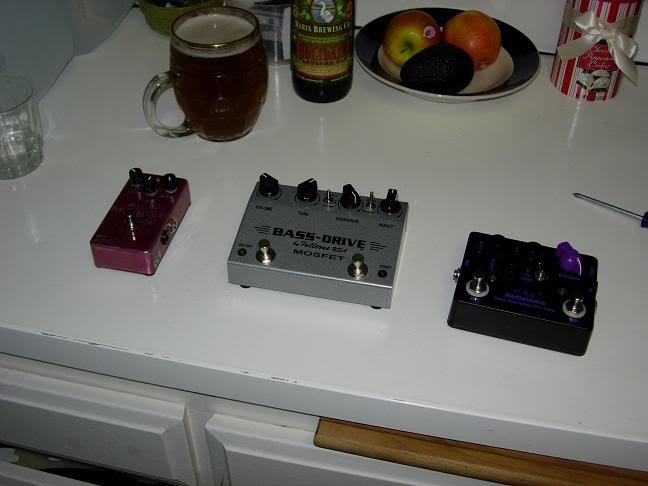
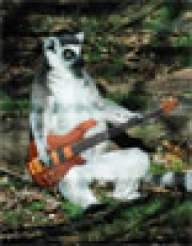
In closing, here is a picture of my assistant along with the pedals:

BJF Electronics Blue Berry Bass Overdrive:
Controls: Volume, Tone, Drive, On/off
Paid: $295.00 new
This pedal seems very basic, but a few things to note makes it more mysterious. Most importantly, it's expensive and nearly impossible to find. Second, even though there are only 3 knobs, it can be quite difficult to find what you want! The Tone control is a bit different in that while the center position is flat, rolling back adds lows but rolling up decreases highs (and maybe adds some mids, can't quite tell). Even in the center position some bite is missing, but otherwise much of the signal is retained. Finally, it's eerily heavy and you can't see what is going on inside, spoOoOoky! The Drive and Tone controls are very dependant on each other, and changes to one might mean chasing your sound down with the other. The manual recommends high settings of Drive dictate low settings of Tone, and vice versa. Most of the time, this is a good rule of thumb to go by when experimenting with tones. This pedal takes a lot of time to adapt to using, but the rewards of a natural, real sounding overdrive are very much worth it.
Samples:
Link Removed
Very natural sounding drive, the original signal is preserved a lot at this setting even with a little roll off on the high end.
Link Removed
With the tone flat, even with the Drive dimed it is still quite mellow, but...
Link Removed
This is where the cheese of this pedal is. I'm still not quite sure how the tone control works exactly, but this is the way to get the most overdrive out of it, and it sounds magnificent.
Fulltone Bass-Drive MOSFET:
Controls: Volume, Tone, CompCut/FM/Vintage, Overdrive, MOSFET/Standard, On/off, Boost/off
Paid: $179.99 new
Lots of options and controls, but very intuitive. Does a great job at retaining the original signal. If your ears are really picky, you can tell that a slight bit of low end is lost, and the high end is slightly artificial (sounds like it gets put back rather than retained from the original signal), but in a double blind test you'd be extremely hard pressed to tell the difference, and that's with no other sounds around, like drums, guitars, vocals, trains, girlfriends, cats, etc. The difference between MOSFET and Standard settings is very subtle, MOSFET being a little warmer of the two. The difference between FM and Vintage modes is that the Vintage mode adds a lot of mids to the signal. Since this pedal overdrives mostly the mids, Vintage mode is quite a bit dirtier than FM, even at similar Gain settings. Boost channel does not work when pedal turned off, but adds a LOT of overdrive to the signal without screwing up volume levels too much. Almost as useful as adding a second overdrive pedal to your board, although there isn't much of a difference in overdrive character between FM and Vintage modes when using the Boost. CompCut mode is a clean boost, but I got it to overdrive relatively easily so I don't know how useful that is. I doubt I'll ever be using that mode anyhow.
Samples:
Link Removed
Much of the clean signal is retained, this pedal can be very subtle.
Link Removed
This pedal can definitely get nasty. Might be a little too thrashy, but you can back off on the tone control a bit to keep it in check (if you prefer).
More Fulltone samples found here.
HomeBrew Electronics Hematoma Bass Overdrive/Pre-Amp:
Controls: Gain, Tone, Level, EQ Shift, Pre-gain, Overdrive on/off (BO), Pre-gain on/off (BP)
Paid: $154.99 new
This pedal is quite versatile and very warm sounding. There is a lot of high end roll off even with the tone control cranked, but it always sounds pleasant so the compromise is worth it (and I'm a treble-crankin' tweeter blowin' type of dude). The Pre-Gain channel can be used as a clean boost separately from the Overdrive, or can boost the Gain before Overdrive (hence the term Pre-Gain). This is useful for going from mellow to wild overdrive, and/or a volume boost. Conversely, you can use this in reverse, if you set the Pre-Gain lower than the Volume, engaging this channel will lower the volume and gain structure. EQ shift is cool, it takes a little more highs off when switched to the right and changes the mid characteristic, sounds more vintage this way. The Tone knob almost works like a passive vintage tone control, and as such I keep it dimed nearly all the time. I use this one the most, as no matter what you do with it, it always sounds good.
Samples:
Link Removed
Even at low levels, this pedal colors quite a bit by removing highs and adding grind. Very warm sounding.
Link Removed
Even when pushing the upper end of overdrive, this pedal is still very warm sounding and never gets harsh or nasty. The high end roll off helps, but the overdrive always has a pleasant, smooth character to it.
Summary:
The Blue Berry sounds the best and most natural, but doesn't have a great variety of tones. Also can be difficult to work with, almost counterintuitive at times. Expensive and hard to find.
The Fulltone has a whole range of tonal variety, but sounds the worst (a little brittle and thin by comparison). Nice treble bite that the others don't have, but not very warm sounding. Everyone and their mother has one.
The Hematoma is the jack of all trades, master of none. Has plenty of options and always sounds good. Dark, but quite warm sounding. Inexpensive and a bit uncommon.
In closing, here is a picture of my assistant along with the pedals:





 I miss my Hematoma. I traded it to finish up the last of my payments on a Focusrite Saffire pro (but my band mates and I are happy now)