• TalkBass has been independent since 1998. Add your voice.
    Create a free account to reply to discussions, view embedded media, and browse with fewer display ads.
    Join freeLog in
    Want zero display ads or expanded classifieds tools? Compare plans.

Double Bass Strange knobs

Hey all,
I love to see old beautiful basses, unfortunately I can see them mainly in pictures...anyhow I came across to this picture in the World of Basses website:

Invalid Link Removed
( look at the picture of the back )

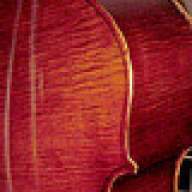
The bass has four strange wooden knobs in c-bouts and lower bouts, they seem to stretch over the edge from the back plate to the rib. Any suggestions what those might be and what might be their function? Just curious....

R2
 
The knobs are a Viennese thing. The main teacher in Vienna the last generation ,Ludwig Streicher, played standing up with a right leg that was locked and perpendicular to the floor and left leg that that was also locked with the heel touching the floor and his toe touching the bass to balance it. The knob on the bass side protects the bass from your shoe when playing this way and the one on the treble side is useless but gives the bass symetry. This stance has become popular in Austria and some eastern european countries.
There is a picture of Streicher playing this way at
Link Removed
 
I played a bass with these same knobs a few years ago. (actually, looked like a similar bass) The guy who had the bass had no idea what the deal was with them, and since then I've asked several other knowledgable people. Nobody seems to know... As for Streicher, the pictures I've seem of his instrument seem to have a ball in the center of the back, like at the back of the bottom block. I was also under the impression from my teacher (who studied with him) that it was simply a rubber ball, but I could be mistaken. Anyway, these knobs are really interesting; I hope somebody can tell us for sure what they're for.
 
Well, Ahhnold did, isn´t that enough?

In fact, I took my bass to the luthier for some sacrificial parts installations. I hope to get it back soon, but I guess it take a few days before all parts are there...in addition to the sacrificial worm blocks, it will have:

a sacrificial neck ( the theory is that the sacrificial neck will break if the bass is knocked down, therefore protecting the bass from actual neck damage,

a sacrificial bass bar ( the theory is that the sacrificial bass bar will be installed to the sound post side, therefore protecting the bass from top sinkage if the bass bar gets loose ),

and a sacrificial bridge ( the theory is that the sacrifial bridge will fall instead of the actual bridge, therefore protecting the sound post from falling ).

I´m so happy already, my bass will be absolutely trouble free, and worm free of course.

R2
 
Originally posted by tsolo
I was thinking about putting something similar on the ribs so i can lay mine on its side to keep from wearing the top and back down to the ribs.

You need to make yourself some handy-dandy Warburton bass-bumpers! Luthiers have always used pieces of ebony or other hard woods to glue on the ribs or outside liners if your bass has liners or linings..as close to the edges of the top as possible. But I use pieces of fan belt, painted matte black of course. The rubber absorbs the bump when you lay down your bass. On the left side only, and of course, use nothing but hide glue!
I charge nothing for this timely tip!
 
WOOOOMPH said:
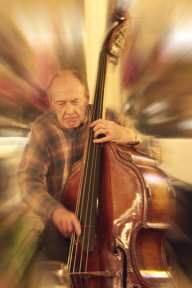
. . . What I find interesting in that picture is the way he is holding the bow, Seems alot of pro's have their "Own" way of doing that. . . .

It looks like a pretty traditional German bow grip to me. It might be a little loose, but he has chubby little hands, so that isn't too uncommon. In the second photo (left profile), it's hard to tell, as the photo is blurred from the movement.

As for the knobs on the bass, It sure seems like it would be structural. If it was cosmetic, I wouldn't see the point at all and if for the comfort of the player, which I can't quite comprehend, why would they be on both sides?

Since it is a flatback, would the inside be crossbraced? If so, are these "bumpers" strategically located on the outside of where the braces terminate on the inside?

I was thinking that maybe a blow to there might be especially traumatic, so they added a bumper, or the tension on the seam is especially high there so the rabbet in the bumpers allows them to wrap around the corner and add a little extra gluing surface for strength?

Of course, I know nothing, just guessing.
 
Pads so it can be laid on its back?
It almost certainly has to be that. My guess would be a custom job for an orchestra or church that stored its basses on shelves.

Chas, I think they are slung too low to assist a crossbrace. Apparently though the need to over-protect a flatback was as necessary in 1860 as it is today. ;)
 
Well,
I´m not sure if I buy that...I understand the need to protect a flatback´s backplate, of course.
But if an orchestra or a church didn´t have room to store their basses ( or any instruments ) anywhere else than on shelves, why didn´t they put cushions on the SHELVES?
:D
R2
 

Latest posts