• TalkBass has been independent since 1998. Add your voice.
    Create a free account to reply to discussions, view embedded media, and browse with fewer display ads.
    Join freeLog in
    Want zero display ads or expanded classifieds tools? Compare plans.

Tobias ... No wait, MTD ... GIBSON ... HUH?

IotaNet

Supporting Member
Dec 8, 2004
3,567
505
64
Minneapolis (Chicago Native)
Sorry for a stupid question but I need to get this straight in my mind.

What is the connection/timeline/pecking order between the original Tobias basses and what we now know as MTD.

I have seen a number of basses under various names (that kinda look the same) that point back to Tobias. The problem is, I don't know which ones are "good" and which ones are not-so-good.

For example:

Tobias Killer B
3f_12_sb.jpg


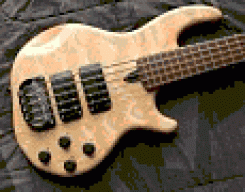
Tobias Basic
bass5close.jpg


Then there are the Tobias Toby's and the MTD X35's, etc. etc.

Can somebody help me sort this out? :confused:
 
Okay, here's a basic layout (without timeline, as I don't know that).

1. Tobias Basses: Manufactured by Micheal Tobias, handcrafted in US of A, the good times.

2. Tobias is bought by Gibson, to ease production. Micheal Tobias is still in charge, basses are still good, but some think quality has gone down.

3. Micheal Tobias leaves Gibson. BOOOO! Gibson shuffles Tobias into the back office and things start to go wrong, fast.

4. Micheal Tobias starts MTD, standing for Micheal Tobias Design. Good basses, made in many places with good quality and great support.

So, Old Tobias is good, early Gibson Tobias not bad, Gibson Tobias not so good (while still being okay) and MTD amazing!!

Hope that helps. Please, anyone else correct me where I may not have all the facts.
 
The Killer B was just getting started when they moved from Burbank to Nashville as I played a few in the old Burbank place. I have a 1993 Killer B and I love it, mine's from Nashville and the quality is definitely inferior but set up nice it's great. All Renegades & Growlers are post burbank and therefore post Mike. The Basic - Classic - Signature models have been made in Hollywood, Burbank, Nashville and the new place (Arkansas?)

Mike has some info on his site
[Invalid or Expired Link Removed]
 
As far as the Gibson Tobias basses, the pre-Nashville basses made while Mike was still involved were great basses, really just as good as the pre-Gibsons IMHO. They moved production to Nashville from Cali in in 1992. The Gibson Tobias basses built in Nashville after that point are kinda hit and miss...some are great, some are just okay. As of right now, Gibson is making Tobias basses in Arkansas, and those new basses are overpriced and MUCH lower quality than the Nashville Gibson Tobias basses.

The Toby's are a lower level line built overseas...they are good basses for the money though.

MTD's are all built by Mike himself and are GREAT basses.
 
As of right now, Gibson is making Tobias basses in Arkansas, and those new basses are overpriced and MUCH lower quality than the Nashville Gibson Tobias basses.
I recently shopped these Arkansas Tobias basses, and I can tell you first hand (not from stories handed down) that these basses were invariably magnificent. The material was first-rate, the workmanship was flawless, the various parts were the best money can buy anywhere in the world, and the sound quality was to die for. I personally defy anyone to find a Tobias bass built within the last couple of years with any quality issues at all.

But Gibson is fighting an uphill battle here. For a decade or so, they did in fact produce inferior overpriced stuff, and got a deserved bad reputation. And once you've blown your reputation, it follows you like stink. When Gibson opened their Arkansas operation, they decided to produce hand-crafted instruments of the highest possible quality, and my hands-on experience is that they have done so.

But clearly, they are battling uninformed word-of-mouth. I can only say, try one out. Get a magnifying glass and examine the workmanship. Listen to the sound. Feel the neck. Check out the hardware. Don't take my word for this, or anyone else's. All I'm saying here is, the Tobias line's history has had ups and downs, as Gibson went through ownership and policy changes. Don't be one of those people whose mind is made up on the basis of reputation only. These current instruments are VERY high quality, in my opinion.
 
  • Like
Reactions: Bassistcool
From extensive reading of interviews with Gibson employees, customers and the CEO (representing the new owners), I have extracted the following points:

1) Gibson (under the new owners) made the corporate decision to designate certain lines "boutique" lines. Gibson describes these lines as producing the best instruments available at any price anywhere in the world. The Tobias bass line was included in the boutique category when the Arkansas plant was decided on as the location where Tobias basses would be built. (See Footnote 1)

2) A strict quality control program is imposed on boutique instruments, and any instrument that fails to match the standard ("the best available at any price anywhere") is permanently rejected. This quality standard SHALL NOT be compromised (see footnote 2). But Gibson is not attempting to "inspect quality in" to their Tobias basses. They've hired (they say) qualified hand-crafting luthiers to produce Tiobias instruments. Quality is now built in from the inception - the selection of woods, the inspection of grains, the certification of proper aging, the identification of possible flaws, the institution of rejection at every step of the processing, shaping, cutting, mating, finishing, etc. Problems are not only looked for at every stage, but pre-empted before they can happen. Problems are now supposed to be identified *before* they become troublesome.

3) Gibson has taken steps to ensure that their boutique (and perhaps others, but I'm not sure about this) instruments SHALL NOT be sold over the internet for discount prices. The number of authorized Gibson dealerships has been drastically reduced, the number of internet-authorized dealers is down to maybe 4 or 5 (musician's friend and others owned by the same conglomerate). NO Gibson dealer may offer any discounts below MSRP. (See Footnote 3)

4) This policy seems to have yanked the license to sell Gibson instruments from a good many shops. It also has served to jack effective Gibson prices up sky high for certain lines. Gibson's claim is that the quality of these lines has been jacked to justify these high prices. I can only testify that Tobias basses are worth the high prices. You get a world-class bass, no doubt about it. You pay a world-class price for it. But the underlying theme is that Gibson doesn't care about YOU, the end customer. Gibson cares about the distribution channel. The goal is to limit the dealerships. and make the dealers happy. You matter only indirectly: if you don't buy the instruments, the dealer complains to Gibson. It's not an unreasonable business model; it just isn't real responsive to the individual musician.

5) This policy seems to be working for Gibson on the whole, because the marque continues to have a lot of cachet, and because they have so many quality classes of Les Paul guitars. Tobias-by-Gibson, however, seems to have reputation problems left over from the days when a near-bankrupt and dying Gibson decided to produce super-cheap Tobias basses and charge high prices, to cash in on Mike Tobias's reputation while it lasted. The current (Arkansas) basses are subject to the new "perfect or destroyed" standards enforced by hand-crafters, and DO leave the factory as world-class, but it's tough to sell even fabulous can't-buy-better-at-any-price instruments for $2K-$6K when the word on the street is that Gibson is ripping you off.

I can tell you that a 2006 Killer B is worth $2K, and I can tell you that Gibson won't let you get a new one for less. Hey, Sadowski and Ritter and Smith and MTD and Warrior and Modulus and even Carvin aren't offering any cheapo bargains either. You will pay top dollar for all of these, guaranteed. You will get your money's worth in every case, guaranteed. I have enough time spent with my Killer B so I know I wouldn't trade it for any Fodera. I *played* a Fodera. The Tobias is better.

But I also wouldn't buy a Tobias-by-Gibson bass built between 1994 and 2004. Gibson like any large corporation has periodic policy changes. The policy change to build the best basses in the world happened in maybe 2003. It's still operative. When they'll decide to "cash in" agaiin is a corporate decision that could happen any day. Get a current Tobias while they last; it will last YOU a lifetime.

Footnotes:

(1) There's really no such thing as "the best possible bass" for many reasons: because people have different preferences for feel and sound, because basses themselves are widely variable in many ways as a result, and because basses strong in one musical genre are often necessarily weak in another. There's no "perfect sound". So the decision was made to build Tobias basses with the accepted "best" materials - maple/purpleheart 5-piece laminates for necks, Grover tuning machines, Bartolini pickups and fully shielded electronics, Hipshot bridges, and solid exotic wood bodies (NOT exotic 1/4-inch tops laminated on generic alder or basswood bodies).

(2) Gibson has lines where "firsts" (without known flaws) and "seconds" (with known flaws) are sold at different prices. Gibson is aware that some unscrupulous dealers sell seconds for the price of firsts, without telling the customer. So "boutique" lines such as Tobias basses do not have factory seconds at all. If flaws are found, the instrument is destroyed and never sold to a dealer.

However, Gibson is aware that wood is inherently unpredictable over time spans of decades, and perfect instruments leaving any factory or luthier shop can become unplayably bad over time. It is Gibson's policy that Tobias basses suffer this misfortune no more often than instruments sold by any other luthier, at any price.

(3) As an anecdote, my personal experience followed this policy. I shopped at several Gibson dealers, and their Killer B price was $2000, no discounts. They told me that they'd match any internet price I could find, and I found that every internet dealer asked $2000 for the same bass. However, I pointed out that the internet sellers charged neither tax nor shipping, whereas the local shop was required by state law to charge me $168 in sales tax. The local shop agreed to "throw in" AT LEAST $168 in "stuff" to match the internet sellers, and eventually they threw in stuff with a "retail value" (not their cost) of $210 worth of stuff.
 
  • Like
Reactions: Bassistcool
Iotanet:

Thanks. Maybe that post was a bit long and detailed, so I should summarize:
1) Tobias basses are the best money can buy in woods, necks, tuners, bridges, pickups eletronics, craftsmanship, etc. NO corners were cut.
2) You the bassist have few choices in Tobias basses - there are a few different body woods, and that's it. You like it or you don't.
3) You WILL pay an arm and a leg for these basses, just like you do any other handcrafted basses (including Carvin). They aren't "industry standard" either - they have unique necks and custom electronics. They're SUPER; they aren't bargains.
4) After a LOT of shopping for my next bass, which included a lot of basses by famous luthiers, I found Tobias-by-Gibson, 2005 or later, to be the best bang for the buck availabe, period. But I also admit I found the Killer B at $2K superior to the Signarute at $5K, price no object. The $2K Killer B had better tone (richness and fullness), and better sustain (despite the Signature's neck-through), in my judgment. Looked better too (but no accounting for taste, right?)

So here's the bottom line: The (new, Arkansas-made) Gibson Tobias bass is one hell of an instrument. It costs a LOT. It's worth it. It may not be for you. By all means, TRY ONE OUT before making a decision. You'll be glad you did.
 
  • Like
Reactions: Bassistcool
These basses could very well be worth the 2-6K price tag to someone with the disposable income. It's humorous that you repeatedly include Carvin in your list of high priced, high quality basses. Just for laughs, I went to the Carvin web site and selected the single most expensive model, the 6 string Elite. From there I selected the most expensive choice in every category, every possible option. Even took the most expensive case. Bear in mind at this price there is PLENTY of choice on every point except body style and brand of pickups, though there are many pickup style choices, and many free finish options. So here's the most expensive Carvin I could come up with:

XB76EP - 6 String Model 35 1/4in scale $ 2449.00
HS - Hipshot Detuner $ 35.00
FWS - flat wound strings $ 10.00
AB - abalone inlays $ 80.00
STF - stainless steel frets $ 40.00
HC18 - Guitar Case $ 79.00
Subtotal $ 2693.00
Shipping $ 19.99
Total $ 2712.99

This is hardly comparable to Gibson's $6000 top of the line. The next most expensive bass, an Anniversary 6, came to $2100 similarly tricked out, the price of the cheapest Gibson Tobias; it takes some work to drive the prices that high, it's quite easy to get a very nice bass much cheaper, with less ostentacious models starting at $799. I am NOT comparing anything other than price, or putting down the quality of the Gibson Tobias basses, but it's a bit misleading to imply Carvins are in the same price range. Carvin's bolt ons start at $599.
 
  • Like
Reactions: LennyE
My Tobias Experince is as follows, I've owned 3 and played many more extensively.

#1-5st. Toby Deluxe-pretty much an overpriced entry/beginner level Bass.

#2-6st. Toby Pro- much nicer but still overpriced, constuction on my bass was actually pretty good.

#3-5st. Growler- IMHO this bass was actually worth more than I paid for it new. The tone was awesome and very flexible, and the Neck profile was just killer.

I've played Tobias' from every era including the "New Arkansas" models, and I feel they are WAY overpriced and nowhere near the quality of the Pre Gibson's or MTD's.

In fact in Feb. I was over in Nashville and stopped in the Opry Mills Mall-(wich contains a huge Gibson store/Mandolin production shop). I played this very bass http://www.instrumentexchange.com/bid-form.asp?list_id=419841&pid=41&catid=131&scatid=495&status=1
and it was a shame the way it played-just horrible and the price-$8500.......lol.I would have rather had my $1200 Growler any day of the week.Not only was the bass in terrible need of a setup-it was just too "cookie cutter" sounding with the standard Barts-for that price I need a bass that really speaks. They also had the whole line up down to the Killer B-(but no new Growler for me to compare against my old one)I played them all and for $3500 for the Classic with a flame maple top I has to pass a; I went on to The LowEnd Bass shop and picked this up instead:Invalid Link Removed

Benavente SCD5-my baby!
It blows every Tobias I've ever played away!

Any how I'm not trying to derail the thread just sharing my thoughts on the new Tobias products- for the money you're much better off with another Custom Builder
 
Flintc said:
From extensive reading of interviews with Gibson employees, customers and the CEO (representing the new owners), I have extracted the following points:

1) Gibson (under the new owners) made the corporate decision to designate certain lines "boutique" lines. Gibson describes these lines as producing the best instruments available at any price anywhere in the world. The Tobias bass line was included in the boutique category when the Arkansas plant was decided on as the location where Tobias basses would be built. (See Footnote 1)

2) A strict quality control program is imposed on boutique instruments, and any instrument that fails to match the standard ("the best available at any price anywhere") is permanently rejected. This quality standard SHALL NOT be compromised (see footnote 2). But Gibson is not attempting to "inspect quality in" to their Tobias basses. They've hired (they say) qualified hand-crafting luthiers to produce Tiobias instruments. Quality is now built in from the inception - the selection of woods, the inspection of grains, the certification of proper aging, the identification of possible flaws, the institution of rejection at every step of the processing, shaping, cutting, mating, finishing, etc. Problems are not only looked for at every stage, but pre-empted before they can happen. Problems are now supposed to be identified *before* they become troublesome.

3) Gibson has taken steps to ensure that their boutique (and perhaps others, but I'm not sure about this) instruments SHALL NOT be sold over the internet for discount prices. The number of authorized Gibson dealerships has been drastically reduced, the number of internet-authorized dealers is down to maybe 4 or 5 (musician's friend and others owned by the same conglomerate). NO Gibson dealer may offer any discounts below MSRP. (See Footnote 3)

4) This policy seems to have yanked the license to sell Gibson instruments from a good many shops. It also has served to jack effective Gibson prices up sky high for certain lines. Gibson's claim is that the quality of these lines has been jacked to justify these high prices. I can only testify that Tobias basses are worth the high prices. You get a world-class bass, no doubt about it. You pay a world-class price for it. But the underlying theme is that Gibson doesn't care about YOU, the end customer. Gibson cares about the distribution channel. The goal is to limit the dealerships. and make the dealers happy. You matter only indirectly: if you don't buy the instruments, the dealer complains to Gibson. It's not an unreasonable business model; it just isn't real responsive to the individual musician.

5) This policy seems to be working for Gibson on the whole, because the marque continues to have a lot of cachet, and because they have so many quality classes of Les Paul guitars. Tobias-by-Gibson, however, seems to have reputation problems left over from the days when a near-bankrupt and dying Gibson decided to produce super-cheap Tobias basses and charge high prices, to cash in on Mike Tobias's reputation while it lasted. The current (Arkansas) basses are subject to the new "perfect or destroyed" standards enforced by hand-crafters, and DO leave the factory as world-class, but it's tough to sell even fabulous can't-buy-better-at-any-price instruments for $2K-$6K when the word on the street is that Gibson is ripping you off.

I can tell you that a 2006 Killer B is worth $2K, and I can tell you that Gibson won't let you get a new one for less. Hey, Sadowski and Ritter and Smith and MTD and Warrior and Modulus and even Carvin aren't offering any cheapo bargains either. You will pay top dollar for all of these, guaranteed. You will get your money's worth in every case, guaranteed. I have enough time spent with my Killer B so I know I wouldn't trade it for any Fodera. I *played* a Fodera. The Tobias is better.

But I also wouldn't buy a Tobias-by-Gibson bass built between 1994 and 2004. Gibson like any large corporation has periodic policy changes. The policy change to build the best basses in the world happened in maybe 2003. It's still operative. When they'll decide to "cash in" agaiin is a corporate decision that could happen any day. Get a current Tobias while they last; it will last YOU a lifetime.

Footnotes:

(1) There's really no such thing as "the best possible bass" for many reasons: because people have different preferences for feel and sound, because basses themselves are widely variable in many ways as a result, and because basses strong in one musical genre are often necessarily weak in another. There's no "perfect sound". So the decision was made to build Tobias basses with the accepted "best" materials - maple/purpleheart 5-piece laminates for necks, Grover tuning machines, Bartolini pickups and fully shielded electronics, Hipshot bridges, and solid exotic wood bodies (NOT exotic 1/4-inch tops laminated on generic alder or basswood bodies).

(2) Gibson has lines where "firsts" (without known flaws) and "seconds" (with known flaws) are sold at different prices. Gibson is aware that some unscrupulous dealers sell seconds for the price of firsts, without telling the customer. So "boutique" lines such as Tobias basses do not have factory seconds at all. If flaws are found, the instrument is destroyed and never sold to a dealer.

However, Gibson is aware that wood is inherently unpredictable over time spans of decades, and perfect instruments leaving any factory or luthier shop can become unplayably bad over time. It is Gibson's policy that Tobias basses suffer this misfortune no more often than instruments sold by any other luthier, at any price.

(3) As an anecdote, my personal experience followed this policy. I shopped at several Gibson dealers, and their Killer B price was $2000, no discounts. They told me that they'd match any internet price I could find, and I found that every internet dealer asked $2000 for the same bass. However, I pointed out that the internet sellers charged neither tax nor shipping, whereas the local shop was required by state law to charge me $168 in sales tax. The local shop agreed to "throw in" AT LEAST $168 in "stuff" to match the internet sellers, and eventually they threw in stuff with a "retail value" (not their cost) of $210 worth of stuff.

Just curious... what are your sources? Links?
 
west*coast*bass said:
What would be even more helpful would be a geneology of the serial numbers to designate where and when the basses were made.

Not exactly what you were looking for but on the old MTD site (from a few years ago) Mike listed the last serial number he made in CA. I believe it was somewhere between 2000 and 2200 but I can not find this same info on his new site.
 
Flintc said:
I personally defy anyone to find a Tobias bass built within the last couple of years with any quality issues at all... I can only say, try one out. Get a magnifying glass and examine the workmanship. Listen to the sound. Feel the neck. Check out the hardware. Don't take my word for this, or anyone else's.

I played an Arkansas-built Tobias Classic (Bubinga-Wenge-Alder) about 14 months ago, and I daresay it was at best on the level of a Chinese-built beginner bass of the late 1980's... not even a modern lower-midrange Far Eastern-built instrument. This particular Tobias has sharp/protruding frets so much they actually pierced my skin, a poorly buffed-out finish at various points of its body and neck, a bridge that was millimeters away from dropping off the body surface, and its neck-through body wings were at different heights from the neck portion of the bass.

...let me repeat that last section as it's almost impossible to believe, and if I had not seen it myself I'd be hard-pressed to believe it. The body wings were lower in hight than the neck-through section of the bass.

I was amazed/astounded/"insert you own adjective here" at the level of ineptitude in the construction of the instrument. Of course I had heard the horror stories (terribly built basses at NAMM of all places?!?) here and hoped they were isolated incidents, but to witness it firsthand? Frankly, a saddening experience as Tobias' were basses that as a young, starting-out bassist were one of my few dream basses, and to see them fall so far from their perch in bassdom was a shattering of a dream. Absolutely no disrespect to Michael Tobias, but I simply prefer the body styling and string-spacing of "Tobias" basses as opposed to MTDs, and when I heard that Gibson was restarting production of true, high-end Tobias' I was ecstatic as that dream of owning a "real" Killer B seemed to be a possibility once again. I put that dream away once again that afternoon.

As I have heard rumbling that Gibson had taken notice of sheer lack of basic building skills coming out of the Arkansas factory and were making changes I can only hope that indeed quality will improve to the pricepoint they hold and the level their name deserves, but it would taken great feats to bring my personal dream back again.

NO Gibson dealer may offer any discounts below MSRP.

Then given the word of mouth on Tobias, Gibson should vastly reduce their sales projections. This is not sarcasm, but I think most would agree, the general feelings of Arkansas-built Tobias, based on actual testing and write-ups online. Not just here but "The Bottom Line" mailinglist and other Internet forums. Not to toot our horn, we might very well be the biggest but we're hardly the only game in town.

I can tell you that a 2006 Killer B is worth $2K, and I can tell you that Gibson won't let you get a new one for less. Hey, Sadowski and Ritter and Smith and MTD and Warrior and Modulus and even Carvin aren't offering any cheapo bargains either.

I would agree that the above aren't "cheapo bargins" as well, but they don't have the stigma attached to them as Gibson-built Tobias' do. I'll tie this with the above post: Does Gibson truly think that the answer to a brand with major image problems is to "lock in" the extremely high price and give the consumer no leeway? That seems like the least effective marketing strategy and method to pull potential customer back to a brand that I've ever heard. Compare this to Stuart Spector, who was in the same position in terms of a large company making low-quality, overseas versions of basses baring his name. When regaining the rights to produce Spector NS basses, Stuart virtually only had to say "I'm back" and had customers flocking to him.

As for the basses you list, they do not suffer the extreme (and verified) word-of-mouth problems that Tobias does - in fact, the opposite as you can pick up a phone and actually talk to this luthiers, e-mail them and get a response. They also have a presence in the used market that take the place of a "cheapo bargain", and in the case of Carvin (which simply on pricepoint doesn't belong within this group) has "1/2 off options" sales and "free case" promotions.

Flintc, as your profile is empty and contains no information about you as a bassist, your posts within this thread are long, extolling the virtues of Tobias Basses to the point of reading like advertisements down to posted lines such as "I personally defy anyone to find a Tobias bass built within the last couple of years with any quality issues at all", "You get a world-class bass, no doubt about it" & "Get a current Tobias while they last; it will last YOU a lifetime" I'll be straightforward and ask:

Are you a employee of Gibson, Tobias, any subsidiary or advertising company, or generally have the nefarious "something to gain" by your posting here in regards to Tobias Basses?

I'll also join The Penguin and Brad Johnson in asking for sources in regards to your "extensive reading of interviews with Gibson employees, customers and the CEO" or failing that, a posting of the interviews in question.