• TalkBass has been independent since 1998. Add your voice.
    Create a free account to reply to discussions, view embedded media, and browse with fewer display ads.
    Join freeLog in
    Want zero display ads or expanded classifieds tools? Compare plans.

Super glue on a fretless board ?

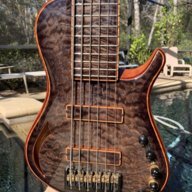
I just bought a rather nice Shuker 6 string fretless, it was originally fretted but the original owner had Martin Petersen remove the frets. It has a rosewood fretboard that's starting to get scratched by my roundwound strings.

I was reading this the other day about putting a layer of superglue on the board to protect it, I should imagine it'll change the sound a bit too.

Invalid Link Removed

Anyone ever tried it, and how did they do it without getting into a right mess ?

Thanks

 
I used superglue on a rosewood board back in the day.
use really thin stuff from a hobby store that the RC plane builders use. I used [Invalid or Expired Link Removed]. I used my finger to apply it. After it dried it came off without too much effort.

Forgot, I used mineral spirits to strip any oils out of the board. I was drawn to superglue after seeing an RC plane builder use it and noticing that it actually penetrated deep into the balsa wood and I deduced that it would act similar with really dried out rosewood.
 
Here's an article that Dan Erlewine wrote for Bass Player a while back about coating a fretless fingerboard with super glue.
http://www.bassplayer.com/article/superglue-savior/jun-06/20674

+ 3/4

I don't agree with using accelerator and no.20 glue (which is kinda thick). This is because I wanted the wicking property the really thin stuff to penetrate and harden the rosewood from within, rather than having a thick coating on top. But everything else in that article is very helpful indeed.
 
Chris Stambaugh uses some sort of superglue to coat his fingerboards. Apparently it's not terribly difficult to apply, but I'm worthless with that crap.

True, you could use flats or epoxy it, but I've hear people say that the superglue has minimal impact on tone. Roundwound on a wood fingerboard is a pretty cool tone, but at a price. Epoxy and semisynthetic fingerboards are obviously more durable, but really change the sound, as do flats. I personally enjoy all fretless tones, so....perhaps my opinion isn't valid.
 
I work on a daily bassis with epoxies and "superglues". If I was going to do a fretboard, I would build up a layer of thin cyanoacrylate "superglue". Use the QUALTY stuff from the Hobby store. Just remember, it would be very hard to apply it evenly even brushing it on. It will need to be sanded to shape and finish. After curing, it's VERY hard and durable.

There are epoxies that set up almost as hard but IMHO, it would be easier to work with the Cyano glue.
 
  • Like
Reactions: Count Bassie
Plus one on the really thin stuff, if you use superglue or epoxy. You can get a water thin epoxy which works really well from Jamestown ditribution. Make sure you tape off the fingerboard so nothing gets where you don't want it.

One other alternative which I used back in the day after Rick turner recommended it, was True Oil. This will soak into the wood as you rub it in and reapply it , and then you can wipe off most of the excess and let it cure over night, then scratch it up with some steel wool and you can apply several more coats. This will leave a finish that WILL breakdown over time, but it saves the board and every couple years you just sand off the True Oil and reapply. It is a little more work but a valid alternative because you can correct your mistakes if you need to. You also don't need to build the coats up either.

Good luck
 
I just don't like the idea of super glue on a fretboard. I like the idea of Tru-Oil (made by Birchwood Casey) much better. It's a long-established finisn for rifle stocks, and it's quite durable. It's also extremely easy to apply or renew.

I don't like the idea of anything but bare ebony with oil as you mentioned. If I had to put something on a softer wood, it would be a Cyano glue. It comes out VERY hard, way more so than epoxy and it's easier to sand and finish. I use it on some of my softer wood inlays on my knives and it makes them tough as HELL :D
 
The superglue thing is really cool. I did it on my fretless Wishbass. I am a total idiot when it comes to woodworking stuffs, but I was able to do this with a lot of ease. It gives it an extremely glassy and hard feel on the board. Plus, I think shiny things. I followed this process: http://www.bassplayer.com/article/su...r/jun-06/20674

Took about 5 hours, if I remember correctly. The fumes are absolutely BRUTAL! It is a very easy and cheap application. Costs about $20-$30. About $5 for the superglue and about $20 for the different grades of sandpaper, if you don't have them. If you buy single sheets, it will be a bit cheaper.

Before Superglue finish:

DSCN0092.jpg


DSCN0095.jpg


After Superglue finish:

DSCN0097.jpg


DSCN0104.jpg


Picture097.jpg


http://www.talkbass.com/forum/showpost.php?p=7399498&postcount=270
http://www.talkbass.com/forum/showthread.php?t=528368&page=14
 
  • Like
Reactions: Count Bassie
The superglue thing is really cool. I did it on my fretless Wishbass. I am a total idiot when it comes to woodworking stuffs, but I was able to do this with a lot of ease. It gives it an extremely glassy and hard feel on the board. Plus, I think shiny things. I followed this process: http://www.bassplayer.com/article/su...r/jun-06/20674

Took about 5 hours, if I remember correctly. The fumes are absolutely BRUTAL! It is a very easy and cheap application. Costs about $20-$30. About $5 for the superglue and about $20 for the different grades of sandpaper, if you don't have them. If you buy single sheets, it will be a bit cheaper.

Before Superglue finish:

DSCN0092.jpg


DSCN0095.jpg


After Superglue finish:

DSCN0097.jpg


DSCN0104.jpg


Picture097.jpg


http://www.talkbass.com/forum/showpost.php?p=7399498&postcount=270
http://www.talkbass.com/forum/showthread.php?t=528368&page=14

That's brilliant, thanks for posting that.

I have the DIY skills of a tadpole, but I'm going to give it a try.
 
Let me stress how little I have done before on woodworking... I knew NOTHING. I have never refinished anything. I have probably sanded something only a time or two before this. It really is easy to do that fretboard. The key is to put THIN layers on. Don't let it be too thick. Make sure you apply it evenly. Spread quickly. WEAR GLOVES. Wear goggles as well and do it outside if possible. I'll be happy to answer any questions you might have. Be patient with it. Just keep applying and sanding, applying and sanding. If you can get a hold of a buffer, that adds a really nice shine at the end as well.
 
I've done a couple with superglue. Some tips

Use the good stuff from either Stew Mac or the hobby shop.

Wear gloves, work outside in a well ventilated area. Use the mineral spirits to reduce the natural oils of the rosewood and use the very thin first to allow it to penetrate the wood before you put any thicker over it. I prefer to let it harden and cure than use the accelerator, as I've seen the accelerator turn it white in spots I'd gotten it too thick. Sand it level with a fine grit wet/dry and then buff it to a nice sheen.
 
The superglue thing is really cool. I did it on my fretless Wishbass. I am a total idiot when it comes to woodworking stuffs, but I was able to do this with a lot of ease. It gives it an extremely glassy and hard feel on the board. Plus, I think shiny things. I followed this process: http://www.bassplayer.com/article/su...r/jun-06/20674

Took about 5 hours, if I remember correctly. The fumes are absolutely BRUTAL! It is a very easy and cheap application. Costs about $20-$30. About $5 for the superglue and about $20 for the different grades of sandpaper, if you don't have them. If you buy single sheets, it will be a bit cheaper.

Before Superglue finish:

DSCN0092.jpg


DSCN0095.jpg


After Superglue finish:

DSCN0097.jpg


DSCN0104.jpg


Picture097.jpg


http://www.talkbass.com/forum/showpost.php?p=7399498&postcount=270
http://www.talkbass.com/forum/showthread.php?t=528368&page=14

Nice job!! You can actually impregnate softer woods with Cyano glue by drawing a vacuum on it. That process takes a pump and a large chamber but the results are amazing. THe softer the wood, the more glue it absorbs making it VERY hard. Harder woods like ebony or any woods that sink in water don't absorb it at all and it mearly sticks to the surface. Either way, it works well.
 
  • Like
Reactions: andronik
I've done a couple with superglue. Some tips

Use the good stuff from either Stew Mac or the hobby shop.

Wear gloves, work outside in a well ventilated area. Use the mineral spirits to reduce the natural oils of the rosewood and use the very thin first to allow it to penetrate the wood before you put any thicker over it. I prefer to let it harden and cure than use the accelerator, as I've seen the accelerator turn it white in spots I'd gotten it too thick. Sand it level with a fine grit wet/dry and then buff it to a nice sheen.

+1 The accelorator causes it to set fast but not as hard. Good for model airplanes, not basses :D
 

Latest posts