• TalkBass has been independent since 1998. Add your voice.
    Create a free account to reply to discussions, view embedded media, and browse with fewer display ads.
    Join freeLog in
    Want zero display ads or expanded classifieds tools? Compare plans.

Fiberglass Speaker Cabinets - light weight

I'm interested in seeing what's out there in terms of fiberglass cabinets. I am a car audio shop owner by trade, and I use fiberglass all the time - plywood is a terrible material to use in a car due to frequent moisture and humidity changes they delaminate easily. MDF is great - but will swell if it ever gets wet. in the P/A world, high-ply wood is used because it's lighter than mdf, though not as rigid. so ideally, sonically, the best cabinets probably would weight a ton and be braced like crazy.

bottom line is, although fiberglass has resonant properties like wood does, it seems to be great material for cabinets because of it's ability to form curves and reduce standing waves inside the cabinet, in addition to being lighter than wood by about 7:1. it can be braced (like the cabinet I attached a picture of) to reduce the resonance.

I searched a bit and didn't find much on this topic - but here's another similar thread for reference. - http://www.talkbass.com/forum/showthread.php?t=102709


here's a speaker box I built not long ago - so you know where I'm coming from

done4-1.jpg


this pic shows some of the bracing -

layers.jpg
 
Cool. Not being an audio engineer, I have no idea how feasible these would be, but I've always wondered about the viability of bass cabs constructed from synthetic materials - such as fiberglass...and why it hasn't been tried/used more often already... :confused:

The key factor, so far as I know, would be the issue of rigidity. But if fiberglass is truly rigid enough, I personally see no reason why it wouldn't work great...

MM
 
so ideally, sonically, the best cabinets probably would weight a ton and be braced like crazy.
The best cabs are braced like crazy, and as a result they're lighter than the un-braced or barely-braced 3/4" plywood variety. Fiberglass and other composites make for great lightweight cabs, but not at a price that enough customers are willing to pay to make them successful.
 
The best cabs are braced like crazy, and as a result they're lighter than the un-braced or barely-braced 3/4" plywood variety. Fiberglass and other composites make for great lightweight cabs, but not at a price that enough customers are willing to pay to make them successful.

Bill is right on both counts.

Ultra lightweight cabs are doable, but there is no cheap way to make one. You either pay for expensive materials, lots of labor, or both. The reason no large manufacturers are building with anything other than plywood is because they don't think the market would support it.

Just look at the new light weight digital bass amps. They're not new. Walter Woods was doing it years ago, only in smaller quantities and for much higher cost. I doubt he ever got rich doing it. You are only seeing the big companies come on board now because cost has come down to a level that the market will support on a larger scale (thanks to the bang & olufsen power amp module that most of these amps use). Notice the price point ($/watt) for these new amps is just about the same as the older heavier amps? If lightweight composite cabs ever make it big it will be because they can be manufactured at a cost the market will support. Today that just ain't so.

About the OP's suggested technique. Unfortunately, single walled monocoque fiberglass construction will most likely result in cab that is slightly heavier than a similar plywood cab. Fiberglass is stiffer than plywood (higher elastic modulus; 3390ksi vs. 1350ksi), but it is also denser (75lbs/ft3​ vs 44lbs/ft3​).

I did some quick calculations comparing the stiffness of the two materials. A 0.55" thick sheet of fiberglass (7781 glass w/ epoxy) will be as stiff as a 0.75" thick sheet of plywood (baltic birch). However, given equal length and width of the sheets, the fiberglass will be about 25% heavier. :(

The real advantage (as the the OP mentioned) to monocoque construction is that you can gain stiffness by using curved surfaces rather than flat ones. Think of a ping pong ball. It is very stiff because of its shape. If that same celluloid material was in a flat sheet is would be very flexible. With this in mind, one may be able to make a fiberglass cab that is significantly lighter than plywood yet just as stiff.

I say go for it! Just don't use flat surfaces. Also check out sandwich construction. You could build a cab with a monocoque parabolic arch for the sides and back in one piece, then use sandwich construction for the flat top, bottom, and baffle. There might be some potential there.
 
quick question.

could these lightweight cabs be produced in a different materiel, such as plastic, much like mackie does with some of their pa speakers ?

they could either be injection molded, or roto molded. altho the initial cost would be substantial, the labor costs would be substantially reduced as the time involved would be like nil, compared to laying it up in fiberglass, & internal bracing could also be molded & plastic welded in for structural rigidity.

just curious,,,
 
quick question.

could these lightweight cabs be produced in a different materiel, such as plastic, much like mackie does with some of their pa speakers ?
The cost of the mold runs around $250K. The electric bass cab market is too small to support that kind of investment.
 
The cost of the mold runs around $250K. The electric bass cab market is too small to support that kind of investment.

+1

You could rotomold for less. The molds and processes are a lot less expensive. You would still probably end up with a cab that is either heavier than plywood, or less stiff. This is just the nature of less expensive plastics. Some higher end engineering-grade plastics might improve the situation, but they probably won't work well with rotomolding and cost too much.
 
i am aware that the initial costs would be expensive, ( as i worked in a number of tool & die shops in my former life ) but if initial cost were the only case, SKB & Gator would not be making all of their cases out of plastic in 3 to 4 different model of every size, they would still all be made out of wood, like the Pearson cases.

also kayaks,, every model under the sun is either blowmolded, or rotomolded, & the kayak market is also a very small market, ( with many smaller niche submarkets within that small market ) whereas, there are still ol'school guys still laying up 'glass & still making wood,,, at a much, much higher single unit price, because of the labor and methods involved.

i'm sure the Mackie PA cabs have more than paid for the tooling since their inception & implementation & production & i'm sure that's a small market also.
 
I'm not sure about the whole plastic process, but I know my hand-laid fiberglass! I'll stick to that.

Zac - in your thread you mentioned divynicell - have you seen it before? because it's not necessarily a flat sheet like the EPS you used. it's available with a scored grid so it will bend corners to a certain extent. my concept has curved corners ever where, and like you said a slight radius to the sides and back. I will use a 2 part mold, and it will have a foam core. the foam is much heavier than the EPS, as you pointed out in your thread, but I won't be using as much. plus I guess I'm going for an interesting look, and quality of sound primarily - at least weight is not the main focus on mine. I've done lots of research on this stuff before (the strength, stiffness #'s, etc.) doing car boxes and boats. but you have lots of good info consolidated in your thread. it's an excellent resource!

another thought just occured to me - I have done projects with kerf'd wood to achieve a bend then reinforced it with glass. I bet I could score the EPS and get the same effect as the boat foam core! I'm curious now...


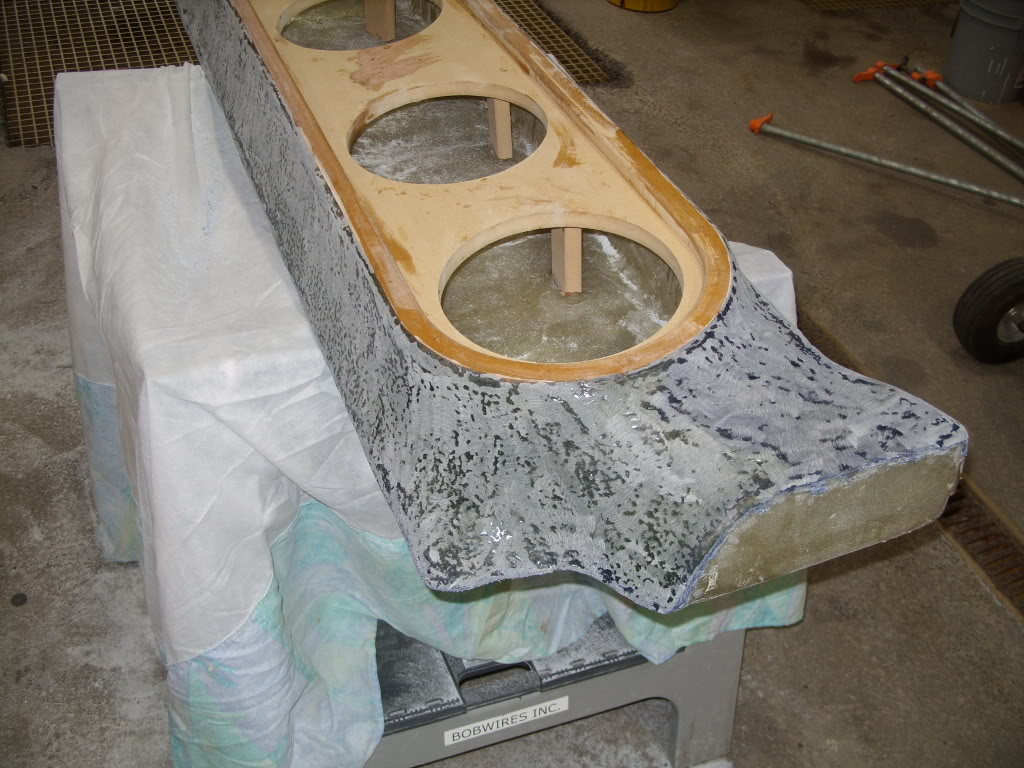
heres a center console I built way back for the middle row of a dodge durango.

morekerfs5.jpg

homemadeduraglass1.jpg

done2.jpg

done.jpg
 
interesting thread--to the OP who apparently builds with fiberglass, how much would you estimate something like a 212 cost per box?

not a clue at this point - if I had a 2 part mold that was a good design it would probably take all day to prep the mold, gelcoat it, lay the glass. then another day to pop it out clean it up and sand it down with filler, and reinforce it. then a little bit to wrap it and load the drivers and put on a grill. so probably 3 days to make, conservatively. if you paint the cabinet, like I plan to, a bit longer. so realistically my cabs will be spendy, but sweet. with my labor (straight time) and materials for a 2 12 it would be getting up near 2000. all the little things that would make the process faster in terms of the glass would also make it less strong/rigid.

If I was making 5 at a time, I'm sure I could crank out more for less $, but that's not happening any time soon... that is unless someone wants to commission one...
 
Zac - in your thread you mentioned divynicell - have you seen it before? because it's not necessarily a flat sheet like the EPS you used. it's available with a scored grid so it will bend corners to a certain extent. my concept has curved corners ever where, and like you said a slight radius to the sides and back. I will use a 2 part mold, and it will have a foam core. the foam is much heavier than the EPS, as you pointed out in your thread, but I won't be using as much. plus I guess I'm going for an interesting look, and quality of sound primarily - at least weight is not the main focus on mine. I've done lots of research on this stuff before (the strength, stiffness #'s, etc.) doing car boxes and boats.

Yes I've seen the scored Divinycell. Many core materials come in a variety of scored configurations. You want this for things like boat hulls where you have a large curved surface. I used techniques more similar to aircraft or surfboard building where light weight and stiffness are priority number one. Having the scored core helps improve peel strength because you get resin down in the scores. This also adds quite a bit of weight. This is why it works for boats where you need the extra durability and can afford the extra weight. Not so much in a homebuilt airplane.

but you have lots of good info consolidated in your thread. it's an excellent resource!

Don't hesitate to PM if you have any quesetions or want to discuss something in greater detail. I'm a real geek for this stuff. ;)

another thought just occured to me - I have done projects with kerf'd wood to achieve a bend then reinforced it with glass. I bet I could score the EPS and get the same effect as the boat foam core! I'm curious now...

I've done some experiments with XPS (not EPS; the white beadboard stuff), and kerfing. You can layup glass on one side of the foam board, then kerf the foam where you want to fold corners. You then form your shape and glass the inside; thus forming a sandwich composite.

This is nice because it allows you to use a molding table to get a nice finish on your outer layer of glass and you can easily implement vacuum bagging or at least apply pressure to get a low resin content and a nice light layup. Doing your kerf cuts with a hot-wire makes things MUCH easier and the wire won't cut through the glass, but goes through the foam like butter. Also, you can use a template to easily guide your cuts.
 
In a composite, the resin is primarilly for consolidtion of the fibers, and for environmental protection of the fibers.

As such, if Polyester (being much cheaper) will provide the impact and handling resistance that your require, I'd use it. It's also a bit safer to handle, uncured.

For glass, I'd avoid chopped mat, as you will need much more resin to hold everything together. I'd use a several layers of 90° weave, rotating each layer 45°.

How are you going to do your lay-up? Wet? Vacuum? Are you going to craft the full cabinet in one (or two) pieces? Are you going to lay each side and then attach them together?
 
As such, if Polyester (being much cheaper) will provide the impact and handling resistance that your require, I'd use it. It's also a bit safer to handle, uncured.

Polyester resin is the cheapest resin available in the marine industry and offers the poorest adhesion, has the highest water absorption, highest shrinkage, and high VOC's.

If the OP plans on using XPS (or even EPS) core material then polyester resin is out. It will melt the foam.

IME, epoxy is safer. It doesn't have any of the fumes that you get with curing polyester. Polyester has a high VOC content. It only hardens as the solvents in it evaporate out. That's what the MEPK hardener does. Epoxy is 100% solids. There is nothing to evaporate out, no VOCs. Some epoxy hardeners can be a little nasty, but most (west systems, system 3, etc.) are very safe.

Another consideration is the mechanical properties of the two resins. Epoxy will typically result in a much stronger, stiffer, and more durable composite. Thus you can use less and result in a lighter composite. Epoxy molecules form cross linked bonds. It is almost as if the entire piece of epoxy composite is one large molecule. You don't get this type of bonding with polyester.

Consider that any critical composite aerospace parts, racecar parts, or high end boat parts are built with epoxy, not polyester. It is for the reasons listed.

Polyester is cheaper. It is also a bit easier to process because you can control cure rates with MEEK catalyst, so you have more control over your working time when doing a layup. Epoxy requires choosing the right hardener and paying close attention to pot temperature and time and room temperature and wet out time. Epoxy can also exhibit an "amine blush", which can be problematic. This is controllable though by using the right epoxies and the right conditions.


Pros and Cons ya know? :hmm:
 
For glass, I'd avoid chopped mat, as you will need much more resin to hold everything together. I'd use a several layers of 90° weave, rotating each layer 45°.

A big +1 to that. Chopped mat is for building heavy things.

I used 2-3 layers per side of 8oz 7781 glass for my 23lb ZacLite 210. With a .75"-1" core thickness it is very strong. It easily handles me standing on it.

If you have any tight or compound curves or radii, you might want to chose a satin weave instead of a 90o​ plain weave. It will be a little harder to wet out, but MUCH easier to conform to the curves/radii. Any differences in strength or stiffness will be negligible.
 
not a clue at this point - if I had a 2 part mold that was a good design it would probably take all day to prep the mold, gelcoat it, lay the glass. then another day to pop it out clean it up and sand it down with filler, and reinforce it. then a little bit to wrap it and load the drivers and put on a grill. so probably 3 days to make, conservatively. if you paint the cabinet, like I plan to, a bit longer. so realistically my cabs will be spendy, but sweet. with my labor (straight time) and materials for a 2 12 it would be getting up near 2000. all the little things that would make the process faster in terms of the glass would also make it less strong/rigid.

If I was making 5 at a time, I'm sure I could crank out more for less $, but that's not happening any time soon... that is unless someone wants to commission one...
how much would it cost once the mold was already made?
 

Latest posts