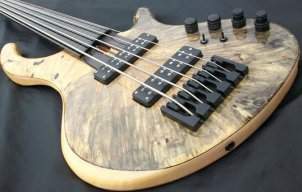
Well, to begin, this is a build thread all about this tutorial.
http://www.talkbass.com/forum/showthread.php?t=494551
I have actually glued it all up and started shaping everything, Im currently doing aluminum inlay on the board, the neck is a bolton so Ill be able to stain it black to give it some color.
The whole point of this is to 'proove' to everyone here as well as furniture builders that we do not have to clear cut a third of the island of Madagscar, a quarter of the Amazon, and the Congo jungle to build our instruments. To sum it up, yes wood is a big factor in the looks of a bass, but time spent and techniques is just as big if you ask me. Walnut, Ash, Maple, Redwood.... there are so many woods available locally that are gorgeous and inexpensive. I don't think anything on this planet makes me go mad as much as walking into a house with Mahogany floors. Anyways, enough bitching from me today. Here's the tutorial.
I take a walk in the forest everynow and then, especially after a big summer storm. A few years ago I found a 59 year old Ash that had been destroyed by carpenter ants (or taken over) also a Maple tree that had no bark... a fallen walnut tree. The first thing I do is identify the tree, there are numerous books on tree ID at your local library. Here is a piece of crotch/spalted/flamed Maple I found after a storm, a big branch had fallen off and I cut the base (crotch) and tugged it out with an ATV.
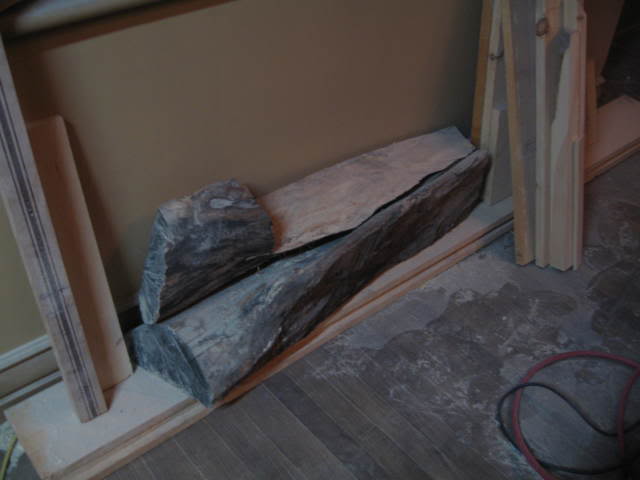
As soon as it was in my yard, I cut into 2 pieces. The most important thing to do when cutting wood is to get rid of the heart, since wood dries from the outside in, its important to bore out the heart or to rip the log right in half. I noticed the spalt and the rippling on this particular piece the minute I saw it.
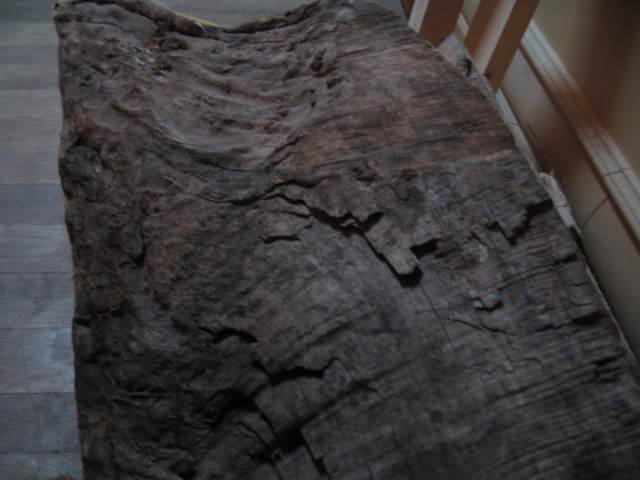
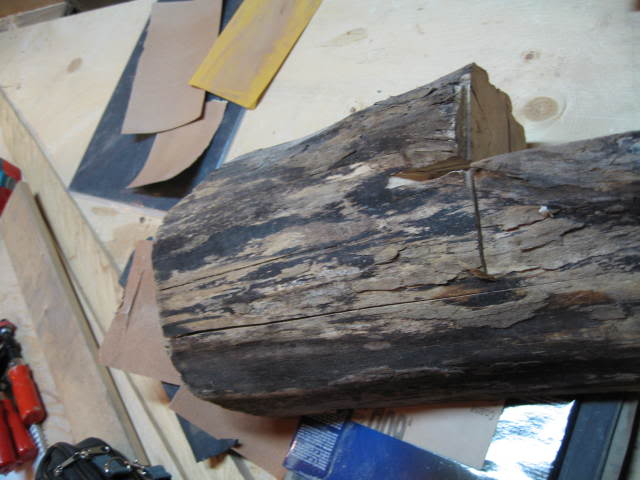
Wood is basically millions of microscopic 'straws' in which water and minerals make its way to the branches. On most North American trees, the darker lines in the wood are a 'rush of growth' in the springtime, thats why Ash, for example, gives us problems while sanding, the 'spring rings' are softer since they grow when the tree wakes up in March. The lighter colored wood is dense and grows slowly throughout June to November (this is based on my knowledge of Quebec and Ontario trees) so... when you cut a tree, its important to take the heart out and seal the ends, as well as taking off all the bark, this is so that the wood can evacuate its water through the sides and not by the ends, where it would be easiest, so you gotta take the bark off so it can do just that, and seal the ends otherwise your pieces might crack and split at the ends due to uneven drying. Heart out, bark off and ends sealed you must store the wood in an area not too different from the forest so to not 'shock' it but its important to keep it out of the rain and the elements, a big tarp does the trick. Keep the pieces at least 2 feet off the ground and do NOT put them right on the grass, unless you want spalt...
I bought this essential tool for drying wood.
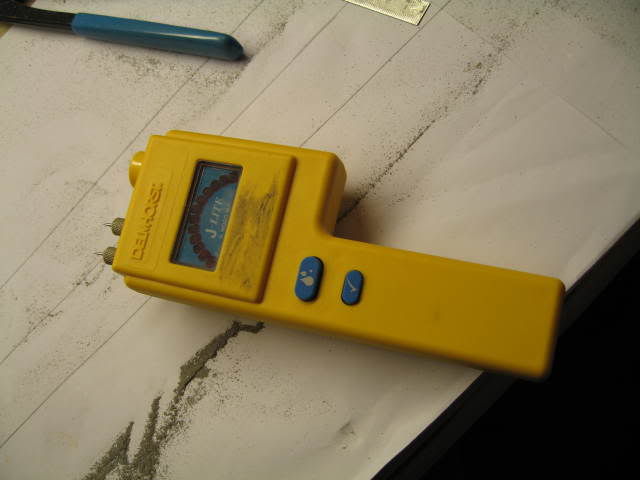
They are available at a few places and unfortunately a good one is pricey. You will find the wood to be at about 25-30% MC (moisture content) the point is to take it down to at least 10%. At one point I had stored a bunch of wood in that little wasted area under the stairs in our house. I put a dehumidifier in there running 24/7 along with a rotating fan.The temperature was about 40degrees celcius and the RH was at 40% at all times, it would only take about 2 weeks of this for the wood to be bone dry, some Walnut cracked, the Ash was rock solid, it all depends on the species. I would then cut these big chunks into their final sizes, either body blanks or tops, sticker them and clamp them so they end their drying as straight as can be in my shop. At this point I have so much of this stuff in my shop, its all at 6% after all these years.
Here is an interesting read on the subject
http://www.talkbass.com/forum/showthread.php?t=494551
I could talk about this for hours, there are so many different techniques to drying wood, steam, solar, etc.. I thought Id share my quick and inexpensive method. My 'forest' bass will end up costing me about 12$ of gas... and I can't wait to show you pics of it. I will answer all questions to the best of my knowledge, and don't forget, cut dead but standing trees as much as possible, and please remember that doing this can be highly illegal and could result in costly fines if you get caught.
http://www.talkbass.com/forum/showthread.php?t=494551
I have actually glued it all up and started shaping everything, Im currently doing aluminum inlay on the board, the neck is a bolton so Ill be able to stain it black to give it some color.
The whole point of this is to 'proove' to everyone here as well as furniture builders that we do not have to clear cut a third of the island of Madagscar, a quarter of the Amazon, and the Congo jungle to build our instruments. To sum it up, yes wood is a big factor in the looks of a bass, but time spent and techniques is just as big if you ask me. Walnut, Ash, Maple, Redwood.... there are so many woods available locally that are gorgeous and inexpensive. I don't think anything on this planet makes me go mad as much as walking into a house with Mahogany floors. Anyways, enough bitching from me today. Here's the tutorial.
I take a walk in the forest everynow and then, especially after a big summer storm. A few years ago I found a 59 year old Ash that had been destroyed by carpenter ants (or taken over) also a Maple tree that had no bark... a fallen walnut tree. The first thing I do is identify the tree, there are numerous books on tree ID at your local library. Here is a piece of crotch/spalted/flamed Maple I found after a storm, a big branch had fallen off and I cut the base (crotch) and tugged it out with an ATV.
As soon as it was in my yard, I cut into 2 pieces. The most important thing to do when cutting wood is to get rid of the heart, since wood dries from the outside in, its important to bore out the heart or to rip the log right in half. I noticed the spalt and the rippling on this particular piece the minute I saw it.
Wood is basically millions of microscopic 'straws' in which water and minerals make its way to the branches. On most North American trees, the darker lines in the wood are a 'rush of growth' in the springtime, thats why Ash, for example, gives us problems while sanding, the 'spring rings' are softer since they grow when the tree wakes up in March. The lighter colored wood is dense and grows slowly throughout June to November (this is based on my knowledge of Quebec and Ontario trees) so... when you cut a tree, its important to take the heart out and seal the ends, as well as taking off all the bark, this is so that the wood can evacuate its water through the sides and not by the ends, where it would be easiest, so you gotta take the bark off so it can do just that, and seal the ends otherwise your pieces might crack and split at the ends due to uneven drying. Heart out, bark off and ends sealed you must store the wood in an area not too different from the forest so to not 'shock' it but its important to keep it out of the rain and the elements, a big tarp does the trick. Keep the pieces at least 2 feet off the ground and do NOT put them right on the grass, unless you want spalt...
I bought this essential tool for drying wood.
They are available at a few places and unfortunately a good one is pricey. You will find the wood to be at about 25-30% MC (moisture content) the point is to take it down to at least 10%. At one point I had stored a bunch of wood in that little wasted area under the stairs in our house. I put a dehumidifier in there running 24/7 along with a rotating fan.The temperature was about 40degrees celcius and the RH was at 40% at all times, it would only take about 2 weeks of this for the wood to be bone dry, some Walnut cracked, the Ash was rock solid, it all depends on the species. I would then cut these big chunks into their final sizes, either body blanks or tops, sticker them and clamp them so they end their drying as straight as can be in my shop. At this point I have so much of this stuff in my shop, its all at 6% after all these years.
Here is an interesting read on the subject
http://www.talkbass.com/forum/showthread.php?t=494551
I could talk about this for hours, there are so many different techniques to drying wood, steam, solar, etc.. I thought Id share my quick and inexpensive method. My 'forest' bass will end up costing me about 12$ of gas... and I can't wait to show you pics of it. I will answer all questions to the best of my knowledge, and don't forget, cut dead but standing trees as much as possible, and please remember that doing this can be highly illegal and could result in costly fines if you get caught.