I thought I'd start a thread here specifically about Rocklite, the new synthetic alternative to ebony for fingerboards. I've started working with it now on some necks for clients (other Luthiers). I'll share my observations as I go, and encourage any of you who try it to join in. Tell us how it works or doesn't work for you.
First, some background about ebony and the synthetics:
There is a revolution taking place in the world of ebony fingerboards. Real ebony, particularly African ebony, is getting very scarce, very expensive, and highly regulated. There are many sub-species of ebony, but the hard, dark black species are often grouped together as "African ebony". Included are Gabon ebony, Madagascar ebony, West African ebony, and others.
Good quality African ebony bass fingerboards are getting difficult to find, and are often costing $100 or more. They are highly regulated by CITES. And ebony boards frequently have serious problems with cracking and warping. I gave up on using African ebony on my basses about ten years ago. Too expensive, too many problems.
Macassar ebony is a somewhat different wood, not part of the African Ebony group. It's not pure black, and usually has some brown streaks. Compared to African ebony, Macassar ebony is a bit softer, isn't as brittle, machines easier, and has less problem with cracking. There's still a reasonable supply of it, and it's not too expensive. I've been using Macassar ebony fingerboards on all of my basses for about 12 years. They cost me about $40 each from LMI.
Those are the two kinds of real ebony: African ebony is pure black, very dense and hard, scarce and expensive. Macassar ebony is black with brown stripes, less dense and hard, still available and reasonably priced.
Synthetic Ebony:
Over the years, several "synthetic ebony" products have been introduced and used for instrument fingerboards. I'll mention Ebanol, Richlite, and now Rocklite. These are three different types of materials, made by different processes. They are not the same thing at all.
Ebanol and Rockwood:
Ebanol has been around since the '70's, I believe, and has been used in some mass production instruments. Fender was using it for a while. Ebanol (and a few similar products) are made by taking a softer, more porous board of some other wood and soaking it under pressure with a black plastic resin. It's a better version of dying the wood, filling the pores with black-dyed resin. It makes it black and hardens it somewhat. It's generally regarded as a cheap substitute for ebony, although some people like it for what it is. It tends to look and feel like, well, a block of black plastic. On fretless basses, Ebanol fingerboards have a similar feel and sound to epoxy coated fingerboards.
As a side note, Rockwood is a similar product to Ebanol, made about the same way. Rockwood is available in many rainbow colors, and is commonly sold in smaller blocks for making knife handles, pens, etc. It's made by saturating soft wood laminates with clear or tinted hard resins. Like Ebanol, it machines and feels like a block of plastic. It has a high content of plastic resin, usually a polyester. It's tough to saw, gumming up blades and smoking.
Richlite:
Richlite has been around for about 20 years. It's kind of a derivative of Bakelite in how it's made. Many thin layers of wood paper are saturated with black resin and stacked up and cured under high pressure. It's more like a hard black cardboard.
In the world of industrial plastics, there's a similar product called Garolite. It's tough and black and looks good for flat plates. It's commonly used to make insulator blocks in electrical equipment, and insulating parts in machines. I use 1/16" black Garolite sheet as the backing when I make wood veneer pickguards.
As far as I can tell, Richlite is a similar material to Garolite. I've worked with smaller pieces of Richlite, but I've never used it for a fingerboard. Like Garolite, it's shiny and black as a block or a sheet. But, it doesn't look as good when you carve it into contours, such as a radiused fingerboard. It gets greyish, and you can see some ghost lines of the layers. It can be re-coated with polyester resin or epoxy to make it shiny black again. Then it's about like Ebanol. It's strong and hard, but it's not going to fool you for ebony. It has a synthetic look. Pretty nasty to saw and machine.
Rocklite:
Rocklite is a relatively new synthetic ebony that's come on to the market. It's made in England, and is now being imported by LMI. Right now, they are the only source of it here in the US. It appears that Rocklite is a much more sophisticated product than Richlite or Ebanol. Their goal is to closely match the properties of real ebony.
From what I understand, Rocklite is made by grinding up wood into long thin splinters, which are then packed into a mold in a linear orientation, saturated with black resin, and cured under high pressure. The process is more like MDF, but using long oriented splinters, rather sawdust. The result is a closer replication of the material structure of real ebony. And the density, hardness, etc. are all really close. It has more wood and less resin than Ebanol or Richlite. It should behave more like wood, particularly in gluing and in temperature expansion. If true, those are big advantages over Ebanol and Richlite.
I have several Rocklite fingerboard blanks here in my shop right now, which are going on custom necks for two of my Luthier clients. I'll be gluing, radiusing, and slotting them over the next few days.
Holding these bare boards here in my hands, I can tell you that Rocklite is very, very close to real ebony in color, weight, hardness, and overall look and feel. It's like a flawless piece of Macassar ebony, but pure black with no brown stripes. It has a fairly realistic grain and texture, but no growth rings.
For reference, the Rocklite 5-string size bass fingerboard is currently $46 from LMI. That's about equal in price to Macassar ebony, and about half the price of top grade African ebony.
So here's a Rocklite fingerboard on a guitar neck blank for Mike Lipe.
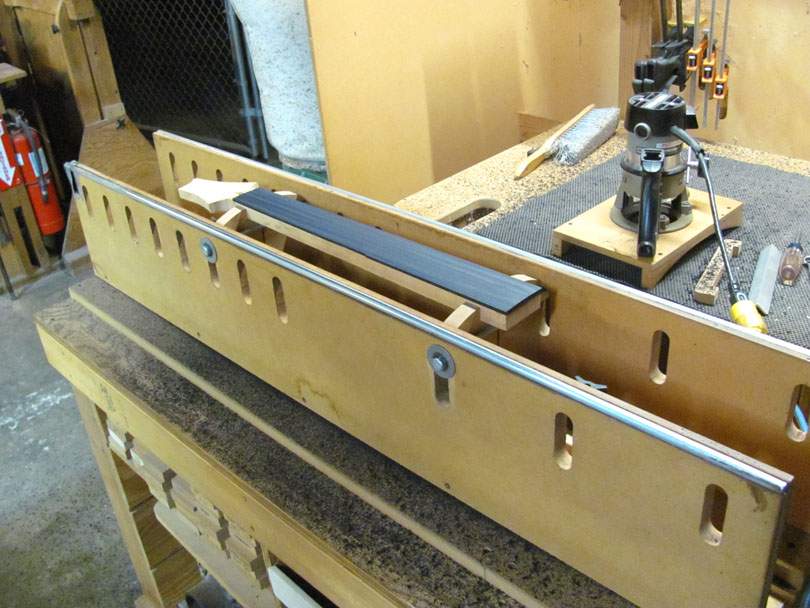
The Rocklite blank came through sanded fairly rough, like 100 grit. It appears to be a medium density fine-grained dry wood, like birch or alder. But all black. It's not packed full of resin or wax, like cocobolo. It looks like wood.
I was originally thinking that I would glue it on with West Systems epoxy, like I do with all the Macassar ebony fingerboards on my Scroll Basses. But Mike usually prefers that I use LMI's Yellow Instrument Makers Glue on his necks. So, I went ahead and used the LMI glue on this one. There doesn't seem to be any problem. The glue does sink into the surface well and grab hold.
Here's a closeup after radiusing the surface in my router fixture. My router process cuts the radius as about 10 flat facets. The lighter lines are the edges of those facets. You can see that the Rocklite actually has grain. It's fine and very uniform, running along the length of the fingerboard. About like ebony's grain, although much more perfect. That's down in the wood, not caused by the router.

And here it is after cutting the fret slots and sanding the surface. No problems at all sawing the slots. No binding or smoking like a waxy wood. It feels a little softer to cut than Macassar ebony, and much softer than African ebony. This is sanded with 150 and 220 to round off the facet ridges. Again, notice the grain.
From here, it goes to Mike. He'll put in the inlays and fine sand it to 600 or 800. I'm not sure what he plans to do for coating on this one.

Coming up, I'm putting a Rocklite fingerboard on a bass neck for Jeremy (aka FreekMagnet on here). On that one, I'll be radiusing and slotting it, then taking it all the way up to a full polish, like I do with Macassar ebony. We'll see how that works out.
So far, I'm impressed. This may be the answer to the ebony problem. Not a cheap substitute, but an actual better replacement, that we may prefer over real ebony.
Within a few years, Rocklite (and maybe some competitors) may just replace all ebony on instrument fingerboards. And, as they keep developing this technology, they will work out formulas for other properties and colors. I suspect that pretty soon, it'll be available with realistic looking striping for those who want it.
And then, maybe they will come up with a good synthetic Brazilian rosewood. We're looking at the future of exotic woods in our business. Like it or not.
First, some background about ebony and the synthetics:
There is a revolution taking place in the world of ebony fingerboards. Real ebony, particularly African ebony, is getting very scarce, very expensive, and highly regulated. There are many sub-species of ebony, but the hard, dark black species are often grouped together as "African ebony". Included are Gabon ebony, Madagascar ebony, West African ebony, and others.
Good quality African ebony bass fingerboards are getting difficult to find, and are often costing $100 or more. They are highly regulated by CITES. And ebony boards frequently have serious problems with cracking and warping. I gave up on using African ebony on my basses about ten years ago. Too expensive, too many problems.
Macassar ebony is a somewhat different wood, not part of the African Ebony group. It's not pure black, and usually has some brown streaks. Compared to African ebony, Macassar ebony is a bit softer, isn't as brittle, machines easier, and has less problem with cracking. There's still a reasonable supply of it, and it's not too expensive. I've been using Macassar ebony fingerboards on all of my basses for about 12 years. They cost me about $40 each from LMI.
Those are the two kinds of real ebony: African ebony is pure black, very dense and hard, scarce and expensive. Macassar ebony is black with brown stripes, less dense and hard, still available and reasonably priced.
Synthetic Ebony:
Over the years, several "synthetic ebony" products have been introduced and used for instrument fingerboards. I'll mention Ebanol, Richlite, and now Rocklite. These are three different types of materials, made by different processes. They are not the same thing at all.
Ebanol and Rockwood:
Ebanol has been around since the '70's, I believe, and has been used in some mass production instruments. Fender was using it for a while. Ebanol (and a few similar products) are made by taking a softer, more porous board of some other wood and soaking it under pressure with a black plastic resin. It's a better version of dying the wood, filling the pores with black-dyed resin. It makes it black and hardens it somewhat. It's generally regarded as a cheap substitute for ebony, although some people like it for what it is. It tends to look and feel like, well, a block of black plastic. On fretless basses, Ebanol fingerboards have a similar feel and sound to epoxy coated fingerboards.
As a side note, Rockwood is a similar product to Ebanol, made about the same way. Rockwood is available in many rainbow colors, and is commonly sold in smaller blocks for making knife handles, pens, etc. It's made by saturating soft wood laminates with clear or tinted hard resins. Like Ebanol, it machines and feels like a block of plastic. It has a high content of plastic resin, usually a polyester. It's tough to saw, gumming up blades and smoking.
Richlite:
Richlite has been around for about 20 years. It's kind of a derivative of Bakelite in how it's made. Many thin layers of wood paper are saturated with black resin and stacked up and cured under high pressure. It's more like a hard black cardboard.
In the world of industrial plastics, there's a similar product called Garolite. It's tough and black and looks good for flat plates. It's commonly used to make insulator blocks in electrical equipment, and insulating parts in machines. I use 1/16" black Garolite sheet as the backing when I make wood veneer pickguards.
As far as I can tell, Richlite is a similar material to Garolite. I've worked with smaller pieces of Richlite, but I've never used it for a fingerboard. Like Garolite, it's shiny and black as a block or a sheet. But, it doesn't look as good when you carve it into contours, such as a radiused fingerboard. It gets greyish, and you can see some ghost lines of the layers. It can be re-coated with polyester resin or epoxy to make it shiny black again. Then it's about like Ebanol. It's strong and hard, but it's not going to fool you for ebony. It has a synthetic look. Pretty nasty to saw and machine.
Rocklite:
Rocklite is a relatively new synthetic ebony that's come on to the market. It's made in England, and is now being imported by LMI. Right now, they are the only source of it here in the US. It appears that Rocklite is a much more sophisticated product than Richlite or Ebanol. Their goal is to closely match the properties of real ebony.
From what I understand, Rocklite is made by grinding up wood into long thin splinters, which are then packed into a mold in a linear orientation, saturated with black resin, and cured under high pressure. The process is more like MDF, but using long oriented splinters, rather sawdust. The result is a closer replication of the material structure of real ebony. And the density, hardness, etc. are all really close. It has more wood and less resin than Ebanol or Richlite. It should behave more like wood, particularly in gluing and in temperature expansion. If true, those are big advantages over Ebanol and Richlite.
I have several Rocklite fingerboard blanks here in my shop right now, which are going on custom necks for two of my Luthier clients. I'll be gluing, radiusing, and slotting them over the next few days.
Holding these bare boards here in my hands, I can tell you that Rocklite is very, very close to real ebony in color, weight, hardness, and overall look and feel. It's like a flawless piece of Macassar ebony, but pure black with no brown stripes. It has a fairly realistic grain and texture, but no growth rings.
For reference, the Rocklite 5-string size bass fingerboard is currently $46 from LMI. That's about equal in price to Macassar ebony, and about half the price of top grade African ebony.
So here's a Rocklite fingerboard on a guitar neck blank for Mike Lipe.
The Rocklite blank came through sanded fairly rough, like 100 grit. It appears to be a medium density fine-grained dry wood, like birch or alder. But all black. It's not packed full of resin or wax, like cocobolo. It looks like wood.
I was originally thinking that I would glue it on with West Systems epoxy, like I do with all the Macassar ebony fingerboards on my Scroll Basses. But Mike usually prefers that I use LMI's Yellow Instrument Makers Glue on his necks. So, I went ahead and used the LMI glue on this one. There doesn't seem to be any problem. The glue does sink into the surface well and grab hold.
Here's a closeup after radiusing the surface in my router fixture. My router process cuts the radius as about 10 flat facets. The lighter lines are the edges of those facets. You can see that the Rocklite actually has grain. It's fine and very uniform, running along the length of the fingerboard. About like ebony's grain, although much more perfect. That's down in the wood, not caused by the router.
And here it is after cutting the fret slots and sanding the surface. No problems at all sawing the slots. No binding or smoking like a waxy wood. It feels a little softer to cut than Macassar ebony, and much softer than African ebony. This is sanded with 150 and 220 to round off the facet ridges. Again, notice the grain.
From here, it goes to Mike. He'll put in the inlays and fine sand it to 600 or 800. I'm not sure what he plans to do for coating on this one.
Coming up, I'm putting a Rocklite fingerboard on a bass neck for Jeremy (aka FreekMagnet on here). On that one, I'll be radiusing and slotting it, then taking it all the way up to a full polish, like I do with Macassar ebony. We'll see how that works out.
So far, I'm impressed. This may be the answer to the ebony problem. Not a cheap substitute, but an actual better replacement, that we may prefer over real ebony.
Within a few years, Rocklite (and maybe some competitors) may just replace all ebony on instrument fingerboards. And, as they keep developing this technology, they will work out formulas for other properties and colors. I suspect that pretty soon, it'll be available with realistic looking striping for those who want it.
And then, maybe they will come up with a good synthetic Brazilian rosewood. We're looking at the future of exotic woods in our business. Like it or not.
Last edited:


 I was planning to order a rocklite but hadn't pulled the trigger yet. Curious to see this thread play out...