• TalkBass has been independent since 1998. Add your voice.
    Create a free account to reply to discussions, view embedded media, and browse with fewer display ads.
    Join freeLog in
    Want zero display ads or expanded classifieds tools? Compare plans.

Picked up a jmj and wondering about the AweSome tone control mod

the nasty rumor

Commercial User
Nov 9, 2008
30
18
PDX
philajjarapu.bandcamp.com
Disclosures
no current endorsements, but I do make my living as a music teacher.
[This invalid link has been removed]

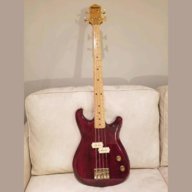
I was really impressed with every jmj I've come across in stores for a while now, and I lucked into one in a pawn shop and couldn't resist, and I didn't have a solid body, so what's a bassist to do?

I took it to rehearsal yesterday (yeah, we're being safe and masked up) and it killed.

This mod seemed interesting in that it's easily reversible. Has anyone done it? I emailed them and they have no audio or sound clips.

From that link:
"How The T2P-Switch Works
The T2P-Switch contains two mini-toggle switches (from rear-to-front): (SW5, SW3)

These switches are used to control the Bridge (coil-1) pickup, and the Middle (coil-2) pickup coils.

SW5 is an ON-ON switch used to put the two pickup coils in either a Parallel connection or Series Connection. Down is Parallel, and Up is Series.

SW3 is an ON-ON switch used to change the phasing of the two pickup coils (i.e., coil-1 and coil-2). Down puts the coils in normal-phase and Up position puts the pickup in reverse-phase."

I'd love to hear anyone's thoughts on this or any other reversible mods you've done or seen.

I'm not interested in routing. I might be interested in the nordstrand or aero replacement pickups, or any other drop in pickups.

Thinking about a tort guard, anyone have opinions about it?
 
  • Like
Reactions: bassrique
Given so many basses with a P-style pickup, you would think that if useful this mod would be popular. If audio samples were available, I would be curious to listen for sure.

One thing to keep in mind...

A Mustang pickup is VERY different from a P-Bass pickup in an important way:

P pickups have their two coil halves wound in opposite directions, so connecting them in series “head to tail” [+ -] [+ -] makes them hum-cancelling. The magnets in each half are installed in opposite polarity (all north in one half, and all south in the other). That makes the pickup hum-cancelling, and the output for all four strings are in phase with each other.

Mustang pickup halves are all identical. All are wound the same direction. They are connected “tail to tail” (+ -) (- +) to make them hum-cancelling. ALSO, the magnets in each half are all installed the in the SAME polarity (all south). SO, Mustang pickups are hum-cancelling, but the signal from the E and A strings are OPPOSITE IN PHASE from the D and G strings.

It would be interesting to experiment with a Mustang pickup to see what happens with the mod, but I would not expect the results to sound at all like the same mod to a P-Bass.

One interesting aside... All vintage and modern American and Mexican “Mustang” (not PJ) pickups are made this way. The only exception is the American Performer. The American Performer Mustang pickup halves are opposite-wound with opposite-polarity magnets (made and connected like a P pickup), so the signal outputs for all strings are in phase. It HAD to be this way, or weird things would happen when the Mustang and J pickups were combined!
 
Last edited:
One thing to keep in mind...

A Mustang pickup is VERY different from a P-Bass pickup in an important way:

P pickups have their two coil halves wound in opposite directions, so connecting them in series “head to tail” [+ -] [+ -] makes them hum-cancelling. The magnets in each half are installed in opposite polarity (all north in one half, and all south in the other). That makes the pickup hum-cancelling, and the output for all four strings are in phase with each other.

Mustang pickup halves are all identical. All are wound the same direction. They are connected “tail to tail” (+ -) (- +) to make them hum-cancelling. ALSO, the magnets in each half are all installed the in the SAME polarity (all south). SO, Mustang pickups are hum-cancelling, but the signal from the E and A strings are OPPOSITE IN PHASE from the D and G strings.

It would be interesting to experiment with a Mustang pickup to see what happens with the mod, but I would not expect the results to sound at all like the same mod to a P-Bass.

One interesting aside... All vintage and modern American and Mexican “Mustang” (not PJ) pickups are made this way. The only exception is the American Performer. The American Performer Mustang pickup halves are opposite-wound with opposite-polarity magnets (made and connected like a P pickup), so the signal outputs for all strings are in phase. It HAD to be this way, or weird things would happen when the Mustang and J pickups were combined!

I have emphasized my point of interest about. If I play double stops, octaves or chords across the strings, how does the out of phase manifest in sound?
 
If I play double stops, octaves or chords across the strings, how does the out of phase manifest in sound?

I think there might be some very slight effect, but I doubt you (or anyone else) would be aware of it or recognize it as a problem.

The lower strings are the ones that are technically “reverse polarity”. If you look at the signals from the four strings on an oscilloscope you will see that the initial sharp transients from the E and A strings go negative (pointing down), and the transients form the D and G strings go positive. The note waveforms are also somewhat asymmetrical.

SO, If you listen to the sound from the E and A strings there is a subtle difference in timbre from the D and G strings. It is a characteristic of the Mustangs’ sound and tone character. To me it sounds like the lower strings are slightly “fuller” or “thicker”, and the upper string are slightly brighter and have a bit more “edge”. (I think this is actually a good choice made by Leo and the engineers when they set up the original Mustangs. I think most artists would prefer the lowest notes to sound “bassier” and the high notes to have more detail.)

But the main audible effect will be on the sound of the initial note transients. This will be most audible with sharp, aggressive notes played with a pick and with the tone control all the way up, and not audible at all when playing with fingers and the tone rolled off.

I first “discovered” the Mustang polarity effect back in the eighties, when I was fooling around with my 1974 Mustang. I was noticing that the tone was somehow different on notes played on the D and G strings, regardless of technique or whatever amp and cab I was using. I was concerned that there was a problem with the pickup, like maybe a defect, or a problem with one of the coils.

After I confirmed the polarity difference, I experimented by reversing the polarity of the whole pickup (by reversing the pickup wires). The tone character effect I described above was reversed. The lower strings sounded noticeably thinner, and the upper strings were a bit duller, and maybe a little louder. I would have had to raise the E-A side of the pickup and lower the D-G side to balance the strings.
I definitely preferred the original setup!

I have been able to hear the polarity effect on every Mustang I have played, including my JMJ.

BUT... I have never, ever found it to make any difference in the way I play, or been concerned about it one whit. It’s just the sound of my bass.

AND... consider that a BUNCH of talented and discerning artists and recording engineers (including JMJ) have performed and recorded with Mustangs on thousands of projects since the ‘60s. If there was a problem I think SOMEONE would have addressed it by now (or at LEAST mentioned it on some forum...).

I have certainly never paused while listening to a bass line, thinking “damn, what was Justin THINKING, with that polarity mismatch effect. Ruins the whole song!”

And neither have you!

Bye for now from the Land of the OCD...
 
If you listen to the sound from the E and A strings there is a subtle difference in timbre from the D and G strings. It is a characteristic of the Mustangs’ sound and tone character.

Speaking of the inherent character and tone of a Mustang Bass...

ALL vintage and modern American-made and Mexican-made Mustangs (except the PJs and the American Performer Mustang) have the out-of-phase pickups.

But some (if not all) of the Japanese reissues (MIJ and CIJ) have phase-correct pickups. Their pickup halves are opposite-wound and with opposite magnet polarity, like a P-Bass. (Those meticulous Japanese engineers...) I have no idea about the various Squier/Indonesian Mustangs.

I wonder if that accounts for some of the difference in tone character many folks hear between the vintage Mustangs and the Japanese reissues?
 
Last edited:
  • Like
Reactions: bassrique
One thing to keep in mind...

A Mustang pickup is VERY different from a P-Bass pickup in an important way:

P pickups have their two coil halves wound in opposite directions, so connecting them in series “head to tail” [+ -] [+ -] makes them hum-cancelling. The magnets in each half are installed in opposite polarity (all north in one half, and all south in the other). That makes the pickup hum-cancelling, and the output for all four strings are in phase with each other.

Mustang pickup halves are all identical. All are wound the same direction. They are connected “tail to tail” (+ -) (- +) to make them hum-cancelling. ALSO, the magnets in each half are all installed the in the SAME polarity (all south). SO, Mustang pickups are hum-cancelling, but the signal from the E and A strings are OPPOSITE IN PHASE from the D and G strings.

It would be interesting to experiment with a Mustang pickup to see what happens with the mod, but I would not expect the results to sound at all like the same mod to a P-Bass.

One interesting aside... All vintage and modern American and Mexican “Mustang” (not PJ) pickups are made this way. The only exception is the American Performer. The American Performer Mustang pickup halves are opposite-wound with opposite-polarity magnets (made and connected like a P pickup), so the signal outputs for all strings are in phase. It HAD to be this way, or weird things would happen when the Mustang and J pickups were combined!
Wow I never knew this- it kinda makes sense in that the originals were essentially cheaper student basses, so they were likely trying to standardize and cut costs where they could. I want to experiment on a P using two identical coils now!
 
Wow I never knew this- it kinda makes sense in that the originals were essentially cheaper student basses, so they were likely trying to standardize and cut costs where they could. I want to experiment on a P using two identical coils now!

I've heard that Leo Fender was notorious for being "frugal". When he was developing or reworking an instrument he would determine what specifications were necessary for a part or circuit, and then find the lowest-cost supplier. As long as the design worked well and was reliable, he would go with the most cost-effective option.

It would certainly be easier and cheaper (err, more cost-efficient...) to have a big box of identical pickup coils than to have to order and keep track of two different types.

It WOULD be cool to see what a P-Bass would sound like with two identical south-magnet pickup halves wired tail-to-tail [+ -] [- +].

And also compare the modified version to the JMJ.

Sound files of "normal P" vs "modified-P" please, if you do it!
 
  • Like
Reactions: sunbeast
I've heard that Leo Fender was notorious for being "frugal". When he was developing or reworking an instrument he would determine what specifications were necessary for a part or circuit, and then find the lowest-cost supplier. As long as the design worked well and was reliable, he would go with the most cost-effective option.

It would certainly be easier and cheaper (err, more cost-efficient...) to have a big box of identical pickup coils than to have to order and keep track of two different types.

It WOULD be cool to see what a P-Bass would sound like with two identical south-magnet pickup halves wired tail-to-tail [+ -] [- +].

And also compare the modified version to the JMJ.

Sound files of "normal P" vs "modified-P" please, if you do it!
I do have two basses with standard-wind Lindy Fralin P pickups right now, so it is a possibility! I could also sort of approximate it by flipping one coil of a P pickup and reversing its phase, though this would be less ideal as most P pickups have raised poles on only one side.
 
I do have two basses with standard-wind Lindy Fralin P pickups right now, so it is a possibility! I could also sort of approximate it by flipping one coil of a P pickup and reversing its phase, though this would be less ideal as most P pickups have raised poles on only one side.

Go ahead, DO IT!! You KNOW you want to.......

Stitch Devils.jpg
 
I've heard that Leo Fender was notorious for being "frugal". When he was developing or reworking an instrument he would determine what specifications were necessary for a part or circuit, and then find the lowest-cost supplier. As long as the design worked well and was reliable, he would go with the most cost-effective option. - It would certainly be easier and cheaper (err, more cost-efficient...) to have a big box of identical pickup coils than to have to order and keep track of two different types. - It WOULD be cool to see what a P-Bass would sound like with two identical south-magnet pickup halves wired tail-to-tail [+ -] [- +]. - And also compare the modified version to the JMJ. - Sound files of "normal P" vs "modified-P" please, if you do it!
~
If a person had two stray sets of genuine P pickups on hand, took the same section of each set, and cobbled together a such a P split pickup, wired how you proposed, the idea could be tested, though I have not done so.

However, I read somewhere [possibly pre-Internet era] that due to the larger footprint of the coils of the P split pickup design, that if this was done, there would be cross-talk from the desired signals being allowed to be out of phase, affecting the A and D string, causing a partial cancellation of their output, and a change of tone.

Obviously this would be undesirable.

If true, it would go a long way toward explaining why Leo chose the design for the P pickup which he did, and spent the extra money on tooling at the time.

OTOH, by [later] making the coil footprint smaller, such as that of a classic Mustang pickup, it would seem that this problem was avoided, until the birth of the American Performer Mustang provided the other reason to change it to the P design anyway, as you explained earlier.

Also, if we examine the current aftermarket pickups for Jazz basses, multiple makers have managed to squeeze the two coils next to each other inside of that form factor, achieving humbucking operation, one of which calls it a 'linear' humbucker design.

IIRC, the first to do this was DiMarzio, back during the 70s or 80s, and I'm pretty sure that I have one or two of those in a box of parts somewhere, from my era of trying alternate pickups on my Ric 4001, to beat the Ric's ostensibly ubiquitous hum.
~
 
Last edited: