I've found without any doubt that the best knot for metal is the noose, but for what I play, a nice random tangle sounds best.What knots do you use?

TalkBass has been independent since 1998. Add your voice.
Create a free account to reply to discussions, view embedded media, and browse with fewer display ads.
Join free Log in
Want zero display ads or expanded classifieds tools? Compare plans.
I've found without any doubt that the best knot for metal is the noose, but for what I play, a nice random tangle sounds best.What knots do you use?

I’d heard some outright egregious bollocks here on TB over the years, but think this one might just take the biscuit. Totally devoid of any foundation in reality, experience or logic, “best cabs for short scale basses” has all the makings of a classic TalkBass trope.Heard someone mention that 110’s and 210’s are the best cabs for short scale basses, I’m struggling to work out the reason or if there’s any truth to this.

No speaker can gain power or volume as the sound radiates from the cabinet, but the room boundaries and radiation patterns can certainly affect the perception a lot.Perhaps @agedhorse or one of the other MI vets here can confirm whether the bass waves coming from a rear-firing folded-horn cabinet gain power as they radiate further from the cab.
Heard someone mention that 110’s and 210’s are the best cabs for short scale basses, I’m struggling to work out the reason or if there’s any truth to this.
My experience is that 15’s can maybe sound a little boomy, and 410’s sound great with almost anything, but I’ve never thought that a particular speaker size is best for any specific scale length.

Can anybody ell me - what are the best flats for playing metal after 8PM in Milwaukee on a green bass while I’m wearing Nike running shoes?


Perhaps @agedhorse or one of the other MI vets here can confirm whether the bass waves coming from a rear-firing folded-horn cabinet gain power as they radiate further from the cab.
No speaker can gain power or volume as the sound radiates from the cabinet, but the room boundaries and radiation patterns can certainly affect the perception a lot.
Why was it that the common complaint about those rigs was while on stage you would hear just some undefined mud, and would be tempted to turn up the volume, you were killing everybody in the seventh row? The company came up with a powered 2x12 cab to add to the stack for immediate note response, way before the bi-amping craze, but curiously that didn’t catch on.
I’m just going by observations while being in the audience for shows in that time period, those amps were ubiquitous by 1970 and for just a few years later, but it seem like they disappeared overnight, as large scale PA systems improved. That evolution, plus the emergence of the SVT with a mid-range focused sound, led Acoustic to drift away from the concept(issuing more front-firing cabs), and poster boy JPJ moved on to early GK. Jaco kept his, but eventually dabbled with Hartke.
Then there’s that phenomenon of when your neighbor is having an outdoor summertime party, blasting EDM or some other bass heavy music on consumer level stereo equipment (i.e., not proper sound reinforcement), and the low end is throbbing several houses away(your place)to the point of being a nuisance, but people at the party aren’t being knocked down(they may be going deaf, but that’s another story). I understand how the high end information disappears over distance.
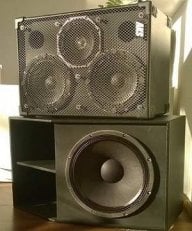
My experience is that 15’s can maybe sound a little boomy, and 410’s sound great with almost anything, but I’ve never thought that a particular speaker size is best for any specific scale length.
No speaker can gain power or volume as the sound radiates from the cabinet, but the room boundaries and radiation patterns can certainly affect the perception a lot.

Part of the perception of muddiness is because the mids are more directional, and with a folded horn the mids are also smeared by multiple reflections within the horn’s folded flair. The farther away you are the more on axis you become compared with standing on stage.
It's absolutely true: the bigger the bass the bigger the speaker.Heard someone mention that 110’s and 210’s are the best cabs for short scale basses, I’m struggling to work out the reason or if there’s any truth to this.
My experience is that 15’s can maybe sound a little boomy, and 410’s sound great with almost anything, but I’ve never thought that a particular speaker size is best for any specific scale length.

LabellaI’d heard some outright egregious bollocks here on TB over the years, but think this one might just take the biscuit. Totally devoid of any foundation in reality, experience or logic, “best cabs for short scale basses” has all the makings of a classic TalkBass trope.
Can anybody tell me - what are the best flats for playing metal after 8PM in Milwaukee on a green bass while I’m wearing Nike running shoes?

Somebody told me in the 00s that 18s are bad for stage use because the sound waves they produce are too long to hear at close distance.
could this almost be explained mathematically? If sound waves dissipate as distance traveled increases, which is the bigger factor for increases in distance of wave traveled relative to energy loss?
Does the frequency/energy of the wave itself play a larger role? Or, rather, does the relative starting power/volume play a bigger role? I’m almost thinking of this as an equation of distance= delta energy of wave* db of input (assuming the same medium)
I’m probably way off but it interests me nonetheless!
Edit: I should consider differences in radiation pattern as well, but I’m thinking of a fixed point of perception without an over abundance of reflection patterns for this. More or less distance only.