• TalkBass has been independent since 1998. Add your voice.
    Create a free account to reply to discussions, view embedded media, and browse with fewer display ads.
    Join freeLog in
    Want zero display ads or expanded classifieds tools? Compare plans.

112 ported cab (Basslite S2012) - review appreciated!

Hello Talkbass!

I am in the planning stage for a (rather simple) 112 cab rated at 100W, using an Eminence Basslite S2012, no other mid/tweeter speakers.

My plan is to build 2 cabs, a "modular 212" 200W rig. Amp is a Quilter Tone Block 200. I will be using a Mesa Boogie Subway+ Bass Preamp, so I will have a HPF filter in my signal chain, which will be set to roughly 45Hz while using the cabs.

These are the main attributes of the cab:
- Net internal volume: 60l / 2.12cf
- 2x 3" ports, 14.2cm / 5.59" long
- tuning: 48Hz
- rated: 100W
- F0: ~68.80Hz
- F3: ~55.80Hz
- Peak: ~1.8dB at 100Hz
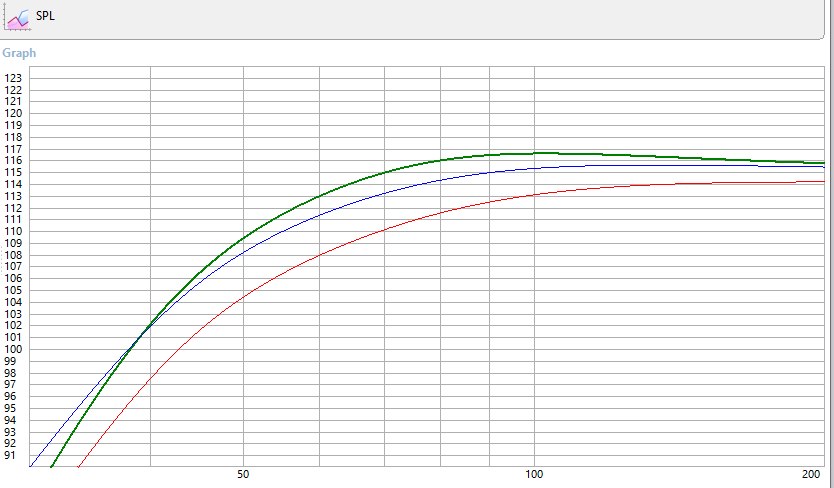
- SPL @100Hz, 100W: ~116.58 dB

I have read some posts by DukeLeJeune where he suggests plugging one or more cab ports to modify the cab tuning as needed. That is an awesome concept and I want to do this with this cab, that's why I will be using 2x 3" ports instead of a single 4" port.

Plugging one port (if I calculated it correctly):
- tuning: ~34Hz
- rated: 100W
- F0: ~86Hz
- F3: ~61.70Hz
- Peak: ~0.85dB at 135Hz
- SPL @100Hz, 100W: ~115.35 dB

Plugging both ports it becomes a sealed cab:
- rated: 80W
- Qtc: ~0.766
- F0: ~123.3Hz
- F3: ~74Hz
- Peak: ~0.4dB at 200Hz
- SPL @100Hz, 100W: ~113.12 dB
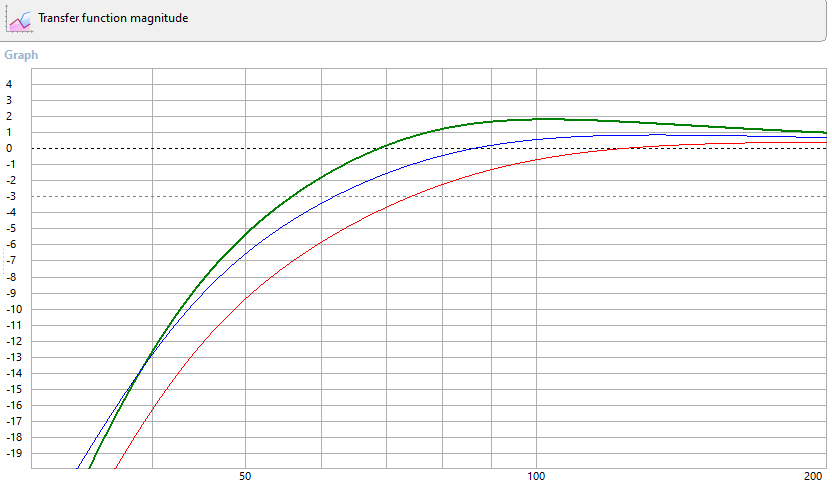
WinISD Transfer Function.png


WinISD SPL.png


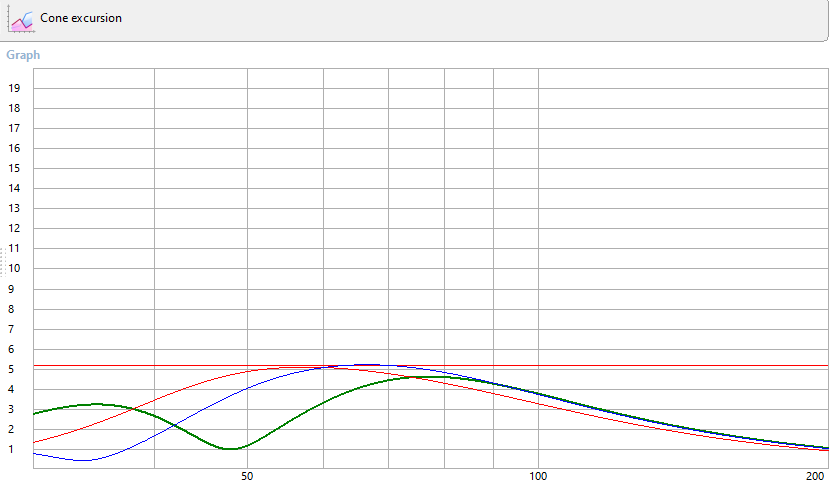
WinISD Cone Excursion.png


I did the modeling in WinISD, however I have read in several TB threads that it is unreliable for cab modeling. Additionaly, this is a first for me: I never designed a cab before, and am not 100% confident everything is correct.

Would some knowledgeable TBer be willing to double check my design? I would really appreciate it.

All feedback is welcome!
 
Last edited:

IF this is reliable, the green tuning will be closer to what most player end up preferring.

Watch out with what happens to displacement with the different tunings, you can get into unexpected trouble if you don't get this sorted out first, and it may disqualify some. With a single 3" port, you will also need to investigate port air velocity.
 
IF this is reliable, the green tuning will be closer to what most player end up preferring.

Watch out with what happens to displacement with the different tunings, you can get into unexpected trouble if you don't get this sorted out first, and it may disqualify some. With a single 3" port, you will also need to investigate port air velocity.

I forgot to attach the air velocity graph, I am sorry:

WinISD Air Velocity.png


I think since the tuning with a single port is so low (34Hz) and I am modeling in WinISD with a HPF (butterworth, order = 4, 43Hz) most of the energy generated by the port is actually wasted, and the wind velocity stays low(ish). This rationale is, obviously, based on intuition, not knowledge.

By the way, is it correct to model the Subway+ Preamp HPF as a 4th order butterworth? I read the user manual and IIRC there are two 2nd order HPFs being combined, but that is actually beyond my capacity to fully understand.

You made me realize I didn't add the volume inside the ports to the net cab volume used in the calculations when the ports are plugged - is that what you meant by "what happens to displacement with the different tunings"?

EDIT: I am thinking that by displacement you meant the same as what WinISD calls "cone excursion"... if that is the case, I did verify that cone excursion wouldn't exceed xmax on the winISD simulation, I think it should be ok...?

EDIT 2: volume per port is ~0.64 liter... differences to the end result exist but are pretty much negligible, probably well within the margin of error for building such a cab in the real world.
 
Last edited:
When you block one port, what happens to the port velocity. It should increase a lot.

It does indeed. I didn't see it before because of the HPF. When I turn off the HPFs from the simulation, this is what WinISD simulates:

WinISD Air Velocity no hpf.png

The air speed basically doubles when 1 port is plugged. But the HPF protects me from this effect:

WinISD Air Velocity with hpf.png


I added the HPF to the model to prevent cone excursion from exceeding xmax. Without the HPF, it looks like this:

WinISD Cone Excursion no hpf.png


And with HPF:

WinISD Cone Excursion with hpf.png


So I didn't really realize this could happen until you warned me, and the HPF "protecting" from this effect is actually a nice unpredicted side effect, a happy coincidence.


PS: it probably is not clear from the conversation, but I really appreciate your feedback @agedhorse ! I have done a lot of lurking here in talkbass prior to joining, and have read A LOT of your posts, learned A LOT from you.
 
  • Like
Reactions: agedhorse
The HPF is essential to the driver surviving such tunings at higher power.

It's threads like this that makes me value just buying what a knowledgeable person develops and get on with playing ;).

While I can appreciate that the op has a project of great interest to him, I have to commend @agedhorse for contributing the way he does.
 
Last edited:
It's threads like this that makes me value just buying what a knowledgeable person develops and get on with playing ;).

I fully understand, and agree with, the spirit of your message.

I am not fooling myself into thinking I can build a cab as good as one that has been engineered by a pro. Nor do I think that I am learning everything there is to know about cab building by engaging in this very simple project. And I certainly can appreciate the effort behind designing and then producing high quality gear in commercial scale - a Subway 115's value (for example) far exceeds its price tag.

I am mostly doing this for my personal satisfaction: I enjoy learning new things, and I have learned a lot so far. Bonus points if the end result is good enough to gig with.


PS: I am not a native english speaker + text communication is iffy. This message is not meant to come across as confrontational or negative in any way. My apologies in advance if it does.
 
I fully understand, and agree with, the spirit of your message.

I am not fooling myself into thinking I can build a cab as good as one that has been engineered by a pro. Nor do I think that I am learning everything there is to know about cab building by engaging in this very simple project. And I certainly can appreciate the effort behind designing and then producing high quality gear in commercial scale - a Subway 115's value (for example) far exceeds its price tag.

I am mostly doing this for my personal satisfaction: I enjoy learning new things, and I have learned a lot so far. Bonus points if the end result is good enough to gig with.


PS: I am not a native english speaker + text communication is iffy. This message is not meant to come across as confrontational or negative in any way. My apologies in advance if it does.

No problem at this end. I commend you for your efforts and wish you the best.
 
  • Like
Reactions: gsneto