• TalkBass has been independent since 1998. Add your voice.
    Create a free account to reply to discussions, view embedded media, and browse with fewer display ads.
    Join freeLog in
    Want zero display ads or expanded classifieds tools? Compare plans.

Double Bass 1940 Kay Fingerboard

I've often wondered about black locust. Have you ever had problems with grain straightness, or volatility/unpredictability?

The piece I had was air dried for 15+ years. I had no problems machining it or with it being unstable. I though it was ash or hickory in the rough but found differently once I cut into it. I will defer to anyone that has had first had experience with kiln dried.

The bark and foliage is toxic to livestock and it has a bad rep because of that. I will wear a good respirator the next time I work it.
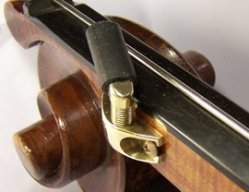
 
I have made BG fingerboards out of Dymondwood from Rutland Plywood. It is a composite wood product made by compressing maple/birch veneer under high pressure with an epoxy adhesive. It is super hard, more like a plastic, a pain to work with, BUT it makes an incredible FB - denser than ebony, string wear on the BG nonexistent. Some brave soul may try to make a DB FB.
 
I agree with deVilliers and Condino. Carbon can only help. The comment about flexing the board with two hands is not, imho, a good way to determine wether or not to keep a board. Also, Kays were built with very low neck projection, and the reputation of their sound suffers for it. If you're going to remove the board, you have an opportunity to improve the instrument by adding a shim between the neck and the board, increasing the overstand ( Space between the board and the top plate), and also increasing the height of the bridge. It's worth the investment ( you'll need to modify or replace the existing bridge), as the bass will have significantly more volume and presence. Care should be taken not to exceed a bridge taller than 6 3/4 inches, with regular string action, as Kay bass bars and tops are subject to failure.

In addition to these upgrades, do you think it would be worthwhile to raise the saddle? This would keep extra tension off the top and allow as high a bridge as you wanted...
 
Also, another question: if a shim under the board is added, does this change the scale length? If I'm imagining it correctly, the change in angle would necessitate a longer string to make it to the bridge...

There will be an increase, but it is small. For example, if you increase the bridge from 6" to 6-1/2" on a 42" bass, the increase in string length will be around .075" or a bit over 1/16".

Edit: This is a huge simplification, however. I based it on a wedge shim where the string position at the nut is unchanged, and is on the plane of the table. If the shim is untapered and everything is raised evenly, then the string length might not change at all.
 
There will be an increase, but it is small. For example, if you increase the bridge from 6" to 6-1/2" on a 42" bass, the increase in string length will be around .075" or a bit over 1/16".

Edit: This is a huge simplification, however. I based it on a wedge shim where the string position at the nut is unchanged, and is on the plane of the table. If the shim is untapered and everything is raised evenly, then the string length might not change at all.

Thanks! I actually figured this out for myself by drawing some diagrams and measuring the result. (Then high school geometry started to come back to me!)

Putting an un-tapered shim under the whole board probably wouldn't be a problem considering how tiny Kay necks are...
 
Thumpie,

I don't think the raised saddle is necessary. Why make an extra tall bridge, and compensate with the saddle? Why not just go for a good bridge height?
Also, with regards to string length; in general, longer strings will produce more sound, and will be tighter. a small change (1/16") would likely go unnoticed. Imho, moving the bridge towards the nut is not a crime, if you were really concerned about string length preservation.

There's some really interesting talk on this forum about wood varieties. I think a new thread about fingerboard sustainability and alternatives might be a good thing... I'll get one started. Hopefully more people will find it that way.
 
Thumpie,

I don't think the raised saddle is necessary. Why make an extra tall bridge, and compensate with the saddle? Why not just go for a good bridge height?

Good point. I'm trying to figure out what bridge height I'll need to get a conformable acro clearance at the bouts. The bridge is already 6" at its highest point and I'm wondering if another 1/2 inch will do it. The top of my mid-'40s Kay is pretty flat--I don't know if it was made that way or if I has sunk over the years. Also, I might be increasing the string "rake" which might require an even higher bridge.

These are the questions I wake up in the middle of the night obsessing on. I have an appointment with Mr. Beerman next week, and I'm sure he'll tell me all I need to know...
 
I'm thinking that you could surface-harden hickory (or walnut or maple, for that matter) by soaking the playing surface in CA glue. Let it soak in, sand smooth and away you go. Not that CA is cheap, or without environmental cost...

That's the method suggested in the Stewmac trade secrets archive.
Invalid Link Removed

I'm going to try 2 or 3 thin coats of satin polyurethane instead to harden the surface. Prior to that, I'll dye the board, and then use the sanding dust, baking soda (both dyed, dried, and mixed together), and CA glue method to fill the troughs on a 1950 Kay maple board. The test scraps look good so far.

The polyurethane should be tough enough to walk on.