The first Gibson manufactured pickup was introduced in 1935, it used bar magnets. It worked with steel stringed instruments. These pickups couldn’t be used with a gut stringed bass.
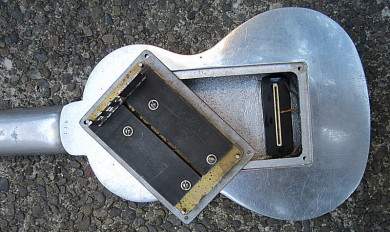
Before an internal pickup was available for upright basses, people would put a mic on a short floor stand on the floor in front of the bass. If you turned the bass, the mic would be off axis. Picking up foot noise and leakage was a problm. The Ampeg innovation was to place the mic inside the body to avoid this issue. They used a crystal mic because it was small.
There are current upright bass products that employ high quality miniature mics in much the same way that Ampeg did, by attaching the mic to the body. That technology has a long standing track record and has not gone away. These days mics can be placed inside the body, outside attached to the bridge, tailpiece, the top, attached onto the strings behind the bridge, etc. An alternative is a piezo pickup.
Before an internal pickup was available for upright basses, people would put a mic on a short floor stand on the floor in front of the bass. If you turned the bass, the mic would be off axis. Picking up foot noise and leakage was a problm. The Ampeg innovation was to place the mic inside the body to avoid this issue. They used a crystal mic because it was small.
There are current upright bass products that employ high quality miniature mics in much the same way that Ampeg did, by attaching the mic to the body. That technology has a long standing track record and has not gone away. These days mics can be placed inside the body, outside attached to the bridge, tailpiece, the top, attached onto the strings behind the bridge, etc. An alternative is a piezo pickup.
Last edited: