• TalkBass has been independent since 1998. Add your voice.
    Create a free account to reply to discussions, view embedded media, and browse with fewer display ads.
    Join freeLog in
    Want zero display ads or expanded classifieds tools? Compare plans.

2X10 Combo w/ 4X10 cabinet

You are also assuming that those specs are worth the paper and ink they are printed on. 99% of manufactures have THERMAL ratings for their speakers listed, not excursion ratings. The thermal ratings have little to nothing to do with how much power the speakers will handle from an amp. If you find a generic 410 that is rated at 400 Watts RMS, that doesnt mean that cab can handle 400 watts of power. Its probably closer to 200-250.

That's insanity! If a Cab is rated at X Watts at Y Resistance Why exactly is it going to "Blow Up" if you are using it within it's designed range? What did I miss? Where is the "Physics"?
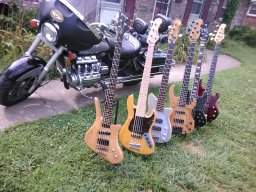
 
This is why I love my BA500.
Grabbed a 4 ohm 210 (in my case an ampeg BXT210M) lets me run 250 watts to the built in 210, and the other 250 to extension 210. Sounds great.

Now that runs as my backup rig. Current one is: SVT III Pro into two ampeg pro neo 210HLFs.

If I need that extra oomph at a gig, I can take both rigs, send the DI of the SVT III Pro to the effects return of the BA500. Voila---eight 10s running 950 watts total (plus the tube preamp of the SVT III). All the speakers are running very near peak efficacy!
 
You are also assuming that those specs are worth the paper and ink they are printed on. 99% of manufactures have THERMAL ratings for their speakers listed, not excursion ratings. The thermal ratings have little to nothing to do with how much power the speakers will handle from an amp. If you find a generic 410 that is rated at 400 Watts RMS, that doesnt mean that cab can handle 400 watts of power. Its probably closer to 200-250.

Mostly plus 1. You may reasonably be able to assume that the speakers will not die if fed their thermal rating for a reasonably short period of time. But they will start distorting somewhere around half that power as I understand it, and so at full thermal power they will sound, in the pungent words of a friend of mine from Oklahoma, "like hammered sh!t."
 
I did read it, and again, they are not equal.

Let's us the standard Resistance formula for multiple speakers:

A 400 watt cab with 2X10" @ 8 Ohms will have 2 16 Ohm Speakers

Resistance = 1 / (1/Speaker A + 1/Speaker B)
Resistance = 1 / (1 / 16 Ohms + 1 / 16 Ohms)
Resistance = 1 / ((2/16) = (1/8) = (.125))
Resistance = 1 / .125
Resistance = 8 Ohms

A 400 watt cab with 4X10" speackers will have 4 32 Ohm speakers

Resistance = 1 / (1/Speaker A + 1/Speaker B + 1/Speaker C + 1/Speaker D)
Resistance = 1 / (1 / 32 Ohms + 1 / 32 Ohms + 1 / 32 Ohms + 1 / 32 Ohms)
Resistance = 1 / ((4/32)= (1/8) = (.125))
Resistance = 1 / .125
Resistance = 8 Ohms

Each of the speakers in the 2X10 cab has a resistance of 16 Ohms, while each of the speakers in the 4X10 has 32 Ohms. Increasing the total resistance, reduces the total acoustical output.

The 6 speakers are effectively putting out the same volume. Is that what you meant?

If you'll read the rest of what I wrote, you'll see this is exactly what I meant.

To break it on down, for this purpose, "all things equal" means each of the 6 ten inch speakers is the same design, the 410 and 210 provide the same effective internal air volume per speaker, and the cabinets are tuned the same.
 
You have opened a can of worms here! Nearly everybody in this forum will tell you it is a bad idea to mix your speaker sizes and your ohms. I'll tell you the same. That being said, I ran a SWR Redhead and a Goliath III 4X10 for years with no problems whatsoever! I would still be using this combination, if it weren't for the quest for light weight gear I have engaged in. Get 2 2X10s or 2 4X10s with the same ohmage and preferably same maker and you'll be golden, provided your amp can handle the ohms. Good luck!
 
Yep, and once upon a time nearly everyone would tell you the world was flat, Or the Earth was the center of the universe. (Fallacy of Common Belief)

But unless you can put into Mathematics it's only Theory...

You have opened a can of worms here! Nearly everybody in this forum will tell you it is a bad idea to mix your speaker sizes and your ohms.
 
I did read it, and again, they are not equal.

Let's us the standard Resistance formula for multiple speakers:

A 400 watt cab with 2X10" @ 8 Ohms will have 2 16 Ohm Speakers

Resistance = 1 / (1/Speaker A + 1/Speaker B)
Resistance = 1 / (1 / 16 Ohms + 1 / 16 Ohms)
Resistance = 1 / ((2/16) = (1/8) = (.125))
Resistance = 1 / .125
Resistance = 8 Ohms

A 400 watt cab with 4X10" speackers will have 4 32 Ohm speakers

Resistance = 1 / (1/Speaker A + 1/Speaker B + 1/Speaker C + 1/Speaker D)
Resistance = 1 / (1 / 32 Ohms + 1 / 32 Ohms + 1 / 32 Ohms + 1 / 32 Ohms)
Resistance = 1 / ((4/32)= (1/8) = (.125))
Resistance = 1 / .125
Resistance = 8 Ohms

Each of the speakers in the 2X10 cab has a resistance of 16 Ohms, while each of the speakers in the 4X10 has 32 Ohms. Increasing the total resistance, reduces the total acoustical output.

The 6 speakers are effectively putting out the same volume. Is that what you meant?

The amp sees the cabinets as a whole, not the individual drivers. If there are 2 8 ohm cabs, power will be divided evenly between the 2 cabs. This is true whether, for example, the 210 has 2 16 ohm speakers in parallel or 2 4 ohm speakers in series. Or whether the 410 has 8 ohm speakers in series-parallel or 32 ohm speakers in parallel.

So whatever the impedance of the individual drivers, if the 2 cabs present the same total impedance, the speakers in the 210 will receive twice as much power as the speakers inside the 410.

Inside each cabinet, each speaker will see it's share of the power delivered TO THAT CABINET. In the 210 each will see 1/2 of the power delivered to the cabinet. In the 410 each will see 1/4 of the power delivered to the cabinet. So each driver in the 410 sees 1/4 of 1/2 of the total power put out by the amp, or 1/8 of the total power. In the 210, each speaker sees 1/2 of 1/2 of the total power being put out, or 1/4 of the total power.

You will have the 2 drivers inside the 210 at their limits when the can still take double the power.

The amp can only respond to the impedance of the cabinet, it cannot determine the individual impedances of the drivers inside the cab, or whether they are wired series or parallel. Ohm's law will result in equal splitting of the power from the amp between two 8 ohm cabinets. The 410 will not receive more power than the 210 because the 410 is an 8 ohm load to the amp, just exactly like the 210 is.
 
Yes, it the amp sees each 8 ohm cab as equal units. But what's in each cabinet and what comes out is controlled by the formula listed previously. Do the math! Your "Theories" don't hold water.


The amp sees the cabinets as a whole, not the individual drivers. If there are 2 8 ohm cabs, power will be divided evenly between the 2 cabs. This is true whether, for example, the 210 has 2 16 ohm speakers in parallel or 2 4 ohm speakers in series. Or whether the 410 has 8 ohm speakers in series-parallel or 32 ohm speakers in parallel.

So whatever the impedance of the individual drivers, if the 2 cabs present the same total impedance, the speakers in the 210 will receive twice as much power as the speakers inside the 410.

Inside each cabinet, each speaker will see it's share of the power delivered TO THAT CABINET. In the 210 each will see 1/2 of the power delivered to the cabinet. In the 410 each will see 1/4 of the power delivered to the cabinet. So each driver in the 410 sees 1/4 of 1/2 of the total power put out by the amp, or 1/8 of the total power. In the 210, each speaker sees 1/2 of 1/2 of the total power being put out, or 1/4 of the total power.

You will have the 2 drivers inside the 210 at their limits when the can still take double the power.

The amp can only respond to the impedance of the cabinet, it cannot determine the individual impedances of the drivers inside the cab, or whether they are wired series or parallel. Ohm's law will result in equal splitting of the power from the amp between two 8 ohm cabinets. The 410 will not receive more power than the 210 because the 410 is an 8 ohm load to the amp, just exactly like the 210 is.
 
MaddAnthony_59 said:
Yes, it the amp sees each 8 ohm cab as equal units. But what's in each cabinet and what comes out is controlled by the formula listed previously. Do the math! Your "Theories" don't hold water.

I honestly have no idea what you are trying to say. I have been wrong before and will be wrong again but I am not wrong here. If you are trying to say something other than that each 8 ohm cabinet receives one half the power from the amp its perfectly opaque to me. But obviously your math only applies to all-parallel internal wiring, even though for these two examples, inside the cab, all series or (in the 410) series parallel wiring accomplishes the same thing.

Here's another way to look at it. Let's talk resistance because impedance varies with frequency. Each 8 ohm cabinet you connect to an amp looks to the amp like an 8 ohm resistor. Replace the 410 with an 8 ohm resistor and that single resistor will still get half the power. Replace that resistor with 4 2 ohm resistors and the resulting 8 ohm load will take half the power. Or use 16 half ohm resistors in series. The amp sees an 8 ohm load snd sends that load half the power.

The amp cannot see or feel or smell the kind, number or internal wiring of 2 separate 8 ohm loads connected to it in parallel. To the amp, the cabinet (8 ohms) is the load it sees, not the individual drivers.

So let's try this: At moment X the amp is putting out 200 watts. Using your assumptions that each cab is all parallel wired, tell me how much power each driver is receiving at that moment.
 
MadAnthony is just wrong in his assumptions. JHAz is correct.

+100 However let's let Anthony mull this over for a while and take another look at it. I'm sure he'll have a paradigm shift and it will become clear. :)

We have strayed a long way from the topic the OP brought to the table.

most combo amps have their internal drivers present the lowest impedance that their amps can handle. Often they do not even have external speaker jacks. Those that do are often wired in series with the internal load to prevent over stressing the amp. This actually reduces the available output power. The second point about the combo idea is that the speaker portion of the combo is usually more of a compromise between portability and looks rather than good engineering.

In my mind the way the OP should go is to buy a second identical 4x10 and a better more powerful amplifier. Maybe take a look at the Carvin BX1500.
 
Probably not, but you're right, this was an unintentional hi-jacking, and I'm sorry for straying from the topic. We can take the argument offline or to another thread if you Really want to.

As for the OP's original question, Perhaps a 6X10 cab with a slightly more powerful amp? I've had good luck with SWR gear in the lower registers. An SM-500 with a Goliath Senior Cab perhaps. That should put your "B" String back in "Bass"!

I'll certainly agree that a 6X10 is a much better choice than a 2X10 & a 4X10. :smug:

Cheers!
+100 However let's let Anthony mull this over for a while and take another look at it. I'm sure he'll have a paradigm shift and it will become clear. :)

We have strayed a long way from the topic the OP brought to the table.

most combo amps have their internal drivers present the lowest impedance that their amps can handle. Often they do not even have external speaker jacks. Those that do are often wired in series with the internal load to prevent over stressing the amp. This actually reduces the available output power. The second point about the combo idea is that the speaker portion of the combo is usually more of a compromise between portability and looks rather than good engineering.

In my mind the way the OP should go is to buy a second identical 4x10 and a better more powerful amplifier. Maybe take a look at the Carvin BX1500.
 
Sorry for yet another zombie thread, but I have a couple of questions that haven't been answered anywhere.

1.)If you daisy chain 2 cabs, and the amp sees a single load, why doesn't it see a single bank of speakers?

2.)If you combine a 400W 410 with a 400W 210, and the amp's output is split evenly, then each driver would be driven equally, or close to it. Am I out to lunch there?