

Enjoy the benefits of a premium membership!
Upgrade Account
-
TalkBass has been independent since 1998. Add your voice.
Create a free account to reply to discussions, view embedded media, and browse with fewer display ads.
Join free Log in
Want zero display ads or expanded classifieds tools? Compare plans.
You are using an out of date browser. It may not display this or other websites correctly.
You should upgrade or use an alternative browser.
You should upgrade or use an alternative browser.
4, 5 or 6 String Basses for Jazz Fusion
- Thread starter MaidenVT
- Start date
More options
Who Replied?

I play 5 string fretless in jazz and fusion because I was raised by Gary Willis. lol 
I like the extra low string for playing lower notes in the Keys between B and E. Also playing across strings is easier with more strings. On a six it's easier to play those high notes without having to go very high on the neck. Fusion bass playing can be more demanding than other styles. The bass will often have solos or melodic parts over its entire range. Sometimes chords even. More options that's all. I feel somewhat restricted on a 4 now.
I like the extra low string for playing lower notes in the Keys between B and E. Also playing across strings is easier with more strings. On a six it's easier to play those high notes without having to go very high on the neck. Fusion bass playing can be more demanding than other styles. The bass will often have solos or melodic parts over its entire range. Sometimes chords even. More options that's all. I feel somewhat restricted on a 4 now.
Last edited:

I played BG and upright professionally. My #1 BG since about 1995 has been a 6-string. I own 4s and 5s, but prefer to avoid playing them too much. The reason is because optimal fretboard logic varies a bit depending on how many strings you have. When I play a 4 or 5 for very long, it starts to rewire my brain and I feel it degrades my fluency on the 6. I could easily switch between various BGs if there was a good reason that sufficiently offset the cost.
I started on 4 and transitioned to 5 a few years after turning pro. I wanted to play five because some songs go below the low E, and also because the low B allows me to transpose lines down a perfect 4th without changing the bass line. It's fairly common to play songs lower to accommodate a singers range. I wanted to play 6 because I felt the C string would provide a better range for soloing over changes, which was a significant part of my job. The C string also allows access to a wider range of tones.
After such a long time playing the 6, there are very few situations where I feel it present any significant disadvantage. It doesn't matter if the music does not require the B or the C string, I don't feel they are in the way. However, I felt it was a fairly challenging to transition to learn the 6, and it took a long time before I started feeling like a naturalized 6 player.
So IMHO access to extra strings can be viewed as an advantage, but there is a cost. It's up to you to decide if the potential advantages are relevant and if you are willing to put in the required work. Play whatever makes the most sense to you.
I started on 4 and transitioned to 5 a few years after turning pro. I wanted to play five because some songs go below the low E, and also because the low B allows me to transpose lines down a perfect 4th without changing the bass line. It's fairly common to play songs lower to accommodate a singers range. I wanted to play 6 because I felt the C string would provide a better range for soloing over changes, which was a significant part of my job. The C string also allows access to a wider range of tones.
After such a long time playing the 6, there are very few situations where I feel it present any significant disadvantage. It doesn't matter if the music does not require the B or the C string, I don't feel they are in the way. However, I felt it was a fairly challenging to transition to learn the 6, and it took a long time before I started feeling like a naturalized 6 player.
So IMHO access to extra strings can be viewed as an advantage, but there is a cost. It's up to you to decide if the potential advantages are relevant and if you are willing to put in the required work. Play whatever makes the most sense to you.

Whatever you need... this always amazes me, yes, it's double bass- and that makes it even more mesmerizing. The Late Rinat Ibragimov, using a three stringed bass.
"Fusion" is not just one thing.
That said... I concur you can use a 4 string. The notes you play are ultimately more important than the instrument anyway.
Personally, I find 5 string basses overall are more versatile and give you more options. You just have to develop better muting technique, and not go crazy with the low notes. 18mm spacing works well for me, YMMV.
I don't see much benefit to a 6 string -- too heavy, harder to mute, narrower string spacing. You can get nearly the same benefits with a 24 fret 5 string.
That said... I concur you can use a 4 string. The notes you play are ultimately more important than the instrument anyway.
Personally, I find 5 string basses overall are more versatile and give you more options. You just have to develop better muting technique, and not go crazy with the low notes. 18mm spacing works well for me, YMMV.
I don't see much benefit to a 6 string -- too heavy, harder to mute, narrower string spacing. You can get nearly the same benefits with a 24 fret 5 string.

I don't see much benefit to a 6 string -- too heavy, harder to mute, narrower string spacing. You can get nearly the same benefits with a 24 fret 5 string.
The extra muting requirements are real and fairly significant. The TRB6P is heavy but it balances well on the strap, so I am okay with the weight. The string spacing is 19mm. The TRB6P has a 24 fret neck, but IMHO it's not really practical to play up near the end of the neck. You can play all the way to 24 but at some point my hand comes across the front of the neck and access to the lower strings get increasingly constrained.. Also at some point, the pinkie become useless, I.E. 1,2,3 fingering is required.
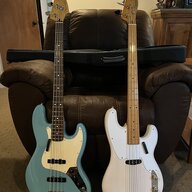

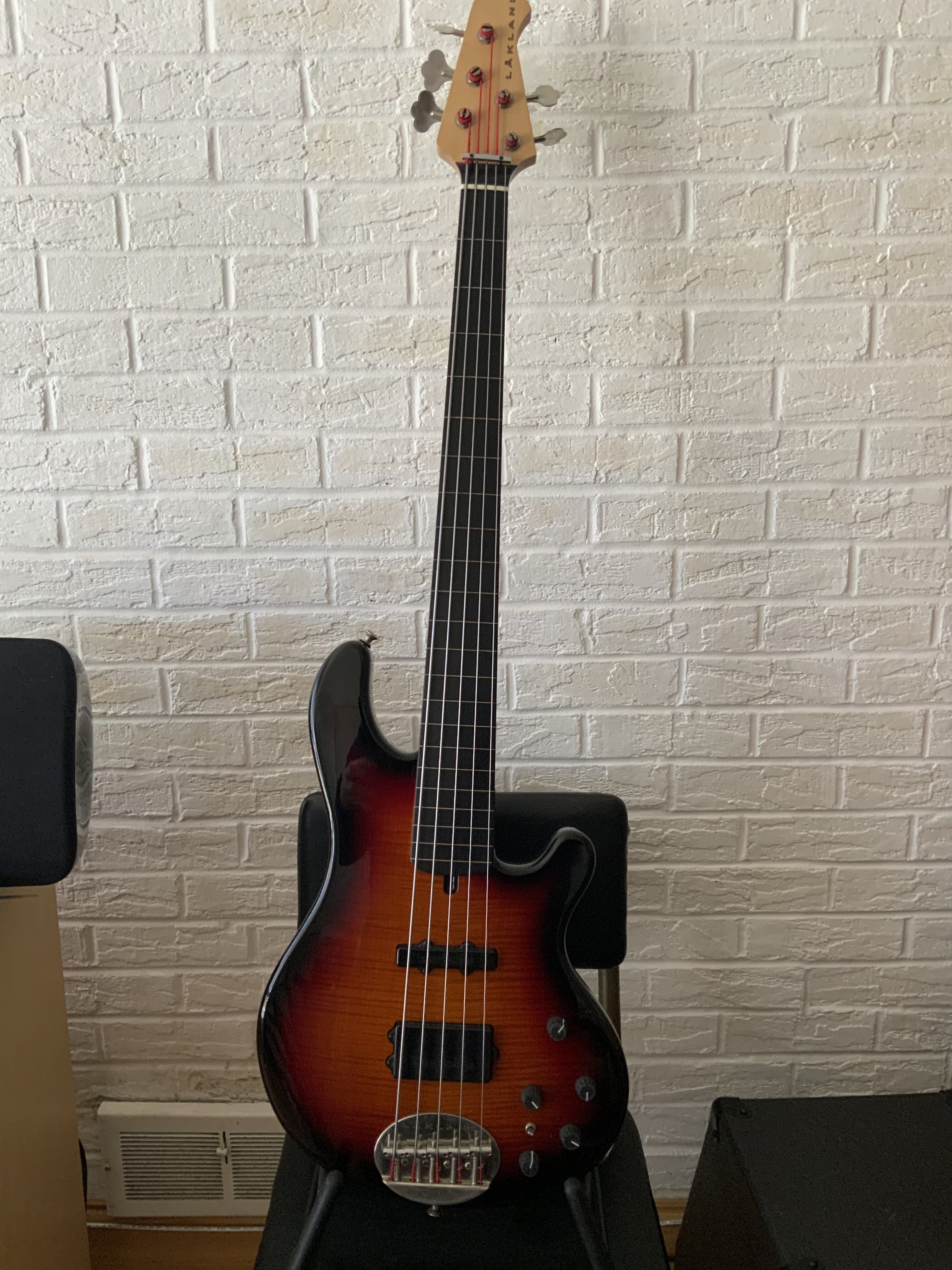
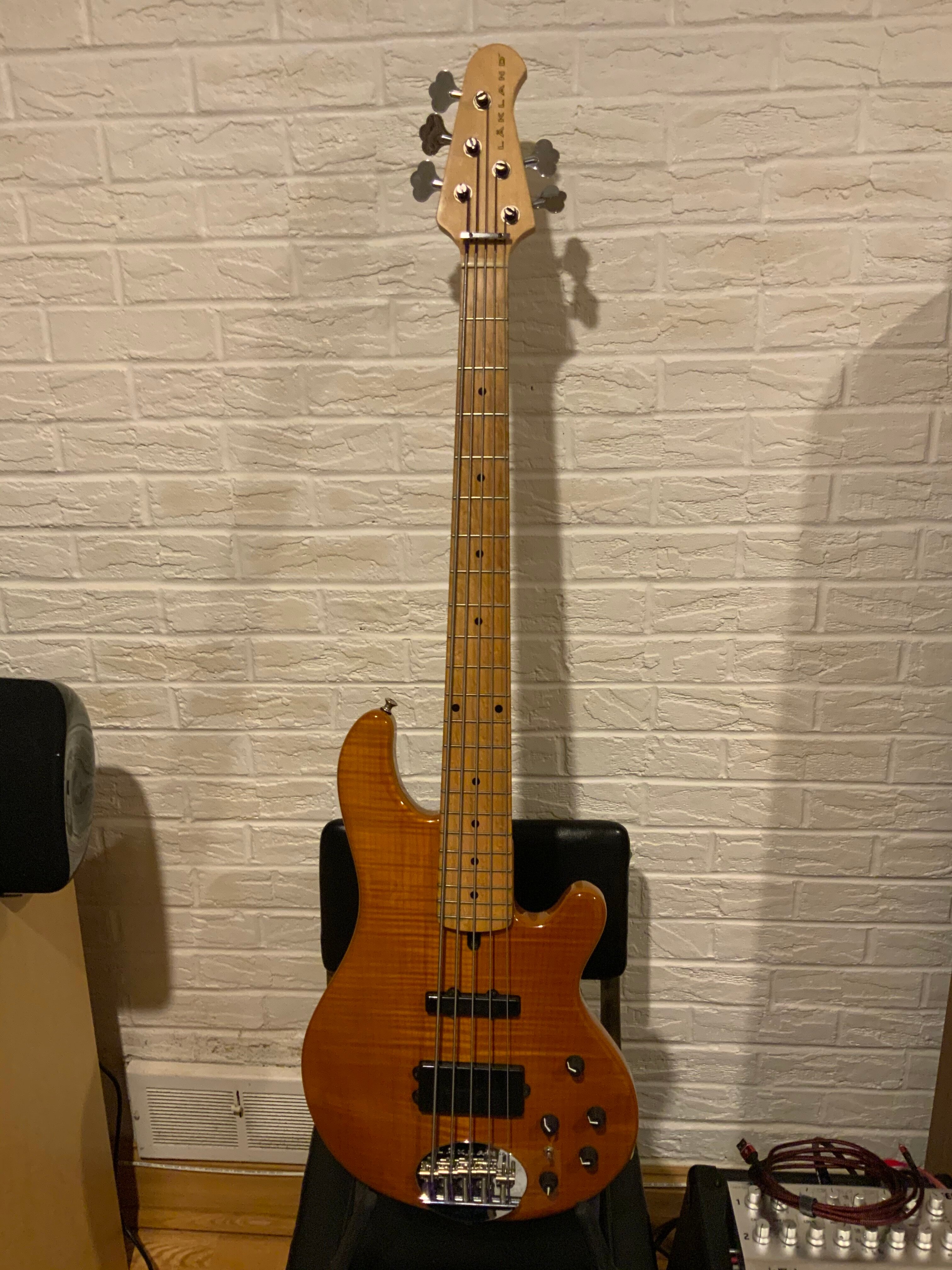
Both my EB’s shown below are Lakland 55-94’s. I played any style of music four string basses for years. Once I transitioned to the 55-94’s
I found it weird to transition back to playing my Precision. Moving over to either of my Double Basses is fine, but I’m now more comfortable with the 5’s.
Just a personal quirk of mine I guess. While I’ve had the occasion to play a few 6 string basses, I find the width of a 6 string neck challenging. Additionally, while it is easier to solo “across” the 6 string, to my ears it sounds more like a “baritone guitar” than a bass, because the notes on the C string extend above the range of the highest notes on the G String. Just my take of course.
I found it weird to transition back to playing my Precision. Moving over to either of my Double Basses is fine, but I’m now more comfortable with the 5’s.
Just a personal quirk of mine I guess. While I’ve had the occasion to play a few 6 string basses, I find the width of a 6 string neck challenging. Additionally, while it is easier to solo “across” the 6 string, to my ears it sounds more like a “baritone guitar” than a bass, because the notes on the C string extend above the range of the highest notes on the G String. Just my take of course.
Frets don’t fail me nowI found a 24 feet 4 string to open up a lot more options than a Fender. Greater than the sum of its parts like


Whatever you need... this always amazes me, yes, it's double bass- and that makes it even more mesmerizing. The Late Rinat Ibragimov, using a three stringed bass.
Yes, in the scope of time a 4 string bass is a relatively new instrument.

Is it necessary to have more than 4 strings for Jazz fusion? What are the advantages?
You are not required to have more than four strings. Ever. Under any circumstances. A 4 string standard bass guitar will work in every situation that calls for electric bass guitar.advantages:
- easy transposing (singers love to change keys!)
- easy access to multiple octaves without shifting neck position
- a handful of lower notes (B0-Eb1)
- a whole ton of higher notes on a 6-string for soloing or comping chords
As far as advantages go, @Esteban Garcia is spot on above.
You aren’t required to have more than four strings. But there are benefits to you if you do.

Plenty of 4 string jazz fusion players.
The obvious advantages of a 6 string is that your can go lower, but also not least higher, for chord work and solos, which is why there are actually quite a few 5 string jazz bass players that tunes their 5 string basses E to C, that is as the upper 5 strings of a 6 string bass, and Stanley Clarke makes quite a lot of use of a 4 string bass tuned A to C, that is as the upper 4 strings of a 6 string bass, which he also tours with, his other Stanley Clarke signature Alembic bass.
The obvious advantages of a 6 string is that your can go lower, but also not least higher, for chord work and solos, which is why there are actually quite a few 5 string jazz bass players that tunes their 5 string basses E to C, that is as the upper 5 strings of a 6 string bass, and Stanley Clarke makes quite a lot of use of a 4 string bass tuned A to C, that is as the upper 4 strings of a 6 string bass, which he also tours with, his other Stanley Clarke signature Alembic bass.
Last edited:

I actually got "bullied" into buying/playing a fiver back in 1998, ha. I'm glad I did make the switch (and currently only play sixes) but it was an uncomfortable situation in a band with some serious cats where I was a bit over my head.IF you think the extra low and high notes outside of a four string range would be useful to you, there you are.
The bigger advantage of more strings as Sr Garcia points out is much different fingering choices ( it's far easier for some to play across the fingerboard than up and down ) and transposing is way easier, you can shift up and down the fingerboard as a guitarist would slide barre chords, and having the range to play across on 5 or 6 makes this a breeze.
But many master bassists past and present use fours and do tremendous work with them with no limits.
IF these things sound like good options, there you go. If you see the instrument as primarily a four string, then stick with it.
There can be in some quarters that how many strings you play is some sort of inferred test of musical manhood, and I think some guys actually get bullied into 5's or 6's, forget that!!! The only right answer for me or you is to use whatever helps us make our best music, and what anybody else thinks is none of their business. Do what fits YOU.


