

Enjoy the benefits of a premium membership!
Upgrade Account
-
TalkBass has been independent since 1998. Add your voice.
Create a free account to reply to discussions, view embedded media, and browse with fewer display ads.
Join free Log in
Want zero display ads or expanded classifieds tools? Compare plans.
You are using an out of date browser. It may not display this or other websites correctly.
You should upgrade or use an alternative browser.
You should upgrade or use an alternative browser.
4 or 5 string for a beginner?
- Thread starter Paul4703
- Start date
More options
Who Replied?
Overall..
If I were starting out - I'd be starting 5 or 6.. may go as far as fretless with position markers. I didn't try fretless for 5 years.. it was like learning a new instrument.
...
Many of us do Chruch work.. the 5 and 6 is becoming the nuts and bolts of the genre - Listen to a Crowder, Tomlin, Crowns tune and there it is...
I know you're getting tons of opinions that a 4 is good enough... I can play everything I can on a 6 on a 4.. I can play it faster on a 5.. I'd be qualifying the question with "to those who own 4, 5 and 6 String basses" This forum is notoriously filled with folks who have an opinion on topics they are not qualified to discuss. Harsh - yes I know this - I care more about your success than my reputation of being direct.
It is easier to go from 6/5 to 4 and Fretless to fretted than the other way round.
Tim
Tim has given you a lot of good, practical advice, however, in the end, it really does depend on what you want to play, and how you learn best. I'm not a pro, But I do want to offer my experiences/perspectives.
1. Going from fretted to fretless IS a new experience, but the first bass I played (jr hi for 2 years) was a bass violin, yeah, a doghouse. Now THAT is another instrument! Way more technique differences there than between electric fretted and fretless. And my opinion is that unless you have a really good ear (I mean REALLY good) the frets allow you to learn some basic things before you have to add things that can't be done on a fretted (like glissandos, slides, where you actually stop at the right pitch). They will also help you build up speed and not sound like, well you know, again BEFORE tackling doing your own intonation on the fly (like you will have to do on the fretless). Oh, yeah, I probably should have said up front, I'm a pretty conservative guy.
2. I got my first 5 partly because I do play in church, and yeah, they are very common in gospel (what I play). And yeah, a fretted E on the B string IS thicker and easier to control (I play there too) than an open E. My only advice here is, depending on your fretting hand strength, the extra neck width and extra string again, could be a hurdle you have to deal with before getting speed. I was already playing guitar when I started playing electric bass and I'm glad I didn't start on a 5er as I had to build up a little hand strength myself.
3. I do own 4s, 5s, and 6s. To be sure, I still have trouble getting around well on a wide-spaced 6 (one of mine is wide-spaced, one is close-spaced), but since I don't really know what to do with the C string, I rarely use either. I can get around on a 4 best, probably because that is what I started on. So if you expect to mostly need a 5 and spend the most time practicing/playing/working on a 5 you will be most comfortable there. But in the final analysis what bass will enable you to learn and advance best is up to you, your commitment and quite honestly your current strength, reach, dexterity, hand-eye-ear coordination etc.
Consider all of what we say, but do what will keep YOU the most motivated, progressing the most regularly and satisfy your goals.
Most of all ENJOY the music you make!


As said before, learning will be the same.
From my experience, i would learn on a four: you will build your playing. So it can be a good thing to have to move around your neck to play. It will increase your ability faster; because of these moves you have to do. As said before, a 5 will be easier because you will have more notes to play with less moving. But, in the process of learning, you could be more "static" than with a four.
It's a big part of the reason i switched back to the four, after 2 years of playing a 5, cause my playing was becoming too "static", more "vertical" than "horizontal"...

From my experience, i would learn on a four: you will build your playing. So it can be a good thing to have to move around your neck to play. It will increase your ability faster; because of these moves you have to do. As said before, a 5 will be easier because you will have more notes to play with less moving. But, in the process of learning, you could be more "static" than with a four.
It's a big part of the reason i switched back to the four, after 2 years of playing a 5, cause my playing was becoming too "static", more "vertical" than "horizontal"...

Jaco played a 4.[/QUOTE said:is it only me , or is that endlessly perpetuated "jaco payed a 4" "4 was enaugh for jaco" etc thing getting slightly old ...?
How is what Jaco played in any way shape or form relevant to the initial question-or to many ofthe question , this statement is thrown at?
Johnson plays a 5
Jackson plays a 6...
take your pick
...Or why not play a 3 ...Levin had a 3.


As some have stated earlier, whether you play a 4 or a 5 isn't the most important issue. A far more important question, though, is...
...maple? or rosewood?
...maple? or rosewood?

It doesn't really matter. I don't think fivers are harder to learn on than a four string. They can however be a little more demanding physicaly. If the extra width of the fretboard doesn't bother you than go ahead with the five string.
The five string can give you more flexibility but I have found that the Low-B's usefulness really depends on the type of music you play. The type of amp you use is also important. Low-B strings can sound really crappy through an amp that was not designed with a five string in mind.
The five string can give you more flexibility but I have found that the Low-B's usefulness really depends on the type of music you play. The type of amp you use is also important. Low-B strings can sound really crappy through an amp that was not designed with a five string in mind.

i started on a 4 when i was ...18 (geez over 20 years already...ugh) and when i turned 19 i saw a used 5 string modulus for sale and just loved it...been playing 5 string ever since. Not so much for having 'extra' notes to use but mainly because the neck was wider and was easier for my big fingers to use.
I'd agree with those on this thread that say to do what feels best to you and to try 4 5 6 whatever you can try ...
Froad
I'd agree with those on this thread that say to do what feels best to you and to try 4 5 6 whatever you can try ...
Froad
I don't think basing what instrument you buy should be based on how easy it is to play scales on them.
On a 5 it requires less movement and on a 4 you have to move up the neck a bit more, but moving up the neck when playing scales will help you learn to navigate the fretboard better.
Also, in a band environment you won't be playing scales all the time.
On a 5 it requires less movement and on a 4 you have to move up the neck a bit more, but moving up the neck when playing scales will help you learn to navigate the fretboard better.
Also, in a band environment you won't be playing scales all the time.
I play a 4 string and I don't want to ever play a 5 string. But it really is up to you. Go with what you feel is best. Either way, have fun.
I'd start with a 5
the added complexity will really help you IMO. Also, buy a cheap bass (Squier or SX or something), so you can get a real nice bass once you figure out what you're comfortable on.
I don't think basing what instrument you buy should be based on how easy it is to play scales on them.
On a 5 it requires less movement and on a 4 you have to move up the neck a bit more, but moving up the neck when playing scales will help you learn to navigate the fretboard better.
Exactly what i wanted to say, but with better english words

don't ask what other people think. There is no right answer to your question.
Both 4 and 5 strings have their (dis-)advantages. Very few people NEED a B string.
I played only 4 strings. Then I bought a Yamaha TRB 1005 (it was a good offer and GAS hit me).
I'm not really getting into it, but will keep playing it, anyway. Learning new things and expanding abilities is never wrong.
Go and try some basses. Get the one you feel comfortable with. Play it. The longer you play, the better you will know what is best for YOU.
Both 4 and 5 strings have their (dis-)advantages. Very few people NEED a B string.
I played only 4 strings. Then I bought a Yamaha TRB 1005 (it was a good offer and GAS hit me).
I'm not really getting into it, but will keep playing it, anyway. Learning new things and expanding abilities is never wrong.
Go and try some basses. Get the one you feel comfortable with. Play it. The longer you play, the better you will know what is best for YOU.
I play 5's out of sheer laziness, why anyone would enjoy and go through the trouble of having to move around vertically on the fret board is beyond me, IME I play a lot cleaner and faster on a 5, although I like fours and im currently having GAS for one, ill choose a five over a four any day.
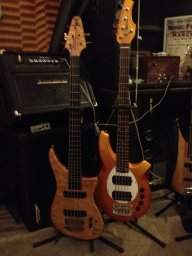
Two issues here always get convolved. Absolute 4 vs. 5 (or 6, etc.) strings, and which to start on if you are eventually going extended range. I love my 5 strings, but they aren't for everyone; there's no answer to be had there, just opinion. As to the other question, again it's a matter of opinion, but my take is that if you know you are going to end up going ER, you might as well start out that way. I don't see any upside to starting out on 4 strings and then making the switch later.

I've been advised that it is important to master scales across two octaves and this means a lot of travelling up and down the neck of my 4 string. Would I be better switching to a 5 string where it would be easier to play the notes without moving so much?
Don't make your decision on being too lazy to move up and down the neck. If you want to be efficient and good at your instrument, you should learn your scales up and down the entire neck. Don't limit yourself to just the first 5 frets. You should know every note on that bass better than you can recite the alphabet.
Just my .02
It doesn't matter. You may want to learn on the same kind of bass that your idols play. I started on 5 strings but can play a 4 string any day without any problems whatsoever. The difference is minimum... I don't really understand these months of adaptation that some people seem to need. It took me around 5 minutes to get used to fanned frets and around the same time to get used to a 6 string bass. As always, YMMV.
Hi,
Been playing the bass now for 6 weeks and comfortable with my progress. I've been advised that it is important to master scales across two octaves and this means a lot of travelling up and down the neck of my 4 string. Would I be better switching to a 5 string where it would be easier to play the notes without moving so much? Or is any gain offset by the 5 string being more difficult to play because of the wider fretboard and narrower string spacing?
Thanks,
Paul.
I suggest learning the scales on the bass you already have. There is no need to buy something new, especially if you're doing this with the hope of avoiding how to play up and down the neck; something you need to learn regardless of how many strings you have. (Playing bass, guitar, violin, ... learning to move up and down on 1 string is a good thing.) Learning how to move up and down 1 string and across the set of strings is really good!
You already have a bass, learn to play it!
(Keep in mind that with a 5 string (low B), you may possible need a new amp as well, to better reproduce the low end.... = more money spending)
FWIW, if I was your bass teacher and you showed up with a 5 string bass (with it's 5 new notes), I'd start demanding that you play scales across 3 octaves! (at least for B, C, Db, D and Eb). So you would not be avoiding anything by getting a 5 string.

- Aug 5, 2005
- 7,243
- 92
- Disclosures
- Endorsing Artist: J.C. Basses
I learned on a 4, and now I play a 6. I wish I'd learned on a 5 or 6.
I'd recommend learning on a 5 - it's becoming the new 4-string.
I'd recommend learning on a 5 - it's becoming the new 4-string.
I played guitar before I moved up to bass after two years. I was 15 and my father knew a guy from work that was selling two Soundgear fives, one natural, one black and a Peavey halfstack. So my first bass was a five and I got it converted to fretless four years later. The extra string took some getting used to, but it was the only bass I owned until I got my 6 this past spring. I bought it because it was there. Would things have been different if I had gotten a 4? Maybe, maybe not. I'll never know. I don't play high or chords or solos, so my 6 is tuned to F#, so I can play anything at any position on the neck. Low E is either open, 5th fret on the B or 10th fret on the F#. My current amp struggles below A, so that's getting remedied, but I love the additional flexibility of another string.
And yes, the "Jaco only needed four" thing is getting real old. I don't care what one particular person played. I don't play what Jaco played, and he didn't play what I play. Was he better than me? Yes. Does that mean I can't groove down low? Absolutely not.
Another example is like comparing Jaco to to any of the ERB guys. Completely different approaches and musical ideas. Jaco didn't need 12 to do his thing, and ERB dudes can't do their thing on 4.
Edit: Plus, with a cheap eBay 6-string and a fretless 5, nobody ever wants to borrow my gear.
And yes, the "Jaco only needed four" thing is getting real old. I don't care what one particular person played. I don't play what Jaco played, and he didn't play what I play. Was he better than me? Yes. Does that mean I can't groove down low? Absolutely not.
Another example is like comparing Jaco to to any of the ERB guys. Completely different approaches and musical ideas. Jaco didn't need 12 to do his thing, and ERB dudes can't do their thing on 4.
Edit: Plus, with a cheap eBay 6-string and a fretless 5, nobody ever wants to borrow my gear.


