• TalkBass has been independent since 1998. Add your voice.
    Create a free account to reply to discussions, view embedded media, and browse with fewer display ads.
    Join freeLog in
    Want zero display ads or expanded classifieds tools? Compare plans.

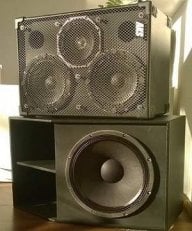
".5 Aligned" 4x10 cabs

The real pro stuff uses larger format HF drivers that can cross over between 800 and 1200Hz, while the MI grade stuff crosses over between 1800-2500Hz. THIS is where the distinction needs to be made, because the higher you cross over the woofers, the greater the interaction between mids. The 215 + horn products that roll off the bottom woofer are typically the MI grade products because they cross over higher. The pro products cross over low enough that it's not so much a problem that the solution's drawbacks don't get in the way of performance. In JBL's case, the JRX, and the older TR/TRX used the concept of rolling off the lower woofer because they cross over at 2kHz and use a "whimpy" HF driver/horn (for the application). The older SR and SRX-725 for example use a large format HF driver and cross over between 800-1200Hz (depending on application, passive is fixed at 1.2kHz IIRC) because the HF driver and especially the horn have the capability and the horn provides adequate loading/directivity at the lower frequencies.

Most (99.9%) of the basscabs make use of whimpy HF drivers, that's also one of the reasons I choose the Oberton coaxial 8"/1.75" driver. The xover point is 1.8khz, which is low enough to have a very smooth off-axis response. Distortion is also no problem since the harmonic distortion of the HF driver is lower then that of the mid driver around the xover point.
 
My apologies for having overlooked Kringle77's and 5StringPocket's previous .5 designs.

JGR, you found it to be an improvement in a guitar cab? Very interesting and encouraging. I would expect the main benefit to be less change as you go from on-axis to off-axis, which imo would be a very definite step in the right direction for guitar cabs. I really don't like that on-axis icepick effect you normally get with side-by-side guitar speakers.
 
My apologies for having overlooked Kringle77's and 5StringPocket's previous .5 designs.

JGR, you found it to be an improvement in a guitar cab? Very interesting and encouraging. I would expect the main benefit to be less change as you go from on-axis to off-axis, which imo would be a very definite step in the right direction for guitar cabs. I really don't like that on-axis icepick effect you normally get with side-by-side guitar speakers.

Yup, not only in terms of dispersion and combing, but also in achieving a more balanced tone overall - it's nice to have more beef in the lower registers.
 
Was thinking if a similar thing might be achieved using "beam-blockers" without the hole in the middle on one column?
Might be an easier or less expensive mod for some folks to do to their existing cabs, though it seems you'd have to rear load the drivers in order to fit them properly, so maybe not so easy/simple.

Also be an aesthetic thing with anything other than grillcloth.

Essentially making an acoustic rather than electric filter. Foam is cheap, and there'd be no issue with the inexperienced ending up with an electrical filter the amp doesn't like as mentioned earlier.

Just a thought.
 
Would a 412 get a higher freq LPF because of the higher fundamentals on a guitar, or a lower LPF because 12" speakers exhibit pistonic beaming at a lower freq than 10" speakers?

Probably around the same frequency as the idea is to roll the highs out of one side before it starts beaming too badly from being beside the other speaker instead of above or below it.

That's a function of driver size and layout, not really the content it's playing, though the effect would likely be more apparent with guitar due to its higher voicing.
 
Yup, not only in terms of dispersion and combing, but also in achieving a more balanced tone overall - it's nice to have more beef in the lower registers.
When Stevie Ray Vaughan was still around, he constantly battled beaming. He tried taping foam discs on his cabs, tried everything except proper acoustical engineering (which was still an emerging field back then). Guitar cabs have had little or no breakthroughs. The only thing I am aware of is BFMs XF guitar cab with the crossfired drivers, but its form factor is too weird to gain any acceptance by guitar players.
 
When Stevie Ray Vaughan was still around, he constantly battled beaming. He tried taping foam discs on his cabs, tried everything except proper acoustical engineering (which was still an emerging field back then). Guitar cabs have had little or no breakthroughs. The only thing I am aware of is BFMs XF guitar cab with the crossfired drivers, but its form factor is too weird to gain any acceptance by guitar players.

The form factor is a bit odd but a nice grillcloth can hide most of it.


A while back, I was experimenting doing a standard-looking 410 bass cab with somewhat similar X-fire tilted back baffle design. Idea being for SVT or other tube players to crank up into "that sound" without ending up too loud for smaller places.

Oddly (or not), with the angles set for more "proper" effect, widest dispersion, etc., it lost a good bit of the kick-in-the-pants feeling or "mojo" for the player standing in front of it. Sounded too "proper". So the angles got shallower and shallower, until it was such that it still scooped the sound up off the floor and spread it around better than a straight cab, but not near as much as it could've without losing the feeling for the player.


Conclusion: the fridges "lack of technically proper design" does indeed play a part in the sound and feel of that rig. It's not all in the amp.

Was still a good cab but the idea was eventually scrapped, mostly due to not being able to find off-the-shelf drivers that ticked all the boxes just right.
 
When Stevie Ray Vaughan was still around, he constantly battled beaming. He tried taping foam discs on his cabs, tried everything except proper acoustical engineering (which was still an emerging field back then).

Proper Acoustical Engineering was an "emerging field" in the 1980s?!?! F. Alton Everest is rolling over in his grave. :)
 
  • Like
Reactions: AlexanderB
I thought the '70's was sort of a "golden age" of hifi innovation.

Nowdays, as far as "regular" home stereo stuff you'd find at a bigbox store or wherever, the focus seems to be on faking hifi as cheap as possible.

Talking mp3's, or these "surround sound in a box for $200-$300" things that sound worse than mp3's. :)
 
  • Like
Reactions: AlexanderB
Proper Acoustical Engineering was an "emerging field" in the 1980s?!?! F. Alton Everest is rolling over in his grave. :)

Ya, we should clear that up...proper acoustical engineering has been known for decades. For some reason, though, sound system technology got real stupid in the 70's as people just added boxes in a horizontal display, thinking that sound worked like lights.

Sorry, I know all about early Western Electric, RCA, Bell Labs, etc. I should have stated that computer modeling and T/S parameters were new at the time.
And Jimmy also hit the nail on the head.

I thought the '70's was sort of a "golden age" of hifi innovation.

All my HiFi gear is from the '60s & '70s. Marantz, JBL, Dynaco, etc....But there were still a lot of guys winging it, or designing speaker systems by the seat of their pants.
 
Last edited:
So after a couple days of mulling this over and reading the links posted, I've got this visualized in my head. All that's happening is that one vertical row of drivers has the highs rolled off in the 475Hz range. Doesn't this make for a darker cab now? Seems like one really needs mids to cut through, but now we have just half of everything from 475 and up. Yah, I get that it minimizes the comb filtering between the side by side drivers, now making for a more technically correct situation, but isn't that like cutting off ones nose to spite your face?
 
So after a couple days of mulling this over and reading the links posted, I've got this visualized in my head. All that's happening is that one vertical row of drivers has the highs rolled off in the 475Hz range. Doesn't this make for a darker cab now? Seems like one really needs mids to cut through, but now we have just half of everything from 475 and up. Yah, I get that it minimizes the comb filtering between the side by side drivers, now making for a more technically correct situation, but isn't that like cutting off ones nose to spite your face?

Well, yes this is a definate possibility. There is definately a trade-off between brightness and uniformity, and some folks prefer one, some folks prefer the other. Pick what YOU prefer, what makes YOU happy, you are the one who needs to be satisfied with the results.

Welcome to my world... designing products for a wide range of players. Each player has personal preferences, and these preferences conflict. That's why there are so many choices out there for players. If something I design doesn't float a player's boat, there's plenty of alternative choices. The opposite is true as well.

It's not unlike when mixing FOH. I have to mix to make the majority of paying audience happy while pissing off the least number of folks who have "different mix tastes". It's the art behind the science, something that 30 years behind a console (my "other" night job) helps develop. The way I incorporate compromises in the mix, and the ability to prioritize what's really important and what's not each night is why I work so much. There is no perfect mix regardless of what some folks might profess. There is a range of acceptable mix parameters. Using those within the challenges of the room and the PA (and of course the damn stage volume) is what separates the wannabes from the pros. The pro engineer goes for a 95% night and gets there almost all of the time. The wannabes go for a 100% night but rarely get to 50%.

IMO, the same applies to players... I would rather see consistent, solid 95% sets than a band that's all over the place. Most paying audience would as well.
 
So after a couple days of mulling this over and reading the links posted, I've got this visualized in my head. All that's happening is that one vertical row of drivers has the highs rolled off in the 475Hz range. Doesn't this make for a darker cab now? Seems like one really needs mids to cut through, but now we have just half of everything from 475 and up. Yah, I get that it minimizes the comb filtering between the side by side drivers, now making for a more technically correct situation, but isn't that like cutting off ones nose to spite your face?
When you EQ the mids up they get to many more of your audience instead of just the ones on axis that is the hallmark of side by side tens.
 
  • Like
Reactions: so tuff
When you EQ the mids up they get to many more of your audience instead of just the ones on axis that is the hallmark of side by side tens.
This. You now have the ability to spread these mids around more evenly, making them easier to hear in more places. A little EQ should compensate. Remember the majority of the energy goes into producing bass. To ask the remaining full - range speakers to pick up the slack in the mids shouldn't be too hard. But the cab will sound different.