
5 String “Super P” with Nordstrand Bigrigs
(So not a 'P' at all then......)
Hi All
After I don't know how long lurking in (on?) Luthier's Corner, I've finally got round to actually taking a few photographs so I can start a build thread. It's taken so long partly because life always seems to get in the way (I have a 13 month old daughter, at the ripe old age of 46) and partly because I've always felt as though I have nothing to add. What little I know about building basses came from here, so it's always felt a bit like teaching grandmother to suck eggs – you really don't need me to tell you how to do it. But anyway, here goes.....
Actually before we start, I should probably say if you are a hand-tool addict, look away now. While I have planes and spokeshaves and use them on occasion, mostly I use machines. Partly this is because I've never learned to use them properly, and partly it's because I like machines. It's in the blood. (My mother's maiden name is Archdale if there are any machine tool buffs out there).
It's also worth saying that anything I say should NOT be taken as advice! There are people here who have one hundred (ok, one thousand) times more experience than me, so please learn from them. The best I can hope is that you will learn from my mistakes!
The Specs:
Fender-style 5 string “Super P”
33” Scale
Fretted
Precision style Ash body with Redwood top
Chambered body with 'f' hole
Quater sawn maple neck
Rocklite Ebano fretboard (an artificial ebany)
Two Nordstrand Bigrig pickus and Nordstrand pre-amp
ETS bridge
I'm aiming for a maximum weight of 4kg. I try really hard to get a bass that balances well but is lightweight. I've had tendinitis in the past so ergonomics are important to me, more so that cutting edge design. I like the idea of building a bass from nice wood, but one that wouldn't look too out of place doing a pub night. We'll see.....
(So not a 'P' at all then......)
Hi All
After I don't know how long lurking in (on?) Luthier's Corner, I've finally got round to actually taking a few photographs so I can start a build thread. It's taken so long partly because life always seems to get in the way (I have a 13 month old daughter, at the ripe old age of 46) and partly because I've always felt as though I have nothing to add. What little I know about building basses came from here, so it's always felt a bit like teaching grandmother to suck eggs – you really don't need me to tell you how to do it. But anyway, here goes.....
Actually before we start, I should probably say if you are a hand-tool addict, look away now. While I have planes and spokeshaves and use them on occasion, mostly I use machines. Partly this is because I've never learned to use them properly, and partly it's because I like machines. It's in the blood. (My mother's maiden name is Archdale if there are any machine tool buffs out there).
It's also worth saying that anything I say should NOT be taken as advice! There are people here who have one hundred (ok, one thousand) times more experience than me, so please learn from them. The best I can hope is that you will learn from my mistakes!
The Specs:
Fender-style 5 string “Super P”
33” Scale
Fretted
Precision style Ash body with Redwood top
Chambered body with 'f' hole
Quater sawn maple neck
Rocklite Ebano fretboard (an artificial ebany)
Two Nordstrand Bigrig pickus and Nordstrand pre-amp
ETS bridge
I'm aiming for a maximum weight of 4kg. I try really hard to get a bass that balances well but is lightweight. I've had tendinitis in the past so ergonomics are important to me, more so that cutting edge design. I like the idea of building a bass from nice wood, but one that wouldn't look too out of place doing a pub night. We'll see.....


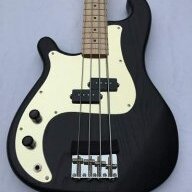





 ) and the third one where I've used bolts and threaded inserts rather just wood screws. The first time I did it because I thought the bass I was building was one I would take to Italy regularly (my wife is Italian and we visit family there often) and so it would help if I could take the neck off to fit it into a suitcase rather than pay for an extra seat or excess baggage. I was sure that normal wood screws were good enough from a strength point of view but I was worried that after 10 times of taking the neck off the screws would begin to lose their bite. Anyway, it worked well so I'm using them again.
 . And given it took me days to work it out in the first place, some written notes probably would have been helpful.... This is probably in more detail than anyone else wants, but it will at the very least remind me how to do it next time!


