• TalkBass has been independent since 1998. Add your voice.
    Create a free account to reply to discussions, view embedded media, and browse with fewer display ads.
    Join freeLog in
    Want zero display ads or expanded classifieds tools? Compare plans.

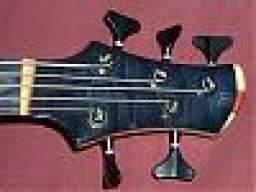
5-String Headstock Opinions

JR, we/builders are NOT supposed to advertise here by starting NAMM Pic Threads.. It's tasteless cheap immature advertising..

NAMM is for the TRADE.. If I have something special to show, I put it up on our website... Currently we are completly sold out with the exception of a few Basses I squeezed out for the Show.. One each 4,5,6 and 7-string.. Ask a friend if you know who is going to take pics of the booth.. I am not bringing a camera...sry.....
 
I for sure say the 2+3 configuration. I just think it looks a little cleaner with only having the B and E strings on top, also, as John Turner mentioned about having only the smaller diameter of the windings wrapping around the post.

As far as the people who don't think they could/would get use to the 2+3 configuration, it takes nothing to get use to at all and personally, I really do think it is more ergonomic. When I purchased my F Bass, it only took a couple of times of tuning to get use to it and I do prefer it now over the 3+2 configuration.

My vote = 2+3, but as you know Ken, some people just can't deal with change.
 
2/3 and here is why...

The 2+3 design allows for more space between the nut and the tuner for the B-string. There have been many issues with certain bass/string combinations where the B string does not have enough space between the nut and the tuner. As a result the string becomes wrapped around the tuner instead of just the silk (NOT a good situation).

So, by ALL means....please...2+3

Thanks, Ken for seeking our opinions on the matter.
 
In medicine, we are always asked to view a patient's problem both subjectively and objectively. (What the patient tells us and what we actually see.) It's a very effective way to evaluate a problem, but it's not 100% perfect. The Physician's objective exam is still going to be somewhat subjective to his/ her prejudices.

With this thought process, the medical community came up with the Double Blind Study (DBS). When a new medication is being tested, some people get the new medication and some get a placebo (sugar pill). The two groups are then evaluate to see how well they did. Some of the sugar pill patients will have improvement in their condition. This is known as the Placebo Effect. Their mind has convinced them that the pill will work, therefor it did eventhough they had no medicine in the pill. That is a single blind study.

In a double blind study, the doctor giving the pills doesn't even know if he is giving the placebo or the actual medication. This is done to eliminate the doctor's influence on the patient when he/ she is giving the medication. This method of testing gives much more accurate out come.

What does this have to do with this thread?

You are saying that the difference between 3+2 and 2+3 is small and varies between people. Is it because of someone's prejudices in B string length or asthetics? You really don't know unless you do a double blind study.

Take 10 of your 5 stringed basses: 5 3+2 and 5 2+3. Cover each of the head stocks with paper bags and secure them with string or rubber bands. Put them in a room and lable the paper bags 1- 10. Make sure they are randomly arranged and numbered. Leave the room and have one of your employees conduct the test without him/ her knowing what bass is what. Then have 10 - 20 players play each bass and evaluate the playability and what ever other features you want of each bass. Then you can evaluate the data and see what configuration plays better and feels better. Of course use the same style bass for all 10 basses. Don't evaluate sound unless you make them all with the same wood, PUPs, etc... This method will eleminate the player's subjective prejudices, thus providing you with more objective results.

On the other hand, I like the 3+2 configuration asthetically. To me the 2+3 is like taking a map of the world and turning it upside down. It just gives me the willies.
 
My vote is 3+2.
I've played your basses which have had the 2+3 and 3+2 (my CR5G, 3+2) and I couldn't tell a difference.
My F Bass is 2+3 and the one I demoed was 3+2, I couldn't tell much, if any.
Your basses are some of the best playing I've ever had the pleasure of playing and hell, the 3+2 just looks good on your headstock!
BTW, offer the old "big head" head stock as on option. With the black veneer-stinkin' classic Smith look!!!
Hey, if enough of us bug him about it, maybe he will ;)
 
The big Headstock is gone because all of you guys out there in 'Smith world' asked for the Smaller head after seeing it on the BMT when we introduced it in 1993. By '96, we made it standard.. Make up your mind guys.....lol....

BTW.. it's lookin like 2/3 is going to be our standard 5er and 3/2 the option.. Thanks for all of your opinions.. I read each and evey one of them.. all Valid.....it's a 'personal' kinda thing.. keep 'em commin if you got 'em.......
 
Ken, that's a good decision in IMO, I really do think the 2+3 headstocks are really coming on strong in the market. In the end, people are still going to get the version they want with you leaving the 3+2 option on the table. Now, if I could only be able to have the pleasure of trying out a BSR bolt-on 5, BSR GN 5, or Fusion. I've been wanting one but nobody in the region carries the American models.
 
KSB - Ken Smith said:
The headstock has an angle between the nut and the tuner post. Closer is steeper an angle and further away is a shallower angel. I have noticed only slight differences between the two designs but I feel something.. Only very slight..

From a mathematical/physics perspective, as the angle after the string break at the nut increases, it will add additional tension to a string, but only if you started with a constant string length and mass at a fixed pitch ... as you increase the angle at the nut, the increasing tension would then affect the pitch, so you would compensate with the tuner key by detuning to get back to pitch. I would have to imagine that on an electric bass the angle of deflection after the nut is negligible (unlike your Double Bass example where string length changes) for a 2+3 or 3+2 configuration.

Personally, I think most people confuse tension (which affects pitch) with stiffness (resistance to flex) based on string constriction materials, core type, wrapping, etc

I simple prefer the 2+3 set-up (like on my Elrick) since it gives a little more room for the "B" string to bend over the nut and allows some of the string core to be wrapped around the tuner post.
 
Bassmanbob said:
Take 10 of your 5 stringed basses: 5 3+2 and 5 2+3. Cover each of the head stocks with paper bags and secure them with string or rubber bands. Put them in a room and lable the paper bags 1- 10. Make sure they are randomly arranged and numbered. Leave the room and have one of your employees conduct the test without him/ her knowing what bass is what. Then have 10 - 20 players play each bass and evaluate the playability and what ever other features you want of each bass. Then you can evaluate the data and see what configuration plays better and feels better. Of course use the same style bass for all 10 basses. Don't evaluate sound unless you make them all with the same wood, PUPs, etc... This method will eleminate the player's subjective prejudices, thus providing you with more objective results.

Probably more importantly, make sure they are all the same scale length and are strung with exactly the same string gauges.
 
sfbassplayer said:
From a mathematical/physics perspective, as the angle after the string break at the nut increases, it will add additional tension to a string, but only if you started with a constant string length and mass at a fixed pitch ... as you increase the angle at the nut, the increasing tension would then affect the pitch, so you would compensate with the tuner key by detuning to get back to pitch. I would have to imagine that on an electric bass the angle of deflection after the nut is negligible (unlike your Double Bass example where string length changes) for a 2+3 or 3+2 configuration.

Personally, I think most people confuse tension (which affects pitch) with stiffness (resistance to flex) based on string constriction materials, core type, wrapping, etc

I simple prefer the 2+3 set-up (like on my Elrick) since it gives a little more room for the "B" string to bend over the nut and allows some of the string core to be wrapped around the tuner post.
If you are considering the nut as a frictionless, this is entirely wrong.

If you take friction into account, there is a possibility of more or less tension between nut and tuner, as controlled by the friction over the nut, which is controlled by the string break angle. However, your following statement about this then affecting the pitch implies that you expect a slip over the nut, and therefore no effective friction at that point, thus negating the rest of the arguement.

I did a spreadsheet analyzing this, it's over in the Luthier's forum.