hello i can use a CGDA tuning in a professional orchestra i don't see why not use it as long as i play in tune and with the right dynamics

Enjoy the benefits of a premium membership!
Upgrade Account
-
TalkBass has been independent since 1998. Add your voice.
Create a free account to reply to discussions, view embedded media, and browse with fewer display ads.
Join free Log in
Want zero display ads or expanded classifieds tools? Compare plans.
You are using an out of date browser. It may not display this or other websites correctly.
You should upgrade or use an alternative browser.
You should upgrade or use an alternative browser.
Double Bass 5ths in professinal orchestra
- Thread starter YurisDoubleBass
- Start date
-
- Tags
- cgda doublebass tuning upright bass
More options
Who Replied?
What do your Principal and the rest of the section think? With the "normal" EADG tuning there is still some room for alternate fingerings but, generally speaking, the best fingerings have everyone using mostly the same positions that also unify string crossings. Then there is no visual disruption. With your suggested tuning your use of positions and string crossings would be different and stand you out visually for the conductor, other players next to you and the audience. I had some trouble because I used EADG but with 1234 fingering when my colleagues all used 124 !! I looked lazy !!!

You absolutely can play 5ths in a professional orchestra. Joel Quarrington has for years, including during his stint as principle of the LSO.
Here is Alex Hanna playing Evahs tuned in 5ths. He is principle of the Chicago Symphony Orchestra. Ignore the extension.
Here is Alex Hanna playing Evahs tuned in 5ths. He is principle of the Chicago Symphony Orchestra. Ignore the extension.
Last edited:
What do your Principal and the rest of the section think? With the "normal" EADG tuning there is still some room for alternate fingerings but, generally speaking, the best fingerings have everyone using mostly the same positions that also unify string crossings. Then there is no visual disruption. With your suggested tuning your use of positions and string crossings would be different and stand you out visually for the conductor, other players next to you and the audience. I had some trouble because I used EADG but with 1234 fingering when my colleagues all used 124 !! I looked lazy !!!
wow, isnt it already enough boredom and uniformity in orchestra?
The two names quoted above are very big, and Principals too. They lead, we follow and think carefully before we question (section politics!). Yes, yuzu, there are lots of traditions in symphony orchestras both visual and musical that can be very stuffy, especially for a young incomer. The sights and sounds of a well-disciplined orchestra attract its audience who are prepared to pay good money. We are working for them in a huge team effort, not just playing for our own pleasure?? The analogy I use for the ultimate team effort is the synchronicity of timing, power and visual beauty of a good rowing eight.
I'm not saying don't use tuning in fifths but am suggesting that it might be wise to discuss with the others in the team.
I'm not saying don't use tuning in fifths but am suggesting that it might be wise to discuss with the others in the team.
Last edited:

If you can win a screened audition, there should be no issue with how you tune.
A couple of years ago I was playing with a local symphonic wind band and a local symphony. I needed low C for a lot of pieces in wind band and a Db in one of the symphony pieces so I put fifths tuning C and G on my bass and kept the D and G from my fourths set. I played Tchaikovsky 6 with that tuning as I wasn't going to be able to restring my bass during intermission. It was a lot of fun and I don't think anyone in our audience noticed my bowing. Our principal was happy that someone in the section had the low Db.
We are not a professional symphony orchestra but we are pretty good for a community ensemble.
All that said, I want a C-extension, that will have to wait a little while.
We are not a professional symphony orchestra but we are pretty good for a community ensemble.
All that said, I want a C-extension, that will have to wait a little while.
- Aug 1, 2005
- 3,546
- 1,421
- Disclosures
- Private Inventor - Bass Capos
...
All that said, I want a C-extension, that will have to wait a little while.
Lot's of people are doing amazing work with 5ths tuning. However, there is no way that a 42" C-string will ever sound as good as a 52.5" C-string.
Lot's of people are doing amazing work with 5ths tuning. However, there is no way that a 42" C-string will ever sound as good as a 52.5" C-string.
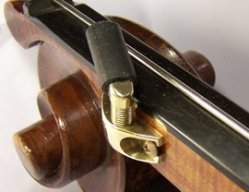
I agree. The handful of times I had to use a C Extension that open C really shook the room. However, I found that the capos were never quite in tune with themselves or the open string. I found it very frustrating. I'll chalk it up to inexperience. As someone who makes extensions for a living, what is your philosophy about the placement of the capos? Thanks in advance!
- Aug 1, 2005
- 3,546
- 1,421
- Disclosures
- Private Inventor - Bass Capos
I agree. The handful of times I had to use a C Extension that open C really shook the room. However, I found that the capos were never quite in tune with themselves or the open string. I found it very frustrating. I'll chalk it up to inexperience. As someone who makes extensions for a living, what is your philosophy about the placement of the capos? Thanks in advance!
Interesting. Full disclosure: I don't make extensions, only the hardware. I have made only one complete unit myself actually, but am in close contact with the many luthiers who buy my parts. I do adapt certain things when luthiers pressure me to do so, but the basic geometry has not changed at all since I started this endeavour.
Were they my Capos? A big part of the motivation to create my product was the limited adjustability of the chromatic gates which were being made in the 1990s. I think that most luthiers who don't use my gates have also moved on to systems which allow for more adjustability, but I still consider my product to be the most adjustable.
One thing is that back in the early '90's a lot of shops weren't very careful about setting the extension nut in the right place. I got my bass back from a major shop once after a fingerboard replacement. When I tuned my bass with the E-gate closed, the open C was way sharp. Physics books say that the extension length should be 25% of the mensure, but in reality it needs to be a bit more. 26.3% for my bass.
So. The first thing to do is verify that the extension nut is properly located. Only then can you start setting the Capos to their proper positions. Whether with my Capos or other people's gates, in the modern world intonation problems are very rarely reported. You do have to forget about your gates and just use your fingers sometimes though. I have done many concerts involving pipe organs where the lowest pipes were terribly out of tune, so you just had to match with your fingers


Lot's of people are doing amazing work with 5ths tuning. However, there is no way that a 42" C-string will ever sound as good as a 52.5" C-string.
This is true but the there is some mitigation due to the 5ths tuned instrument’s general resonance increase as well as by the extended range of the G string.
Interesting. Full disclosure: I don't make extensions, only the hardware. I have made only one complete unit myself actually, but am in close contact with the many luthiers who buy my parts. I do adapt certain things when luthiers pressure me to do so, but the basic geometry has not changed at all since I started this endeavour.
Were they my Capos? A big part of the motivation to create my product was the limited adjustability of the chromatic gates which were being made in the 1990s. I think that most luthiers who don't use my gates have also moved on to systems which allow for more adjustability, but I still consider my product to be the most adjustable.
One thing is that back in the early '90's a lot of shops weren't very careful about setting the extension nut in the right place. I got my bass back from a major shop once after a fingerboard replacement. When I tuned my bass with the E-gate closed, the open C was way sharp. Physics books say that the extension length should be 25% of the mensure, but in reality it needs to be a bit more. 26.3% for my bass.
So. The first thing to do is verify that the extension nut is properly located. Only then can you start setting the Capos to their proper positions. Whether with my Capos or other people's gates, in the modern world intonation problems are very rarely reported. You do have to forget about your gates and just use your fingers sometimes though. I have done many concerts involving pipe organs where the lowest pipes were terribly out of tune, so you just had to match with your fingers
Wow, thanks for the thorough reply! Food for thought the next time I'm using an extension or if I end up buying a bass with one
- Aug 1, 2005
- 3,546
- 1,421
- Disclosures
- Private Inventor - Bass Capos
Good point. with this tuning you don't use the 4th string as much I suppose. I spent many years on a Pöllmann 5 string however. Never liked the response of the lowest string.
I have a question concerning the tuning of capos on on a C-extension. If for any reason, the bridge moves or tilts a little bit (as happens frequently) that would throw away the intonation of the capos. One can still play all other notes in tune, but not the capo-ed notes. How does one deal with this?Interesting. Full disclosure: I don't make extensions, only the hardware. I have made only one complete unit myself actually, but am in close contact with the many luthiers who buy my parts. I do adapt certain things when luthiers pressure me to do so, but the basic geometry has not changed at all since I started this endeavour.
Were they my Capos? A big part of the motivation to create my product was the limited adjustability of the chromatic gates which were being made in the 1990s. I think that most luthiers who don't use my gates have also moved on to systems which allow for more adjustability, but I still consider my product to be the most adjustable.
One thing is that back in the early '90's a lot of shops weren't very careful about setting the extension nut in the right place. I got my bass back from a major shop once after a fingerboard replacement. When I tuned my bass with the E-gate closed, the open C was way sharp. Physics books say that the extension length should be 25% of the mensure, but in reality it needs to be a bit more. 26.3% for my bass.
So. The first thing to do is verify that the extension nut is properly located. Only then can you start setting the Capos to their proper positions. Whether with my Capos or other people's gates, in the modern world intonation problems are very rarely reported. You do have to forget about your gates and just use your fingers sometimes though. I have done many concerts involving pipe organs where the lowest pipes were terribly out of tune, so you just had to match with your fingers
This job is hard enough and auditions rare enough that I would be extremely conservative with any such decision. Good Lord, some orchestras issue horns to their sections for the sake of uniformity and it aint cause everyone sounds the same on every horn! Innovation is great and when you get that Principal chair and don't worry about the Conductor firing you, maybe that would be the time to "let your freak flag fly".
Until then, your risk and YMMV. Good luck with your decision. Make sure it's one you don't regret later.
We ain't talking "should" or outstanding exceptions, just us folks trying to get/hold down a job.
Until then, your risk and YMMV. Good luck with your decision. Make sure it's one you don't regret later.
We ain't talking "should" or outstanding exceptions, just us folks trying to get/hold down a job.
- Aug 1, 2005
- 3,546
- 1,421
- Disclosures
- Private Inventor - Bass Capos
I have a question concerning the tuning of capos on on a C-extension. If for any reason, the bridge moves or tilts a little bit (as happens frequently) that would throw away the intonation of the capos. One can still play all other notes in tune, but not the capo-ed notes. How does one deal with this?
It's not an issue I've ever heard about, but if you do discover that your gates aren't in tune, I suppose the first thing to check would be the bridge placement. Good tip actually!

This job is hard enough and auditions rare enough that I would be extremely conservative with any such decision.
There probably is a big difference between professional orchestras and amateur orchestras. Amateur orchestras are generally not that picky I guess and care less about the players tuning choice. But if professional orchestras have a choice between two equal candidates the tuning choice might be a defining factor and the chance is bigger that they favor 4ths tuning.
But is an interesting topic! I am not totally sure how orchestras generally deal with this these days.


