• TalkBass has been independent since 1998. Add your voice.
    Create a free account to reply to discussions, view embedded media, and browse with fewer display ads.
    Join freeLog in
    Want zero display ads or expanded classifieds tools? Compare plans.

'76 SVT - Issue w/ preamp? power amp? can't tell?

I did the mod on my 70's svt a couple of years before. All works fine, no issues.
That all was at a time when 12Dw7 were hard to get.

To me the sound seems a little bit more smooth with 12AX7. Big advantage is the possibility of tube rollings because the list of different 12AX7 tubes is nearly countless.

In the meanwhile I purchased two sets of 12DW7, JJ and Ei, but currently I have not remod the svt.

The PI stays very unfazed never the less what's plugged in. 12DW7 or any 12AX7 does not cause any difference to the sound.
Very sensitive to tube rolling is the driver stage 12BH7. IMO the driver stage is the most sensitive stage of all, rather then rolling different pentodes.

Very amazing is the current set of pentodes. Two original Magnavox from the 70s, two GE's from the 70's and two GE's from the late 80s (these are the smaller bottle ones).
The 70s Magnavox and GE's are now nearly 40 years inside the amp. It's all Ok and the amp was not regularly giged but eventually it's time now to think about a new set of pentodes ...

I never could understand why ampeg used linear pots for volume. Does anybody have an idea?

Of course there were some issues with this amp in the past.
Red colored pentodes when the amp was just a few weaks old.
Driver stage issue around 1 year later
Rectifier issues around 2 years later.
Supply issues (fried resistor) some years later.
GE pentode failed at gig (wasn't it a GE that stands for reliability ?)
Again issues with supply somewhat later.
Rocker switches issues (solved with grease)
Pot issues (solved with grease)

...did I forget an issue?
Sometimes I had a feel my amp was made by chinamen.

subject cap job. I never did it cause the caps are still fine. I already considered a cap job as a kind of precaution. A German amp desinger did an advise against doing it. He told me that a cap job probably will impact the sound and feel more or less. And as long as the caps are fine it's best way to let it as is.
 
Last edited:

You know what sucks about all of this????

I want to fire that thing up SOOOOO BADLY right now - but my wife and two kids are home, as are my neighbors..........

So it's just SITTING there........UGH!!!!

Thankfully I have a gig Friday night and Saturday.

:bassist::bassist::bassist::bassist::bassist::bassist::bassist::bassist:

Saturday is an outdoor festival. Backline is supplied, but we play first - I might asses the situation quickly. If there is a suitable cab on stage, I might sneak my SVT up there. :cool:
 
Last edited:
By the way - is it my imagination, or is it possible that the amp sounds better, fuller or deeper or richer or something, with the good tube in there? Or is it that I am just not distracted by the alien invasion sounds?
It's possible that the weakness of the tube also caused tonal degradation. But yeah, alien invasion sounds can really distract you from the tone.

Beans' advice about SVT's is always of the highest order, but if it were me, though, I would order a couple 12dw7's and give it a shot in V1. Just do yourself a favor and order NOS. New, the only one making 12dw7's is JJ, and they're built rather sloppy. They sound decent but they look like they were slapped together and always have a lot of build flaws so they don't last very long. NOS 12dw7's seem to have gone up lately, but they're still not prohibitively expensive.

What does the 12au7 half of the 12dw7 do in there anyway, David? You'd think I'd know this by heart by now, huh? ;)
 
  • Like
Reactions: JMacBass65
I would order a couple 12dw7's and give it a shot in V1. Just do yourself a favor and order NOS.

Cool - Yeah, I know Beans word is top notch (as is yours), but I was thinking the same thing - something to check out when I got to it - I'm always happy to mod something, but I like to know where the starting point is. So if DW7 was stock, I'd be inclined to swap it and see what I think. Good news is I got a place nearby that almost certainly will have one in stock. If not, there is always Fliptops.

BTW - Anybody know where I could score a '70 Ampeg logo plate? I made some stupid choices in my early 20's, and the end result is my head looks like this:

IMG_1387.jpg


:rollno::rollno::rollno::rollno::rollno::banghead::banghead::banghead::banghead::banghead::banghead:

I know Fliptops has the grill cloth and faceplate, but they no longer have the logos.
 
The name plate the goes on the grill cloth? Pretty sure I have one kicking around. I don't like them on my amps and they weren't on the earlier amps so I took the one off my 74 SVT when I got it. If I can find it you can have it.
 
What does the 12au7 half of the 12dw7 do in there anyway?

A 12DW7 (7247) is a dual triode, one half similar to a section of a 12AX7, is intended for a gain stage service, the other half, similar to a section of a 12AU7, is intended for cathode follower or phase inverter service. The 7247 is a better performing equivalent with a low noise 7025 in place of the 12AX7. Pins-1, 2, and 3 are section 2 (12AU7); pins-6, 7, and 8 are section 1 (12AX7). One difference between the sections, section 1 has a 1.2W plate dissipation rating, section 2 has a 3W plate dissipation rating. This allows section 2 (12AU7) to have a higher current capacity allowing more drive. There are other differences but it makes it good as a phase inverter.

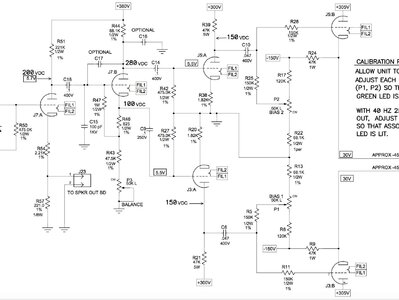
Looking at an SVT schematic, we see that's exactly how they are being used. Section 1 is a gain stage that conditions the signal from the pre-amp, section 2 is a phase inverter. This is followed by a pair of 12BH7's that act as drivers for the power tubes.

But there are several revisions of the SVT: vintage, SVT-HD, SVT-VR, SVT-CL, etc. Are the SVT schematics all the same for these stages? No they aren't. The vintage SVT and the SVT-HD have the same circuits. The VR and CL have basically the same circuit topologies for the gain stage and phase inverter, but they have different component values to optimize the circuit performance for the different tubes being used. Basically, the tubes need to be biased differently. Instead of a 12DW7 and 12BH7's, the VR and CL uses a 12AX7 instead of a 12DW7 and 12AU7's in place of the 12BH7's. To be complete, I've included the circuits below.


If you substitute a 12AX7 in place of a 12DW7 in the gain and phase inverter circuit it will work and was a substitution recommended by MTI who owned Ampeg at the time. It won't perform exactly the same but will be close. The amp can be a little dirtier when pushed, it depends on the brand used and the amp's settings. Some people prefer this.


Vintge SVT Rev F DI.JPG SVT-HD PI.JPG SVT-VR PI.JPG HSVT-CL PI.JPG
 
  • Like
Reactions: JimmyM
BTW - Anybody know where I could score a '70 Ampeg logo plate? I made some stupid choices in my early 20's, and the end result is my head looks like this:

I've bought them on ebay. The prices vary. The fliptop face panels that I've bought are good quality but a bit thinner than the originals. You'd never know the difference once installed though. The early SVT heads did not have a logo on the front face frame. I prefer them that way as well. But if you want historically correct, you gotta have one.
 
Ummm....yeah, sure we do. WOW!

I am a fairly smart guy, but once you get past basic point A to point B signal flow, I loose the plot.

You amp guys blow my mind.

You're right about them being complicated. Even simple circuits can be very difficult to understand. Most people rely on computers to model them these days. Those attachments were included just as a reference for those who are curious.
 
Last edited:
  • Like
Reactions: JMacBass65
You're right about them being complicated. Even simple circuits can be very difficult to understand. Most people rely on computers to model them these days. Those attachments were included just a reference for those who are curious.

The manuals, schematics, all that - great stuff and thanks for posting, I find it all interesting. I can kinda read a schematic, but what is really happening, or the implications of using this component or that one, different designs and so on, right over my head.
 
  • Like
Reactions: beans-on-toast