• TalkBass has been independent since 1998. Add your voice.
    Create a free account to reply to discussions, view embedded media, and browse with fewer display ads.
    Join freeLog in
    Want zero display ads or expanded classifieds tools? Compare plans.

a cab with two different LF drivers

Hello,
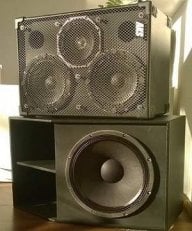
I'm considering building a cab with 6" speaker (B&C 6NDL38) and 8" speaker (B&C 8BG51 or PDN.8BM30 if still available) wired parallel to 4Ω, no crosover. For years I'm using these speakers in two homemade small ported boxes put one on the other, and I like the sound and practicability of this micro rig. I need a second pair of cabs like this, for transport reasons. For the sake of mass transit, I'm thinking about putting them together in one box. I haven't really found such a solution discussed (or made) for bass usage. I built a few boxes for my use, but I'm not knowledgeable enough to say why.

I can think of two constructions:
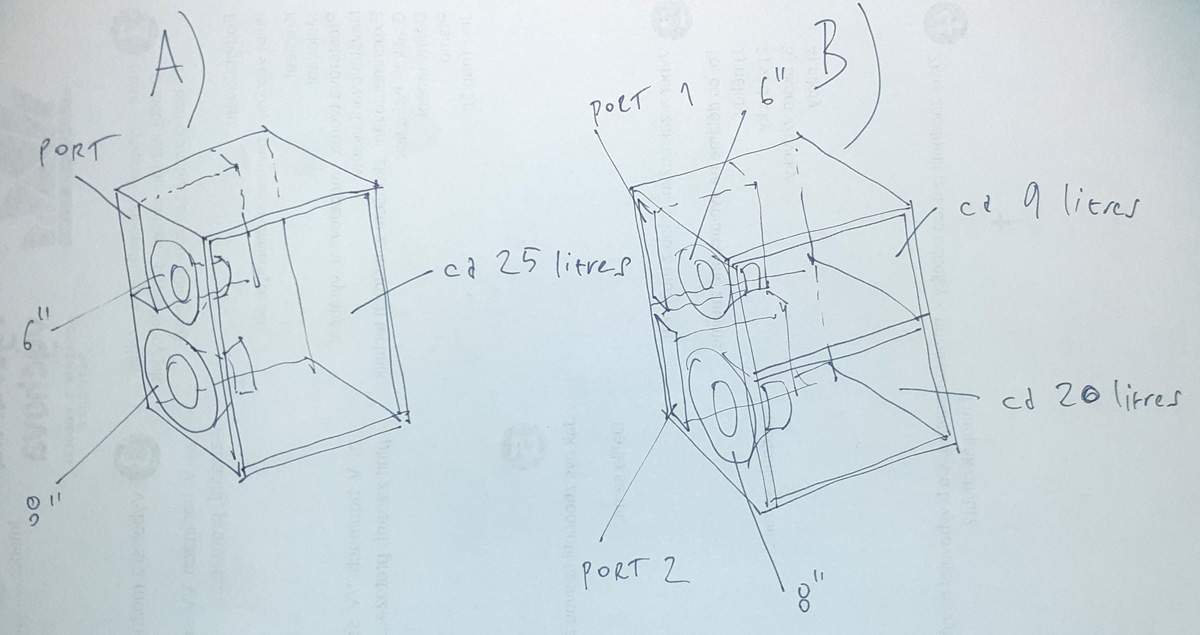
20220617_224144.jpg

A) both speakers occupy the same inner space of the cab, and there's just one slot port for both of them (tuned somewhere in between of both Fb's, likely some 55 Hz).

B) the inner space is dilated into two separate chambers, each size and port would be optimized for each speaker.

Which construction is better? From my perspective, A might be a bit smaller and lighter, and B might be more precisely tuned (and the cab more solid).

For A, please advise on how to compute the inner volume. For the sake of computation in Boxsim, I need to know 'how much inner space' each speaker will 'use'. 6NDL38 has a 9l cab recommended, 8BG51 has 19l. Do I divide the inner space by this ratio? Do I compute whole inner space for both? Or is there is another way? Or it is impossible?

Thank you!

 
If your goal is to go as small as possible, just use the 8" assuming it can handle bass frequencies. What is the point of having the 6" driver?

You may even be better off just getting a 10" driver that will handle lows better.

But no matter what, you can't have them share airspace just like Agedhorse said.
 
What is the point of having the 6" driver?
I found experimentally that this combination does everything I need exactly the way I want. I don't like too much lows and I need to hear the (upper) mids well. On most stages I hear the boomy lows from the stage PA anyway.

As for the 'don't combine 6 and 8', I agree, and will do it that way. If you'd be so kind to educate me, please elaborate the reasons. I'd appreciate a link to good literature, preferably online, as these things are hard to find for non expert.

Anyway, thank you very much!
 
Since you are in the lab crafting a new box may I make a suggestion? Consider making 2 new cabinets, one for 2 8 inch drivers and the other for the 2 6 inch drivers. The dual 6 box would be extremely portable, the dual 8 would be for louder situations, and you could combine both when you really want to be loud. As a bonus stacking 2 cabinets will bring the speakers closer to your ears for better personal monitoring.
 
I found experimentally that this combination does everything I need exactly the way I want. I don't like too much lows and I need to hear the (upper) mids well. On most stages I hear the boomy lows from the stage PA anyway.

As for the 'don't combine 6 and 8', I agree, and will do it that way. If you'd be so kind to educate me, please elaborate the reasons. I'd appreciate a link to good literature, preferably online, as these things are hard to find for non expert.

Anyway, thank you very much!
Two different drivers operating in the same air space fight each other like two different springs trying to control the same mechanical load.
 
Two different drivers operating in the same air space fight each other like two different springs trying to control the same mechanical load.
That’s the best description of a prototype 10”+12” cabinet I encountered from a major manufacturer. I rented it for a gig (hah! Stupid!) and certain notes were twice as loud while other notes disappeared. I didn’t notice this at low volume in the shop, but at bar level it was evident. I really wanted to like it, as I’m attracted to slightly oddball stuff, but it was unusable.
 
Two different drivers operating in the same air space fight each other like two different springs trying to control the same mechanical load.

This sounds right to me, using common sense. And yet, I believe most cabs with two same speakers are made to work in the same air space, right? Since the movement of the speakers is synchronized by the music signal, how it is that the same speakers 'cooperate', while different speakers 'fight'?

Hopefully this is not taking too much of your time. I'm asking only because I find this stuff fascinating. Thanks again!
 
Two different drivers operating in the same air space fight each other like two different springs trying to control the same mechanical load.
...maybe it's just me, but I always find it very helpful when electrical engineers use a mechanical analogy to explain something...it's just so much clearer! :)
 
...maybe it's just me, but I always find it very helpful when electrical engineers use a mechanical analogy to explain something...it's just so much clearer! :)
Can also make mechanical engineers shudder ;)
 
Can also make mechanical engineers shudder ;)
The longer I've been in the profession the more similarities I find between many areas of electrical and mechanical engineering (e.g control theory, system modelling, etc.). I only wish I'd understood that more clearly earlier in my career...I would have gotten a lot fewer looks of frustration from EE colleagues. :)
 
Consider making 2 new cabinets, one for 2 8 inch drivers and the other for the 2 6 inch drivers.
It looks like as if the OP won't get the wanted results with eiter two 8" drivers nor with two 6" drivers

I found experimentally that this combination does everything I need exactly the way I want.
To me it makes no sense (nothing at all) to suggest something which the OP is by far not looking for.
 
I'm wondering what this combination does that a pair of 6's or a pair of 8's doesn't do. Did your experimentation include these possibilities?
Propably the combination does semething which the OP won't get from either two of anything?
I didn't ask him a question WHY but, it looks like as if he has got some reason just doing it.
 
Last edited:
It looks like as if the OP won't get the wanted results with eiter two 8" drivers nor with two 6" drivers


To me it makes no sense (nothing at all) to suggest something which the OP is by far not looking for.

The OP stated that they already had a single 8 and single 6 inch cabinet and they wanted to supplement that with another 8 and 6 inch cabinet. This is in the third sentence of the OP. Doing as OP was suggesting would equal 4 drivers total, 2 6 inch drivers and 2 8 inch drivers in 3 separate boxes. My suggestion was to utilize these same 4 drivers in an optimal situation where identical drivers would share the same airspace in 2 different enclosures. To me it seems like an elegant solution. I would rather carry 2 boxes than 3 if transportation is a consideration and having identical drivers will help the enclosure be tuned optimally which will maximize performance.

I apologize if this offends you or if you can’t see how this would be a viable option. Square pegs can fit in round holes if you try hard enough. My favorite cabinets has mixed drivers in the same airspace, though I would not recommend building one because better results can be achieved with the same ingredients used differently.
 
  • Like
Reactions: Wild Rice Chris
The OP stated that they already had a single 8 and single 6 inch cabinet and they wanted to supplement that with another 8 and 6 inch cabinet. This is in the third sentence of the OP. Doing as OP was suggesting would equal 4 drivers total, 2 6 inch drivers and 2 8 inch drivers in 3 separate boxes. My suggestion was to utilize these same 4 drivers in an optimal situation where identical drivers would share the same airspace in 2 different enclosures. To me it seems like an elegant solution. I would rather carry 2 boxes than 3 if transportation is a consideration and having identical drivers will help the enclosure be tuned optimally which will maximize performance.

I apologize if this offends you or if you can’t see how this would be a viable option. Square pegs can fit in round holes if you try hard enough. My favorite cabinets has mixed drivers in the same airspace, though I would not recommend building one because better results can be achieved with the same ingredients used differently.
If I understand the OP right then he needs "a second pair" of cabs to his existing "two ones" which are 6" cab and 8" cab in particular.
For more practical reasons he intends to put the "second pair" into one cab size format.

So in total the OP intends to have:
6" cab (already existing)
8" cab (already existing)
6" 8" cab which he actually intends to build.

In particular he could also build a 6" cab and a 8" cab which (in total) would provide him with just the same sound in total but, he wants to build a 6" 8" cab.
I see nothing wrong with his intention to build only ONE cab instead of TWO

My suggestion was to utilize these same 4 drivers in an optimal situation where identical drivers would share the same airspace in 2 different enclosures.
Nobody here suggested him to put the 6" and 8" drivers into just the same chamber?

To me it seems like an elegant solution. I would rather carry 2 boxes than 3 if transportation is a consideration and having identical drivers will help the enclosure be tuned optimally which will maximize performance.
If the OP would put the 6" and 8" into seperate cabs then he would end up with 4 cabs instead of 3 cabs (which actually follows his intention).

With seperate chambers for each driver (as suggested above) the chambers can be optimally tuned anyway.
Thus performance was maximized even for a single 6" 8" cab
 
Last edited: