• TalkBass has been independent since 1998. Add your voice.
    Create a free account to reply to discussions, view embedded media, and browse with fewer display ads.
    Join freeLog in
    Want zero display ads or expanded classifieds tools? Compare plans.

A decent thickness sander for the $

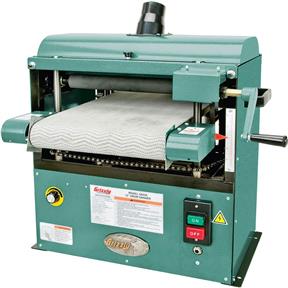
I've been very happy with my Grizzly Baby Drum sander, quite nice for the price. I've run a lot of wood through mine and it works very well. The only thing I had problems with was the power switch died, easily replaced though.
http://www.grizzly.com/products/12-Baby-Drum-Sander/G0459
g0459.jpg

Dirk
 
I've got the little Performax (Jet) 10-20. It is a little underpowered, but it does the job if you are careful with the feed rate and don't try to take too much off in one pass.

I got it for a steal. So, I couldn't pass on it. When it dies I will upgrade to the 16-32.
 
I've been very happy with my Grizzly Baby Drum sander, quite nice for the price. I've run a lot of wood through mine and it works very well. The only thing I had problems with was the power switch died, easily replaced though.http://www.grizzly.com/products/12-Baby-Drum-Sander/G0459
g0459.jpg
Dirk

Been using the baby drum sander for over a year and have been very happy with it. The proplem with this unit is the capacity. None of my instruments are small enough that I can run tops after they are glued up, but for neck laminates and fingerboards this sander has everything you need. I would suggest a 16" capacity machine for luthiers. If you make any acoustic or acoustic bass guitars then something over 18" would be a better idea. Grizzly makes a larger 16" version of this sander that I regret not buying but that is a lot of extra size and weight.
 
I have the 18" grizzly
IMG_0158_2-1-1-1.gif


works absolutely fantastic, I like it better than my 16-32 performax I used to have, but either is a good choice, along with the 18-36 Delta.

Look to Ebay, these things are always on there for $375 to $600, and by selecting nearest first, you can find one close to you, and save big $$$. I got my grizzly on sale, with a discount card from Grizzly for under $800 loaded into my truck, but I was at the showroom in Muncy, PA. Their shipping is reasonable.
 
I'm glad you guys are chatting about this right now... I'm about to pull the trigger on that Grizzly Baby Drum but the decision is a little tougher now since the input on the 16" and 18" wide ones...

The mind is willing but the wallet is weak!!!

I'm wondering if any of you have an available couch for when this unapproved purchase shows up and my wife answers the door... :)
 
Nice... I use a 16-32 (original, not plus) for most of my stuff... it's started to develop an "out of balance warble" when sanding, though when running under no load, it doesn't seem out of balance. I have to take small bites (no more than 1/64" on even the softest woods, and it goes through belts like crazy. Seems like they gum up faster now than they used to.

Good luck on that Jet 18"!
 
were keeping our fingers crossed for ya Jason

Shawn...do you keep the belts cleaned with a rubber cleaner? These definately help to add life, and also look to the brand of belt you are buying. Some of them have a tendancy to collect pitch quicker, especially if you are running a lot of soft woods through and mixing it with hardwoods. This combination creates and almost paste like effect on sandpapers.
 
I bought the Grizzly Baby Drum sander because of a recommendation on another similar thread here. It really does a great job. Actually removes planer snipe, which is my favorite thing about it. Just be careful...

I experienced a common issue with the drive belt sprocket. If you have the belt speed too fast, or crank down just a little too far on the thickness, the wood can jam up and sheer off the forks on the sprocket. That's a $30 repair with a replacement sprocket in the motor. I did it twice before I caught on. That was at 120 grit paper and close to full speed...so I slowed it down to fix that problem. I mostly use it with 60 grit paper now too.
 
We have been limping along with an older two-drum Performax in one of our labs at school for several years, and student use has taken a toll. We admonish students to take very light passes (~1/200" per pass). Nevertheless, the stock conveyor continues to go out of parallel with the sanding drum, and we spend a lot of time maintaining it. A cantilevered sanding head seems less robust than a fully supported head, or a stationary head with an adjustable infeed table.

Because this machine is so tempermental, and we have hundreds of students using this machine every semester, we keep it padlocked, and we require staff to supervise student use. No oily (e.g., cocobolo) or resinous (Pine) species are allowed because they load up the abrasive belts very quickly. Staff cleans the abrasives with a "booger bar" several times a day.

We're replacing the Performax with a largish unit from Grizzly this semester. I'm eager to see how well the Grizzly works in our hellish environment.
 
were keeping our fingers crossed for ya Jason

Shawn...do you keep the belts cleaned with a rubber cleaner? These definately help to add life, and also look to the brand of belt you are buying. Some of them have a tendancy to collect pitch quicker, especially if you are running a lot of soft woods through and mixing it with hardwoods. This combination creates and almost paste like effect on sandpapers.

I've been using the Jet branded belts pre-cut for the machine. Also, I use either a bristle brush or a brass wire brush lightly while spinning the drum ti clean the abrasive. Not the best way, I'm sure, but what I have on hand.