I have both active and passive basses. All of my active basses (except my EBMM Stingray5) have an active/passive switch.
That said, let me dispel some myths:
- Your battery will die on a gig: No it won't if you are diligent about changing your batteries. Two of my basses have a low battery indicator on them that will blink when the battery is getting low. I've tested to see how long it will blink before the battery goes completely dead. It was a LONG time. Secondly, batteries don't just "die", they slowly fade away over time. You might notice you get some distortion or lower output. That's an indicator that your battery is on the way out. The only way your battery will die on a gig is if you never change it until no more sound comes out of your bass. That's pretty foolish.
- Passive basses are more "vintage" sounding / active basses are "modern" sounding. Complete and utter hogwash. An active bass typically has an EQ. My preamp of choice is the John East preamp. You can configure his preamp to have a flat response or a preshape. The preshape has a great vintage tone. Warm and fat. If your active bass sounds "modern" it's because you have a preamp that is coloring the signal to make it sound that way. It has nothing to do with active/passive. An active bass will typically have a volume increase (although quality preamps allow you to attenuate the active output to match it to the passive) and you will get a little brighter top end as the pickups won't be loaded as much and the cable length won't come into play. But most of us are plugging into a buffered pedal of some sort. If you don't want the extra top end, roll off the treble control or use the passive tone control many preamps include. With a passive bass, you get what you get. You might be able to cut top end using a tone control and some passive basses have a bass cut function as well...but you're very limited. An active bass can be whatever you decide it is.
- Active basses are too much to fiddle with. Again, it's your choice. You can fiddle with it, or you can set it and forget it. That's what I do most of the time. I seldom use the onboard EQ except for minor tweaks. I run an external preamp as well and that is where my major EQ comes from as well as my DI. If you want to fiddle with the EQ and the myriad of internal DIP switches and pots some preamps have...you can do that. Or you can just play it the way it comes out of the box. That's all up to you. You DO NOT have to fiddle with an active bass to make it sound good. Set everything at noon and go play. You will get a great tone if it's a good bass.
- I'm old school and I don't like active basses Great. I'm 50 years old, so I'm old school too. That's why I love active basses. They have been around since the 60's (perhaps earlier??). That's pretty old school. A good quality preamp will have a passive switch. Why? Well, it's not a "bail out" switch if the battery dies (see point #1). It's just another tonal option. The John East preamp I mentioned above has two circuits in it. One is active and one is completely passive. The two share nothing. The volume has two circuits. Same with the tone control which works in active or passive mode. You can set the bass up to have a great passive tone, the flip the switch to dial in a different tone with your EQ. Then you can go between them with the flip of a switch (or the pull of a knob). An active bass can do everything a passive one can do...and more. Not true the other way around.
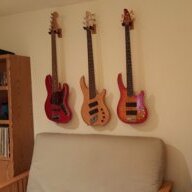
I love my passive bass. I've owned many, but currently only have one. A P bass with LaBella flatwounds. It's my one trick pony. The rest of my basses are all active. Two of them have the John East preamp. One of them is a G&L L-2500 and the active mode on that bass doesn't impact the EQ which is cut only. It does have a treble boost mode, but that's it. It's really more about pushing a stronger signal. It's very transparent. My Stingray preamp is very usable. Not super flexible as there is no passive mode, no selectable EQ points, etc. It just a bass, mid, and treble control. It works. But John East does make a Stingray preamp which might find its way into that bass some day.

It's really not about one being better than the other. There have certainly been a lot of hit records made with passive basses. It's about options and the ability for a bass to cover more tonal ground. If that appeals to you, go active. If not, then passive is your huckleberry.