• TalkBass has been independent since 1998. Add your voice.
    Create a free account to reply to discussions, view embedded media, and browse with fewer display ads.
    Join freeLog in
    Want zero display ads or expanded classifieds tools? Compare plans.

Adjustable heat pickup

With all the discussion around the internet about winding coils, specifically about how many turns to use to get the right tone, I'm surprised I've never seen what I think is an obvious mod to at least experiment with-- variable windings. Obviously you can't change the number of turns on a coil. But you could tap a coil and wire a blend pot between the two outputs. That might not produce exactly the same result as winding a coil differently but it seems like a fun experiment. It should add flexibility to a tapped coil beyond what a simple switch can do.

Has it been done? I haven't seen it, but I'm only 17% of the way through the internet. Any reason it wouldn't work?
 
  • Like
Reactions: Funky40
I haven’t seen anyone tie coils of a humbucker to blend pot, but it seems entirely doable.
Given the two coils are so close together, if they have equal winds, I doubt someone could tell a difference between the two.

If one coil had more winds than the other or different types of magnetic slugs in one coil vs the other (Alnico II vs V), perhaps. But again, you have the co-location problem.

As all real estate salespeople know: location, location, location. The same pickup put in two locations will produce two noticeably different tones (e.g., Jazz bass, Les Paul). Location matters. It’s a bit like mic placement on a voice or a speaker. Similar pickups in the same location will produce similar sounds.

Give it a try and let us know what you find out.
 
You guys are talking about two different things. A coil tap is a single coil that is accessed at two different points - usually at the terminus and at some point before that, like 100% and 80% of the entire coil. A coil split is a single pickup that has two coils, with a switch to turn one of them off.

Both provide tonal variations. And since the two-coil pickup is essentially two single coil pickups in a single housing, a blend knob would work just as it normally does.

I’ve never seen anybody use a blend pot on the two outputs of a tapped pickup; I do find the idea intriguing, but I can’t predict how it would behave.
 
I'm glad to see I'm not completely off the rails with this idea. I plan to give it a try. But it will be a few weeks at least. I don't have the tools to wind pickups, haven't seen any tapped bass pickups for sale.

Instinctively, I worry it might just be an inefficient, complicated way of cutting the volume a bit.
 
  • Like
Reactions: Torrente Cro
It's been done at least a couple times. I tried it once, it behaved according to theory. In practice I did not find it useful to have the adjustable control, since it basically just made for a pickup that slowly got weaker and less interesting once it was past it's optimal point. And why have a control that does that when you can just "hard wire" the optimal point that you like the most?

Although I think @ctmullins is totally correct in saying that coil tapping (a single coil pickup) vs coil splitting (cutting out one coil of a two coil pickup) are inherently different things, at the end of the day the theory is pretty much the same and the result is very similar. If you put a tap at 90% on a single coil pickup, you now essentially have two pickups - one with 90% of the original winding and one with 10%. They just happen to be wound around the same magnet. You can leave them both on, or turn off the 10% by shorting it with a switch, or use a "blend pot" to blend between them, or use a switch with a fixed resistor to get some other result in between.
 
Instinctively, I worry it might just be an inefficient, complicated way of cutting the volume a bit.

Kind of, yes. It will change output, more or less linearly with the number of turns you change and how far you turn the control. And it will change tone, since you're changing the electrical properties of the pickup (it's resistance and capacitance). The result depends on what you start with, but as you lower the pot on the tapped windings, the pickup's tone will generally get brighter as the pickup's output gets weaker. As long as you use a reasonable value pot the pickup will sound no different when at "full."

So ultimately it isn't practically useful (in my opinion) considering the other options we have at our disposal that are more flexible and have fewer downsides. For instance, instead of doing this on a single coil, you could do it on a dual coil humbucker, and then you'd have even more tonal range, plus humbucking noise rejection. Or if your goal was to alter the tone of a single coil pickup, you could just build a network of caps and resistors controlled by switches and add/remove them to the circuit. That would pretty much get you a similar result with much more control and flexibility.
 
It's been done at least a couple times. I tried it once, it behaved according to theory. In practice I did not find it useful to have the adjustable control, since it basically just made for a pickup that slowly got weaker and less interesting once it was past it's optimal point. And why have a control that does that when you can just "hard wire" the optimal point that you like the most?

Although I think @ctmullins is totally correct in saying that coil tapping (a single coil pickup) vs coil splitting (cutting out one coil of a two coil pickup) are inherently different things, at the end of the day the theory is pretty much the same and the result is very similar. If you put a tap at 90% on a single coil pickup, you now essentially have two pickups - one with 90% of the original winding and one with 10%. They just happen to be wound around the same magnet. You can leave them both on, or turn off the 10% by shorting it with a switch, or use a "blend pot" to blend between them, or use a switch with a fixed resistor to get some other result in between.

One of the thoughts that goes through my head constantly is that knobs are overrated. I genuinely believe most of the fiddling players do with the knobs is pointless in the context of playing music with a band, especially in a live setting. So hardwiring a tone into the bass is absolutely something I've considered. On the other hand, you can't usually tell up front what values you need in a circuit to get the results you want. Controls give you a degree of flexibility in choosing components. You can always use a pot to dial in the right noise then measure the resistance across it at that point and replace it with a resistor of comparable value.
 
  • Like
Reactions: ctmullins
One of the thoughts that goes through my head constantly is that knobs are overrated. I genuinely believe most of the fiddling players do with the knobs is pointless in the context of playing music with a band, especially in a live setting. So hardwiring a tone into the bass is absolutely something I've considered. On the other hand, you can't usually tell up front what values you need in a circuit to get the results you want. Controls give you a degree of flexibility in choosing components. You can always use a pot to dial in the right noise then measure the resistance across it at that point and replace it with a resistor of comparable value.

I totally agree! In a live band setting, there are just a handful of useful tones, and "tweaking" them in that context is an exercise in futility. I much prefer switches on the stage.

In the studio, of course, it's a completely different situation. In the studio, infinite adjustability is desirable, as you have the luxury of spending the time to find just the right tone before tracking.
 
I'm not quite seeing how a blend pot could work for this application. (But this might be a bit above my intelligence ceiling...)
Multiple coil taps going to a rotary switch might be a better way to approach this if you're looking for a range of available onboard settings. Could stop there, or keep going and route each setting to its own input on a custom onboard preamp that could compensate for gain on the lower winding sources & buffer the higher impedance ones. If all went well one might wind up with a nice span of rapidly-selectable settings on one knob, from active/hi-fi to overwound/medicine-ball.
 
I'm not quite seeing how a blend pot could work for this application. (But this might be a bit above my intelligence ceiling...)
Multiple coil taps going to a rotary switch might be a better way to approach this if you're looking for a range of available onboard settings. Could stop there, or keep going and route each setting to its own input on a custom onboard preamp that could compensate for gain on the lower winding sources & buffer the higher impedance ones. If all went well one might wind up with a nice span of rapidly-selectable settings on one knob, from active/hi-fi to overwound/medicine-ball.
A switch with multiple taps is definitely the most accurate way to get specific turn counts out of a pickup. I'm not entirely sure a pot would even produce the same results at its min/max as a switch would with the same pickup. The idea behind the pot is that it lets you get between the tap points that would be fixed with a switch. Maybe. If you put a tap at 7,000 turns and another at 8,000 a switch won't tell you if 7,500 turns might have been a sweet spot. But there's no guarantee a blend pot would produce the same result as an actual tap at 7,500.
 
I'm glad to see I'm not completely off the rails with this idea. I plan to give it a try. But it will be a few weeks at least. I don't have the tools to wind pickups, haven't seen any tapped bass pickups for sale.

Instinctively, I worry it might just be an inefficient, complicated way of cutting the volume a bit.

i bet you actually do have the tools to wind pickups. If you have a drill and some scrap wood, all you’d need is pickup wire, magnets, and flatwork. And the counter referenced in the thread if you wanna get fancy

simplest DIY pickup winder that's accurate
 
  • Like
Reactions: SouthernGorilla
Drill based winders are a great way to get started. The one big factor that they often leave out is tension control and a way to limit the transverse motion of the wire (to keep it between your flatwork). If you stick to low RPMs you can do both "by hand" but it's a steep learning curve. You can make a tensioner and transverse with some odds and ends (blocks of wood with felt between them for the tensioner, dowel or rod with collars on it for the transverse). An afternoon of practice and you will know for sure if you like 7,500 or 8,000 turns the best!
 
Although I think @ctmullins is totally correct in saying that coil tapping (a single coil pickup) vs coil splitting (cutting out one coil of a two coil pickup) are inherently different things, at the end of the day the theory is pretty much the same and the result is very similar. If you put a tap at 90% on a single coil pickup, you now essentially have two pickups - one with 90% of the original winding and one with 10%. They just happen to be wound around the same magnet. You can leave them both on, or turn off the 10% by shorting it with a switch, or use a "blend pot" to blend between them, or use a switch with a fixed resistor to get some other result in between.
Idle thought: How would it sound to make a tappable pickup that had 40ga wire for 33% of its windings and 43ga wire for 66% of its windings? Roughly the same amount of metal in each set of windings, but one would have considerably higher resistance (and capacitance would also be different, I think?) than the other.
 
The blend between two portions of a coil is an interesting idea for sure, but I think it would probably be more fiddly and annoying than just having multiple switchable taps off the same coil. I really dig the old Seymour Duncan "Active EQ" pickups with the tiny little switches on them that essentially did something similar to what a coil with a ton of different taps would. Here is a response graph of the different switch combos from one of those pickups:
hGW70ih30r6uzUy36wuKa8I5KGXJwD5uu2IpvAQ8uFJRdLGQjrOecMy5pB8AtQOe4EytOoeQr7qm4vpo13tfIivwlYfu48z4.jpg

A passive version of something like that could definitely be fun to play round with.
 
I'm only 17% of the way through the internet

:D

Be easy enough to use an existing pickup and throw some turns on it

Well, I'm old enough to have been into pickup winding since before the Internet. And yes it has been done. In fact one of the first pickup mods was to overwind them. IOW, add more windings over the top of the originals. And this lead to "tapped" coils, where the original end of the coil still had a wire going to it, so you could wire it to a switch and go back to the original pickup tone.
 
  • Like
Reactions: spiritbass
Any reason it wouldn't work?
It'll do something, but not what you want it to. Pickups are reactive devices - their impedance varies with frequency. A potentiometer is a resistive device - it's impedance doesn't. The net result of blending two taps on a pickup will not be the same as a third tap with a number of windings in between the first two - it'll have a bunch of damping (due to the resistance), and the inductance won't be the same, so what you'll get won't have a resonant peak in the curve like a normal winding - it'll sound duller/lifeless.

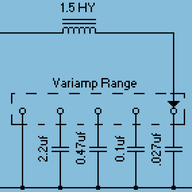
A way to get more of what you probably want (that already exists) is the Varitone thing (The Seymour Duncan curves show the same idea) - you load the pickup with different capacitances, so you get the same sounds as with different numbers of turns, but without the volume variation. By careful choice of capacitors, you can get the steps between setting as fine or as wide as you want.