• TalkBass has been independent since 1998. Add your voice.
    Create a free account to reply to discussions, view embedded media, and browse with fewer display ads.
    Join freeLog in
    Want zero display ads or expanded classifieds tools? Compare plans.

Double Bass Adjusting Stenholm C-extension

What suggestions do you all have for adjusting a Stenholm C-extension on a Double Bass?

Here's some history I found online regarding the introduction of the Stenholm C-extension in the United States:
  • 1950s–1960s — Appears in major U.S. orchestras, including Cleveland and Philadelphia.
  • 1966 — Four New York Philharmonic bassists already using extensions when Orin O’Brien joined.
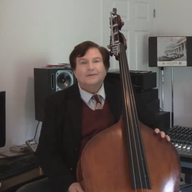
The Stenholm C-extension on my double bass was already on when my teacher at Indiana University Music School (Murray Grodner) bought this instrument from Philip Sklar, when they were both in the NBC Symphony Orchestra in the early 1950s. I wonder which luthier would have installed it, and where.
 
What part of the extension needs to be adjusted? Sometime the pads slip or the small springs weaken. A common problem (frustration) is when the E is in tune, the C isn't (or vice versa) and then you start nudging the bits and pieces around! I've had one on my bass for 15 years.
 
  • Like
Reactions: Don Kasper
What part of the extension needs to be adjusted? Sometime the pads slip or the small springs weaken. A common problem (frustration) is when the E is in tune, the C isn't (or vice versa) and then you start nudging the bits and pieces around! I've had one on my bass for 15 years.
Murray Grodner (double bass professor at Indiana University and founder of Lemur music) used black electrical tape over the pads to provide a little give. This trick was especially helpful when latching E pad closed. Is there a better way?
 
Last edited:
Are the pads made of rubber? Are they OLD? If so, they may need replacing by your Luthier, or YOU, if you're Handy.
Also - many Extension installations of that era, (and currently) were calculated using the "...1/4 of the E string length" for calculating the length of the C Extension - this is INCORRECT and will cause the open C to be TOO SHORT, which leads to the "C vs. E" intonation issue that Louis mentioned.
Can you measure the length of your C string (bridge to nut) and your E string (bridge to closed E stop) and post it here?
There may be an improvement in your future. I can provide the correct measurements/placement of the C nut AND the exact locations of the chromatic stops for Db,D,Eb.
Thanks.
 
  • Like
Reactions: Leo Smith
Are the pads made of rubber? Are they OLD? If so, they may need replacing by your Luthier, or YOU, if you're Handy.
Also - many Extension installations of that era, (and currently) were calculated using the "...1/4 of the E string length" for calculating the length of the C Extension - this is INCORRECT and will cause the open C to be TOO SHORT, which leads to the "C vs. E" intonation issue that Louis mentioned.
Can you measure the length of your C string (bridge to nut) and your E string (bridge to closed E stop) and post it here?
There may be an improvement in your future. I can provide the correct measurements/placement of the C nut AND the exact locations of the chromatic stops for Db,D,Eb.
Thanks.
The length of the C string from the C nut to the middle of the bridge is approximately 53 3/4 inches. I would appreciate it if you could provide me with the exact locations for the chromatic stops. Thank you in advance.

Just a few minutes ago I made a practice track with strings and piano sounds using a keyboard. 4 bars of C long tone followed by 4 bars of E long tone...repeating. Once I tuned the C string of my double bass to the track, the E when pressing down the lever was in tune. Sounded great with the soundtrack. I'll check this more closely with a tuner.
 
  • Like
Reactions: Don Kasper
The length of the C string from the C nut to the middle of the bridge is approximately 53 3/4 inches. I would appreciate it if you could provide me with the exact locations for the chromatic stops. Thank you in advance.

Just a few minutes ago I made a practice track with strings and piano sounds using a keyboard. 4 bars of C long tone followed by 4 bars of E long tone...repeating. Once I tuned the C string of my double bass to the track, the E when pressing down the lever was in tune. Sounded great with the soundtrack. I'll check this more closely with a tuner.
OK.
I'll need your E string length (as exact as possible ) and please recheck your exact C string length (not "approx....")
This will help me calculate the chromatic stops.
Thanks.
 
So, for a C string length of 53.75", the resultant chromatic stop locations are shown below..
Here is the data:

53.750" fret scale

fretfrom nutfret to fret
13.017"3.017" (nut-1)
25.864"2.847" (1-2)
38.552"2.688" (2-3)
411.089"2.537" (3-4)
 
Last edited:
Here is a way to calculate the position of the Stenholm extension stops that I found with the help of Chat AI.

My C-string is 53.75 inches from extension nut to the bridge. So, the E stop the distance should be 11.09 inches from the C-string nut near the top of the Stenholm extension, according to the formula below.

Therefore, the string length from the E-stop nut to the bridge should be 53.75 inches - 11.09 inches = 42.66 inches.

I measured my bass with a metal ruler. These distances are correct. Intonation is good using a digital tuner as well as by ear with an audible sine wave.

To shorten a vibrating string by n semitones, the remaining vibrating length becomes:

image.png.a9fc9029df54338d9f2c529d27b0c80a.png
Where:

  • L0 = open‑string length (your C string is 53.75 inches)
  • n = number of semitones above the open string
  • Ln = vibrating length when stopped at that pitch
The distance from the nut to the note is:

image.png.6b986756da51601beddd880196cd77b1.png

This table shows the positions for the other stops on the Stenholm extension with the C string length of 53.75 inches on my bass.
image.png.0e481b2be1331c4814e31f367f2f4960.png
 
So, for a C string length of 53.75", the resultant chromatic stop locations are shown below...(I've calculated the theoretical E string length using Maths...)
BUT! Only if the E string length is 41.86"...It is crucial to know the E string mensure to make an accurate measurement of the C ext & stops.
Here is the data:

53.750" fret scale

fretfrom nutfret to fret
13.017"3.017" (nut-1)
25.864"2.847" (1-2)
38.552"2.688" (2-3)
411.089"2.537" (3-4)
Thank you for your calculations. A few minutes ago, I posted on TalkBass a formula I found for calculating the positions of C-string extension stops.
 
the string length from the E-stop nut to the bridge should be 53.75 inches - 11.09 inches = 42.66 inches.
OK. What is the actual measurement of your E string from Bridge to E Stop on the Stenholm?
Just curious as to the actual length of your E string vs. the theoretical length.
Finally, when you tune the open C string, then lock the E stop, are the harmonics on the A string and E string (conventional non-extension tuning method) perfectly in tune with each other? That is the test for both the Open C string and Locked E intonation.
Thanks.
 
Last edited:
I measured my bass with a 4-foot metal ruler. The measured distance from the Stenholm C-extension nut to E stop is 11.1 inch. The measured distance (plus or minus 1/16th inch) from the E stop to the bridge is 42.66 inches. This matches the Chat AI calculations.

Intonation was good using a digital tuner as well as by ear with an audible sine wave for pitches...intonation within 5% of a semitone. I made an audio track with strings (violins, violas, cellos, double basses, and piano) using a keyboard. When I played along with the audio track, the double bass was nicely in tune, and the C-extension notes sound great.

My bass currently has a Kaplan light C-string and Kaplan solo strings on the other three. This year I'm recording a series of solos...not using the C-extension. In 2027 I plan to switch to heavier gauge strings during the restoration of my 140-year-old bass by my luthiers. The heavier C-string in the future might require adjustments to the Stenholm C-extension, nuts, and bridge.
 
I measured my bass with a 4-foot metal ruler. The measured distance from the Stenholm C-extension nut to E stop is 11.1 inch. The measured distance (plus or minus 1/16th inch) from the E stop to the bridge is 42.66 inches. This matches the Chat AI calculations.

Intonation was good using a digital tuner as well as by ear with an audible sine wave for pitches...intonation within 5% of a semitone. I made an audio track with strings (violins, violas, cellos, double basses, and piano) using a keyboard. When I played along with the audio track, the double bass was nicely in tune, and the C-extension notes sound great.

My bass currently has a Kaplan light C-string and Kaplan solo strings on the other three. This year I'm recording a series of solos...not using the C-extension. In 2027 I plan to switch to heavier gauge strings during the restoration of my 140-year-old bass by my luthiers. The heavier C-string in the future might require adjustments to the Stenholm C-extension, nuts, and bridge.
Just out of curiosity, can you ask Chat AI this question:
"What is the length of a C Extension necessary for an E string length of 42.66in.?"
(I'm OLD and not savvy with Chat AI...)
Thanks for your interest in this DB Topic.
 
1767648169347.png
 
  • Like
Reactions: Don Kasper
What suggestions do you all have for adjusting a Stenholm C-extension on a Double Bass?

Here's some history I found online regarding the introduction of the Stenholm C-extension in the United States:
  • 1950s–1960s — Appears in major U.S. orchestras, including Cleveland and Philadelphia.
  • 1966 — Four New York Philharmonic bassists already using extensions when Orin O’Brien joined.
The Stenholm C-extension on my double bass was already on when my teacher at Indiana University Music School (Murray Grodner) bought this instrument from Philip Sklar, when they were both in the NBC Symphony Orchestra in the early 1950s. I wonder which luthier would have installed it, and where.
Who could have installed the Stenholm C-extension on my double bass in New York City in the late 1940s or early 1950s? Possibly Simone Fernando Sacconi.

In 1949, Rembert Wurlitzer left the Cincinnati family business (Rudolph Wurlitzer Co. known for pianos, organs, band organs, nickelodeons), and founded the Rembert Wurlitzer Co. in Manhattan in the heart of the performing arts district.

He hired:
  • Simone Fernando Sacconi
  • Dario D’Attili
  • Other European‑trained restorers
This created the first world‑class violin‑family restoration workshop in the United States.

This shop:
  • Restored major Italian basses
  • Installed early C‑extensions
  • Performed museum‑grade conservation
  • Attributed and certified instruments
  • Became the center of American violin restoration training