• TalkBass has been independent since 1998. Add your voice.
    Create a free account to reply to discussions, view embedded media, and browse with fewer display ads.
    Join freeLog in
    Want zero display ads or expanded classifieds tools? Compare plans.

Adjustments in technique to Deal with Pain.

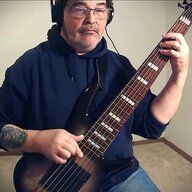
I bought an Ibanez 6 string, and have been playing with it tuned EADGFC to experiment with more of a fingerpicking style (like I'm used to when playing guitar) and playing a more "chordal" melodic style on bass. I pluck with my thumb, index and middle finger mostly. This keeps my right elbow and wrist more relaxed as my right hand/wrist can remain straight with my forearm and my elbow more at a relaxed right angle.

Being older, and after a couple of falls that resulted in two (slightly) separated collar bones (left in one fall, right in the other) I also have tendonitis in my right elbow. But, I also have a slightly torn left rotator cuff, making playing down anywhere near the nut on the fingerboard quite painful. Yes, I've been addressing the health aspect for a long time...doing therapy, stretches, massages, eating right, taking supplements, etc. So that's not my issue. And neither is how high/low my strap is or if I'm sitting (which is essentially the position on my body) and most comfortable.

I'm thinking of going back to a traditional tuning of BEADGC so that essentially the 5th fret can be used more like the open string on a typical 4 or 5 string. I already know the tone is a little different playing some positions. And an "E" on the low B string doesn't sound exactly like an open "E" on the E string. But with this tuning I don't have to reach down lower on the fingerboard (nearer the nut) to do the same runs. Obviously lower notes below the fifth fret are still there if needed, but I won't have to use them if I'm having difficulty reaching. Turning/twisting my shoulder back to reach is really hard to do.

While I'm still kind of adjusting to plucking differently with my right hand, I also now need to be more conscious of my fretting "pressure" using a lighter touch. I've already lowered my strings to where they are nearly sitting on the frets allowing me to play with a lighter touch in fretting. No fret buzz at all on this beautifully flat, wide fretboard (and ultra thin neck profile)

All of this is something kind of new to me as for the past 45 years I've always played with a much more aggressive technique with both hands. Anyone else forced to adjust their technique to continue to play without pain?

Just curious how everyone has adjusted to adopting a new technique after such a long time playing a certain way.
 
Last edited:
  • Like
Reactions: tshapiro
I have recently had a bout of tendonitis and it really made me look at how I played. With the painful reminder used as a guide for what not to do, I adjusted everything from strap length to how hard I play, squeeze ( because you know your not supposed to). It has paid offf, but at time it felt like learning all over again.
 
  • Like
Reactions: M-Mittlesteadt
I have recently had a bout of tendonitis and it really made me look at how I played. With the painful reminder used as a guide for what not to do, I adjusted everything from strap length to how hard I play, squeeze ( because you know your not supposed to). It has paid off, but at time it felt like learning all over again.
Yeah, it does feel like I'm learning to play all over again. In many ways, that's the reason I bought a 6 string bass, but also tuned it differently. I wanted a new challenge coming back after a hiatus from playing. It's allowed me to experiment more.

But from a "standard way" of playing bass and being more supportive as opposed to being more melodic, I noticed how much my shoulder hurt in extending my arm to reach that far out for lower notes. I'm familiar with playing 5 stringers and standard tuning, so that's not foreign to me. But the lighter touch and almost forced repositioning further up the neck is taking some adjusting on my part. I see nothing but it being beneficial in the long run, but in the meantime it's a bit frustrating because I've played so much better and confident in the past.
 
I see nothing but it being beneficial in the long run, but in the meantime it's a bit frustrating because I've played so much better and confident in the past.

It most certainly is frustrating.

You'll learn to love "the new you" soon enough though. Confidence is just around the corner as well.

Best wishes from someone who's been there and done that..never tried the 6-string-bass route, though...:thumbsup:
 
  • Like
Reactions: Prodigus Filius
Which strings does it currently have on it? (string model & gauges).

Try this…
Detune 2 semitones and put a capo on second fret. It’ll turn your 34” bass into a 30” scale bass. That might be all you need (for now) for pain.


The strings will be at a lower tension so will be easier to fret. Adjust your EQ for any changes in tone.

If this causes fret buzz that’s too annoying:
low frets - adjust truss for a little neck relief or
High frets - raise bridge saddles a hair.
 
Last edited:
  • Like
Reactions: M-Mittlesteadt
Which strings does it currently have on it? (string model & gauges).

Try this…
Detune 2 semitones and put a capo on second fret. It’ll turn your 34” bass into a 30” scale bass. That might be all you need (for now) for pain.


The strings will be at a lower tension so will be easier to fret. Adjust your EQ for any changes in tone.

If this causes fret buzz that’s too annoying:
low frets - adjust truss for a little neck relief or
High frets - raise bridge saddles a hair.
I'm using Dean Markley SR2000's - 7 string set. I thought about detuning and using a capo. I have a really nice capo but it won't span the wide fretboard of my 6 string. But maybe I should look into that. Thanks for the tip.
 
I have arthritis in my shoulders that causes pretty bad pain at times. My problem may be different but what actually triggers my pain is holding my left arm up and the farther I have to reach the worse it is. For that reason I play a short scale 4-string. I really would love to play a five or sixer but it's not in the cards for me.
 
  • Like
Reactions: M-Mittlesteadt
I have arthritis in my shoulders that causes pretty bad pain at times. My problem may be different but what actually triggers my pain is holding my left arm up and the farther I have to reach the worse it is. For that reason I play a short scale 4-string. I really would love to play a five or sixer but it's not in the cards for me.
That is precisely why I thought about using a low B string again on my 6 stringer. Instead of the low E, F and G notes having to be played open (E) and on the 1st and 3rd frets of the E string, with a low B, I can play that same low "E" at the 5th fret of the low B. Drastically reduces how far my reach needs to be.
 
That is precisely why I thought about using a low B string again on my 6 stringer. Instead of the low E, F and G notes having to be played open (E) and on the 1st and 3rd frets of the E string, with a low B, I can play that same low "E" at the 5th fret of the low B. Drastically reduces how far my reach needs to be.
Ah, that makes sense. I think I need to try that.
 
  • Like
Reactions: M-Mittlesteadt
Ah, that makes sense. I think I need to try that.
It actually makes my longer scale length bass a shorter scale length than a true short scale bass, while still keeping the tone and feel of a longer scale length. The strings on a long scale bass seem to ring out out more than a short scale bass. It might just be I'm imagining that though. I haven't really compared a short scale bass to what I'm trying.
 
Over the years I’ve revamped my technique in both hands a couple of times, so these days I almost never have pain from playing.

Walking, driving, standing, sleeping, sitting, lifting my arm higher than my shoulder, those all still hurt. Can’t win ‘em all.
I hear you. I want to keep playing as long as I'm able to. If that means making some compromises and adjustments, so be it.

I'm looking at it as "growth" as a player and it's been almost as much fun as it is challenging.
 
  • Like
Reactions: smeet
i've got shoulder damage, tendonitis in my right wrist and now arthritis, i've had to adapt. i play in different positions, and some basses i just can't play without pain. after running through a large number of basses, i have a few that don't hurt. i find that lighter strings are more comfortable to my right wrist, so i play extra lights. due to elbow issues, i have to frequently shift positions as i play or wear a tight elbow brace.

i find that when sitting, changing chair height can make an uncomfortable bass comfortable. for me, the squier broncos and the spector NS bodies allow me to play with no pain at all, but i still need to play in odd positions, which does slow me down and change how i used to play things. but when i first hurt my shoulder, i could only play a ubass, so things are definitely improved.

and i admit, sometimes i feel bitter that i can't play the way i used to, freely and very fast, but mostly i'm grateful things improved over time so i can play, if not as well as i used to be able to. PT didn't help, but time did improve my rotator cuff and elbow.
 
  • Like
Reactions: M-Mittlesteadt
It actually makes my longer scale length bass a shorter scale length than a true short scale bass, while still keeping the tone and feel of a longer scale length. The strings on a long scale bass seem to ring out out more than a short scale bass. It might just be I'm imagining that though. I haven't really compared a short scale bass to what I'm trying.
I used to play a 34 and, at least to my ears, the 34 was thumpier and had more string tension. The only advantage I have with a 30 is that it's easier to play and less weight. I will gladly trade back if a tuning change makes it easier on my shoulder.
 
  • Like
Reactions: M-Mittlesteadt
i've got shoulder damage, tendonitis in my right wrist and now arthritis, i've had to adapt. i play in different positions, and some basses i just can't play without pain. after running through a large number of basses, i have a few that don't hurt. i find that lighter strings are more comfortable to my right wrist, so i play extra lights. due to elbow issues, i have to frequently shift positions as i play or wear a tight elbow brace.

i find that when sitting, changing chair height can make an uncomfortable bass comfortable. for me, the squier broncos and the spector NS bodies allow me to play with no pain at all, but i still need to play in odd positions, which does slow me down and change how i used to play things. but when i first hurt my shoulder, i could only play a ubass, so things are definitely improved.

and i admit, sometimes i feel bitter that i can't play the way i used to, freely and very fast, but mostly i'm grateful things improved over time so i can play, if not as well as i used to be able to. PT didn't help, but time did improve my rotator cuff and elbow.
:thumbsup: :cool:
 
I used to play a 34 and, at least to my ears, the 34 was thumpier and had more string tension. The only advantage I have with a 30 is that it's easier to play and less weight. I will gladly trade back if a tuning change makes it easier on my shoulder.
I added the low B string.

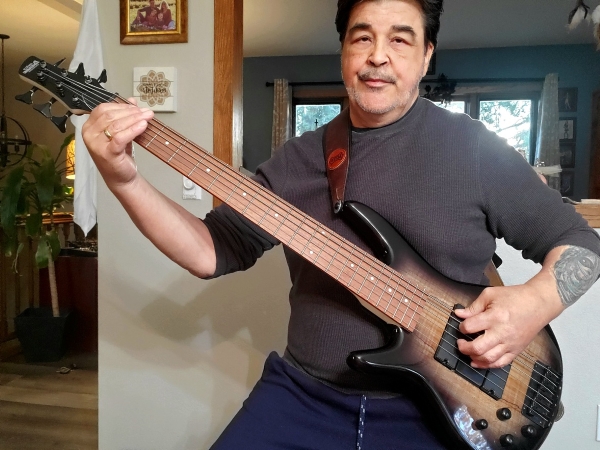
Here's how far out I had to reach for the lower notes on the E string. My shoulder hurt just taking the photo...

Invalid Link Removed

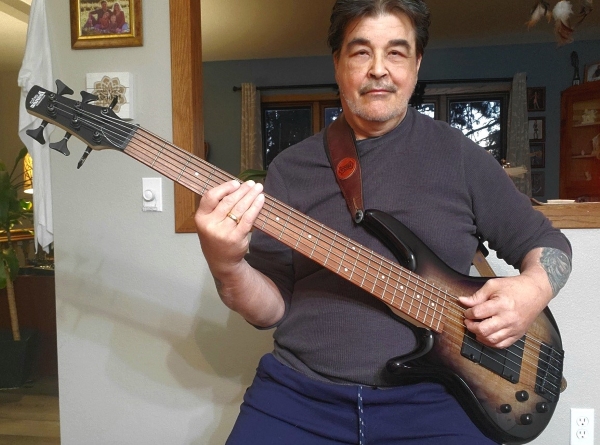
Same notes, but played at the 5th fret position on the low B string. So much more comfortable. I shortened the scale by about 7" in reach without the change affecting the placement and positioning of my plucking hand...

Invalid Link Removed
 
  • Like
Reactions: Prodigus Filius
I added the low B string.

Here's how far out I had to reach for the lower notes on the E string. My shoulder hurt just taking the photo...

Low-F.jpg


Same notes, but played at the 5th fret position on the low B string. So much more comfortable. I shortened the scale by about 7" in reach without the change affecting the placement and positioning of my plucking hand...

Low-F-on-B.jpg
Excellent. Thanks for taking time to post the pics.
 
  • Like
Reactions: M-Mittlesteadt
I have degenerative damage in my left wrist and elbow from rheumatoid arthritis and had to completely change my left hand tehxnique from claw/OFPF to Joel Quarrington left hand classical technique (Canadian School of Double Bass, applied all to fretless EB). It's taken a while but it has enabled me to keep playing, and led to a whole new world of pain-free playing ease.
 
Last edited:
  • Like
Reactions: M-Mittlesteadt
I removed my high F string, and added a low B string.

It's basically a 5 stringer with an added C string. I was playing it a lot last night and I was pain free. I still have a lot of practicing to do with my plucking hand. Due to my right (plucking) elbow's tendonitis also causing wrist and hand pain, I've switched from using only my fingers over the top, to a more guitar-like fingerpicking style using my thumb, index, and middle finger.

So instead of coming over the top of the bass, I'm approaching the strings more from the bridge end of the bass body (more parallel to the strings), keeping my elbow at a comfortable 90° and my wrist remains straight. My elbow, wrist and hand are very relaxed this way. I just need more practice at it. I may now adjust my strap and raise the body even higher now that I don't have to reach so far out with my fretting hand.