• TalkBass has been independent since 1998. Add your voice.
    Create a free account to reply to discussions, view embedded media, and browse with fewer display ads.
    Join freeLog in
    Want zero display ads or expanded classifieds tools? Compare plans.

Double Bass AKG C411 Mounted Inside DB?

bassically_eli

Supporting Member
Feb 7, 2010
1,717
1,623
Virginia
Hey, I finally got a C411 PP a few months ago after eyeballing it for years. Unfortunately, it's very difficult to get an even response across the strings and up/down the next on my ply bass. That is, until I tried mounting it a couple of inches inside the f-hole. Anyone else try this? The response was very even on my bass, and while I don't usually like the idea of a mic inside a bass/f-hole, I think the fact that this one sticks to the top wood makes it different.

Other locations that were usable on my bass are (1) over the bass bar below the bridge foot (and probably above it as well), and (2) attached directly to the bridge. Over the bass bar isn't perfectly even, but usable I think. Not sure I like it better than a pickup though. Mounting to the bridge gives a very direct sound, somewhat similar to a bridge wing PU and about like I might expect from an EUB.

 
Well, every bass is different and a ply top moves differently to a carved one.

But for a sealed contact mic inside or outside should not make a difference if it is at the same position. Maybe a bit, since air pressure differences inside can be higher than outside and the case might get a tiny bit deformed by it, but the main difference comes either from a little difference in placement or a difference in surface structure and form.

Don’t forget that a contact mic is driven by shaking its case, not by air from the outside. The membrane tries to stay where it is (due to inertia) and the case moves relative to the membrane by the moving part it is mounted to.

I haven’t tried many positions with my AKG, just used what worked well with the Ehrlund and MSP.
In my case that was touching the outside bass bar edge (but on the top, not inside), but not directly on the bass bar, which didn’t worked for me, and directly over the soundpost.
But that doesn’t mean that it might not work on your instrument your way which is different to my big carved one.
 
  • Like
Reactions: Povl Carstensen
Well, I still haven't quite decided if I'm going to hold on to the C411 or not. There seems to be nowhere on my bass that has both good tone and an even response across all notes. That said, it's actually quite usable with a notch filter and/or limiter in the signal chain. Of these two options, the limiter seems to work better, which I guess is okay because I have an Art Tube MP/C that I like a lot, and it has a very good limiter/compressor. Thing is, I'm just not quite sure if it's really worth the trouble. My idea behind getting the C411 was to simplify my setup by avoiding blending a mic and piezo--that sometimes results in me fiddling with a lot of knobs; other times I have to turn the mic almost off. However, every time I try the C411 at home, I still spend all my time fiddling with knobs or the pickup location or different putties. Of course, it's possible that that's just how I am :help:

The other option I'm considering is the Yamahiko. I would still use an open air mic when it's appropriate, and the Yamahiko when stage volume is too loud. Seems simple--in theory....
 
Last edited:
The Yamahiko will get you a long way to having the sound you want at the volume you may require. Depending upon the types of performances you do.
I have a pair of Remic DB 5400 Microphones (a Green for live sound and a Red for recording) they work exceptionally well for FOH. Through years of experience
I can say that without exceptional sound technicians and monitor channels so the bass is isolated on it’s own independent feed using a mic is a tricky setup.
I’ve seen it work with Larry Grenadier and a CMC 6 MK41.
 
  • Like
Reactions: bassically_eli
The Yamahiko will get you a long way to having the sound you want at the volume you may require. Depending upon the types of performances you do.
I have a pair of Remic DB 5400 Microphones (a Green for live sound and a Red for recording) they work exceptionally well for FOH. Through years of experience
I can say that without exceptional sound technicians and monitor channels so the bass is isolated on it’s own independent feed using a mic is a tricky setup.
I’ve seen it work with Larry Grenadier and a CMC 6 MK41.
I agree that a mic is pretty ideal for front of house. My experience has been that a mic is pretty much unusable on stage, though, when there are monitors right in front of me pointing right back at the bass. However, when I'm able to use my own amp on stage (so no bass in the monitors) I can usually get quite loud with a mic without feedback. I've had enough experience with my gear to know where to position things, how to EQ, how to use notch and HPF, and when to hit the phase switch. My loudest gigs have mostly been with a folk band, so not crazy loud, and no drummer, so no cymbal bleed to worry about.

I'm currently taking a bit of a break from gigging, but when I get back to it this summer, I think I'll need to be prepared for pretty much anything and everything.
 
  • Like
Reactions: Ric Vice
I gave up on that AKG. The problems you describe sound familiar. My current solution is a Tone Dexter. Sort of like a mic and pick-up blender in one box. Pretty pricey though, especially if you don't have a decent mic to program the thing with. You don't need an Alpha high end mic, but you do need a decent small diaphragm.
 
I worked with a live sound engineer, who allways put a c411 under the fingerboard area on the top of the body, it sounds very good….
I used Ehrlund on my previous bass (not worked well on my current bass) my sweet spots was between the bridge and F Hole, but never inside the bass…
 
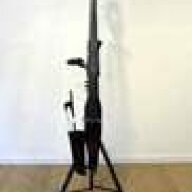
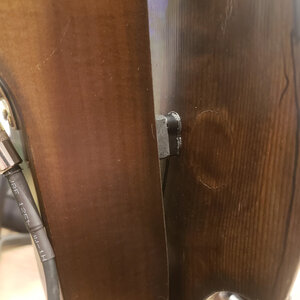
Wanted to share some experience installing AKG's C411 on my MK-bass. It does sound darn close to an acoustic DB with stock single piezo, but not quite. It will never be indistinguishable from mic'd instrument, but it can be from AUB equipped with piezo pickup commonly found in the bridge. Anyway, I wanted to complement piezo with different type of pickup and blend both together, so settled on the C411. I always thought a contact condenser mic, at least this model works by movement of light pickup body relative to stationary internal membrane, unlike standard condencer where membrane moves under air pressure produced by sound and the body stays put. For the contact mic this menas the diafragm is made relatively heavy to stay put due to its inertia, and the body - as light as possible to move in sync with the vibrating surface body the mic is attached to. This implies that anything damping the body movement reduce relative motion, thus the output will be reduced and the tone affected. Very surprizing my practical experience is exactly opposite - the C411 stuck onto the resonating board of my MK bass using supplied goo sounds good, but once I put my finger on it pressing firmer to (thus obviously reducing amplitude of vibration) it starts siunding MUCH better - fuller bass, amplitude actually increases and sound is far more acoustic-like. Cannot explain that. So I placed the C411 on the back of resonating board between it and the solid body and wedged rubber pad between the body and the top of the pickup. IT started sounding even better! I was happy that the stock piezo sound could be affected as the resonating board theoretically cannot move as freely since linked to the solid part of the body by the pickup and the rubber spacer sandwich, but nope, zero impact. Specifically checked few times. So now both outputs are mixed together with Radial Engineering's Bassbone preamp (the C411 also has its own inline mic preamp), and I cannot differenciate recorded sound from the sound of an amplified AUB with a pickup on it. Long story short - if you plan to use the AKG C411, supporting its body pressing harder to the surface it is attached to will greatly improve performance. Counter-intuitive, but that's my first hand experience. Never expected that. The only explanation I have is the design of the C411 does not quire rely on the inertia of inner parts, there's something else going on. Attached are few photos. The black cylinder is AKG's phantom power adapter the mic comes with.
 

Attachments

  • 0.jpg
    0.jpg
    168 KB · Views: 30
  • 1.jpg
    1.jpg
    142.8 KB · Views: 23
  • 2.jpg
    2.jpg
    198.2 KB · Views: 30
  • 3.jpg
    3.jpg
    223.5 KB · Views: 28
  • Like
Reactions: Povl Carstensen
I have a C411, haven't used it in some years though. My current bass has a top that's on the thin, light side and it's just too "live" with the C411, to the point that you can hear other sound sources in the signal. It was actually much more usable and consistent on the plywood bass I was playing when I bought it.
The pressure mount above is interesting though, makes me wonder what it would do if you mounted it like a Schertler Stat B in the bridge opening with a piece of cork (stringy and direct but without piezo qualities would be the good outcome).
 
That's because the top deck (body) acoustically resonates differently [than the bridge] as it emits the sound through f-holes. The bridge just passes vibration from strings to the deck, it itself does not create any sound, e.g. unlike the body (front and back deck), it does not move air. Thus mounting a pickup on the bridge will always result in worse fidelity sound than if it's mounted near f-holes. On the bridge the strings vibration will be reproduced accurately, but the thin body wood vibration responsible for acoustic warm sound is missing at (or very near) the bridge. You have to mount the pickup on the body where this vibration is present. Around f-holes or even back of the base is usually the best.
 
That's because the top deck (body) acoustically resonates differently [than the bridge] as it emits the sound through f-holes. The bridge just passes vibration from strings to the deck, it itself does not create any sound, e.g. unlike the body (front and back deck), it does not move air. Thus mounting a pickup on the bridge will always result in worse fidelity sound than if it's mounted near f-holes. On the bridge the strings vibration will be reproduced accurately, but the thin body wood vibration responsible for acoustic warm sound is missing at (or very near) the bridge. You have to mount the pickup on the body where this vibration is present. Around f-holes or even back of the base is usually the best.
As a devils advocate, I have to say that the way the bridge vibrates is also determined by the flex/vibration of the body. Was the bass made of concrete, a pickup would pick up a different signal on the bridge. Also I think most sound emanates from the vibrating top, not through the f-holes. This said however by someone who uses a Realist or Ehrlund, to get a more acoustic sound.
 
The putty is elastic and absorbs sound. By pressing on the contact mic the absorption of the putty is lowered due to the pressure. So use the thinnest coating of highest adhesive putty for maximum output (which might not necessarily deliver the nicest sound).
By the clamping, the case of the contact mic may get deformed slightly by the vibration which might have a rather large impact on the mechanics happening inside the case.

The best sound is very close to a rigid point as there are all frequencies equally well represented. Unfortunately the amplitude is very low at that points.

In practice close to the bass bar (but not on it) is a good position. But this typically not an option for an EUB.