• TalkBass has been independent since 1998. Add your voice.
    Create a free account to reply to discussions, view embedded media, and browse with fewer display ads.
    Join freeLog in
    Want zero display ads or expanded classifieds tools? Compare plans.

ALL BASSISTS - set up question

elteye

Commercial User
Jul 12, 2009
15
1
Disclosures
Teye, luthier, owner of Teye-guitars
Hello, I have a question for bass guitarists:

A guitar can be set up in such a way that almost everybody can be sorta kinda happy when playing it. Then to be tweaked later on.

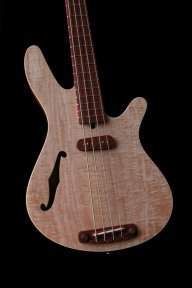
But it seems that bassists are much more diverse in their setup demands. I use my own proprietary hardware, and the setup of my basses requires a little more technical insight and also tools.

To make matters worse, my basses all have 24 frets: a good number of more frets that might cause fret buzz or clang...

Does anyone have a word of advice for a good 'average' setup? In other words, WHAT IS PERFECTLY ACCEPTABLE for ALL bassists when they first pick up an instrument to try it?

Neck relief, string height (please specify fret where the string height was measured)

I would be much obliged!

Thank you,

Sincerely,

Teye

Invalid Link Removed
 
There is no perfect setup.

I like a nice low action, if you setup a bass in the store like this people who cannot play with a low action think the bass is setup sloppy and has awful fretbuzz.

There is a reason mega stores use a setup that can accommodate a LOT of digging in.
 
some like high action, some like low
some like flat fretboards, some like some relief
some like pickups a little high, some like them low.

Like the other guy said. "there is no perfect setup"
 
does anyone READ anymore? lol!

Ok, there is not perfectly acceptable setup.

The statement still applies.

Is the guy coming is a tapper? Maybe he is a slapper who likes to hit hard? Maybe he plays fingerstyle lighter than matt garrison? Maybe the guys picks like his pick is a shovel.

There are too many variables, sorry. Just have a standard setup that you do as an owner and work from there. If the guy is buying a custom bass of you he is probably going to want it setup for him anyways.

I could easily say G string at 1.8mm and E string at 2.3mm, always measure from the last fret. Relief at .35 to accommodate a little more room to dig. To measure relief press the first and last fret and measure between the 7-9th fret.

I assure you though, with that setup you will get people coming in and finding a lot of clank, some guys will love it some won't.

Read Jerzy Drozd's guide for more details, although I use radius gauges from tunemybass.com as they are FAR more practical.
 
I'm at work, so I can't get on youtube and post the links right now, but Warwick put out three (I think) videos on how to set up a bass, not just the mechanics of it, but measurements, etc. It seemed like it's a good bassline (!) to start with, and then tweak as needed from there
 
There is no perfect setup.

I like a nice low action, if you setup a bass in the store like this people who cannot play with a low action think the bass is setup sloppy and has awful fretbuzz.

There is a reason mega stores use a setup that can accommodate a LOT of digging in.

I hate your bass already!! :D

I like stiff strings and moderate action.

Light strings lying right up against the fret board seem to be what lots of people like. I get nothing but buzz and clack. I tend to be pretty aggressive when I play. I have a heavy right hand, and I like my hammer ons too.
 
Some people do like very low and others do like very high. But I think that if you set them up as low as you reasonably can without fret buzz then very few will refuse them. It is clear that quite a few people here will reject basses, or a bass model, or an entire bass brand based on a single poorly setup example at Guitar Center. Really, anything you do to properly set up a bass will pay huge dividends with those who don't recognize that their issues are with the setup and not the product. You don't have to, nor will you, satisfy everyone but a setup that you feel highlights your work well should help you win business. Anyone who objects to a properly set up bass knows what a setup is and knows that their personal requirements are unique and understands that with a little work they can get your bass set up to suit them.

Ken
 
Ok, there is not perfectly acceptable setup.

The statement still applies.

Is the guy coming is a tapper? Maybe he is a slapper who likes to hit hard? Maybe he plays fingerstyle lighter than matt garrison? Maybe the guys picks like his pick is a shovel.
There IS an acceptable middle ground, if you have any sense about you. When I go try a bass, I know that bass isn't set for MY personal taste. Odds are it's going to be a little high or a little low for me. The specs I gave are a really good starting point.
 
Medium action, a little relief. I'm sorry I that don't have quantitative measurements. I'm a feel guy. Personally, I like low action, but I can get a "look" when the action is not too high. I'm gonna set it up on my own later anyway. However, as a "custom" guy, it would be nice if you offered this service (set up pref.) to a potential customer.
 
Yes, that is another detail: my fret boards are compound radius, 10" to 16, so theoretically I should be able to go a little lower before strings buzz. This advantage is IMHO more than eaten up by the use of 24 frets...

And re the official web sites of the Big Boys and their specs: yes of course very useful, but, well I am actually very interested to hear what individual bassists think of this matter.
 
BTW I really would like numbers, measurements. Of course I set up my basses with as low an action as possible before fret buzz. The problem is: fret buzz is directly related to force of attack (string resonance amplitude) and technique (do you strike the string so that the vibrations will be mostly parallel to the frets, or do you just strike the string?)

So I'm actually very interested in getting individual preferred setup measurements.

And yes, when a buyer contacts me and tells me his desired setup, then the problem has disappeared. But what about basses I send to dealers, or basses I make that will end up in the hands of players I do not know yet?

I'm just looking for a good starting point.

Gentlemen? Ladies?

Thank you!