Clear as mud. Damn this language gap. I think you're saying my low mid is your lows, everything one octave out, but warm is what freq to you?

TalkBass has been independent since 1998. Add your voice.
Create a free account to reply to discussions, view embedded media, and browse with fewer display ads.
Join free Log in
Want zero display ads or expanded classifieds tools? Compare plans.

T/S has nothing to do with that range you know?
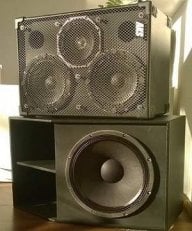
... a non-LF 3015...from large to medium size. In all of them it sounded too mid-heavy to me. ... last cab ...my Ibanez Promethean P3115. Its about 2.0 cu feet. ... ... tuned to 47hz. ... Here it sounds loud,clear and deep. I'm just confused that it sounds the best in the smallest amp/cab I have, but it has really improved the performance of this combo so much that it is a perfect match.
Warmth ... usually not any specific frequency range. Translate it to "musically meaningful distortion, not too strong" in the sense of increased k2 or k4. Or maybe some nicely sounding breakup.
Please keep in mind that harmonic distortion is inherent to any movement of the speaker cone, even the smallest one.
Nothing worth to be debated upon without measurements.
Let me come back to this one:
I ran that example through LSPCAD:
Invalid Link Removed
The TSP of the 3015 are surprinsingly close to those of the Beta-12. I would expect the Beta-12 to perform nicely in such a resonator as well. It is good even in 35 l tuned to something around 57 Hz, really punchy. I am currently using it in 55 l / 55 Hz and like it very much. (The 35 l box now runs a Beta-10, just fine for practising at home)
Who might the 3015 perform in a similar setting? Here its simulation in 60l / 55 Hz.
Invalid Link Removed
Nice. The simulation of a single Beta-12 looks pretty similar, just not as loud.
Actually a pair of Beta-12 has almost the sensitivity of one 3015, as a pair it also almost reaches the Vd of the 3015, and the power ratings are also close. To far less than 2/3 of the price of a 3015, and in a total volume comparable to that of my current cab for the 3015.
So - if the 3015 performed well in a (lightweight) cab of only 60 l, in either or both of the settings shown above, that would be a dream of a box.
Wow thanks for running these numbers. So using an online converter 2.1 cu feet is about 60L. Looks like its a good match which in reality does sound good. I picked 47hz because it was slightly above the Fs freq so I wanted to play it safe. It paid off.
But this is told by Fourier Analysis as you know?
That's a very wrong conclusion to build up cab designs.
If You have the equipment to record the pulse response reliably.
Aside from this we should ask to which degree it is meaningful to put such properties in numbers. Take for example, the Beta-12. I own mine for several years now and have run in in several cabinets, also experimental ones. I have at least a qualitative feeling of what comes from the speaker what from the cab (resonances) and to some degree of the interaction of that system with the surrounding. So what do i need measurements for?
At present i think of trying the 3015 in a 60 l cube. I am still a bit unsure of the material, maybe 18 mm massive spruce, not despite but because of its untamable resonances, maybe 18 mm massive beech (mmhm, will become heavy...), maybe again 12 mm plywood, maybe chipboard - 12 mm or 19 mm ...
Anyway, the simulations indicate that such a setup would work - although the tuning might be a bit higher, IMHO.
Its Fourier transform yields the frequency response (in a purely linear approach).Impulse response tells something about the damping of the system. The system includes amplifier and cabinet.
The volume comes from its depth. Anyway, as shown in the old photo, VB was about 71 Liter, and the tuning of the port must have been far too low. A while ago i increased the port area to > 300 cm^2 (its visible height from 3 to 8 cm) and thus also Vb (by the additional volume behind the port).your present cab is estimated to come with Vb appro 75..80 Liter? Probably this is rather the total volume.
I can't imagine that such a small cab like yours contains of such a big net volume like 80 Liter.
It is actually higher than estimated (~56 Hz instead of the intended 51.5 Hz). The models are a bit inaccurate because they do not take into account that this cab is equipped with a shared wall port. That's why the tuning frequency initially was far off.Therefore may be the port dimensions of the present cab was wrong calculated?
60 Liter with a square front of 40x40 cm corresponds to a depth of 37 cm + thickness of the sides. Accordingly, increasing the depth to ~47 cm yields 75 Liter. Plus, of course, the volume behind the port.I estimate the net volume Vb of your present cab to appro 60 Liter.
Its Fourier transform yields the frequency response (in a purely linear approach).