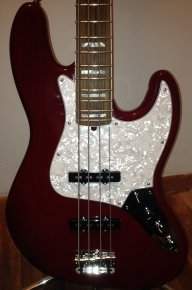
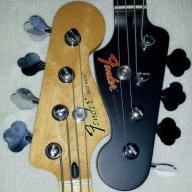
• TalkBass has been independent since 1998. Add your voice.
    Create a free account to reply to discussions, view embedded media, and browse with fewer display ads.
    Join freeLog in
    Want zero display ads or expanded classifieds tools? Compare plans.

American and foreign

Many Fenders are made in Mexico, thereby relieving the need to travel overseas. (Fender Mexico & Fender California are only a few hundred miles apart)
Cheaper labor costs are part of it, but also cheaper components.

Exactly!

You really have to pay attention to detail when considering a Mexican made Fender. Some are great and some are pretty bad. Most are decent basses for the money.
 
  • Like
Reactions: Killed_by_Death
My advice would be to judge each bass on it's own individual merits and dont lump everything into a category of where it's made. I have had/currently have MIJ, MIJ, CIJ and MIM Fenders and G&L Trubites made overseas and every bass I had was great by itself and none really inferior to the others. My MIM Classic 50's is KILLER and so is my 2008 MIA American Standard.

MIA Fenders are, dare I say made my Mexicans in the USA, while MIM Fenders are made by Mexicans in Mexico. I'm a big fan of the "higher end" MIM stuff like the Classic Series Fenders.
 
There is no correct answer to this question.
I know this is probably not the best question, but what is the difference in a Fender made over seas and American ? For the price are you really going to know the difference ? It's quite a price gap.
Mark

There is no correct answer to this question - it's all subjective. I can tell you that I've played/owned/found both good and bad basses in the American, Mexican, and Japanese made Fenders. In my opinion, this is an overall Fender quality control issue more than it is a geographic one. For example (and also in my opinion), other brands such as G&L, Ibanez, Ernie Ball, ..., are more consistent with regard to overall quality, craftsmanship etc. regardless of where they are made.
 
  • Like
Reactions: Loring
First thing, Fenders "over-seas" really are Made in Japan Fenders, and they are highly coveted as lower cost MIA alternatives.

Cheap Fenders are Made in Mexico. Some of the things you may find on MIM Fenders vs MIA:
1. Poor setup (A nut that is hardly filed, and the strings drastically far away from the fretboard. This can be fixed easily with a setup)
2. Poor Quality control (Neck warping is a concern here. I don't think this is fixable cheaply, but not sure)
3. Pickup quality (I believe MIA pickups have polarized pickup pins as the magnets in the pickups. Where as MIM pickups have a big ole fat magnet at the bottom of the pickup, and the pins just deliver that energy. But aside from the semantics you can assume MIM pickups will sound more tinny and less refined to their american counterparts. Could swap the pickups for a $100-$200)
4. Shielding issues (These bases may have hum. It is fixable I believe. I'm not sure the cost)
5. Poorer quality hardware (The bass can go out of tune more easily, and the mechanism of tuning may be harder to control. Could swap out the tuners for $125 I think)

There are other finer details that luthiers would understand more than myself. These include Plekking, Wood Material, Finish, and coatings (the back of the neck coating can make your hand movements slower or faster).

That's all I can think of at the moment. Buying a used American made instrument is almost always a better deal than a new cheaper made instrument in my opinion.
 
  • Like
Reactions: Killed_by_Death
For us non-professional bassists, I'd say the difference between a Fender MIA vs. MIM is definitely not worth the huge price differential.

If you're new and trying to figure out what you like, I would recommend taking a look at used MIM Fenders and used G&L Tributes. You can easily find nice examples of both in the $300-500 range.

If MIA is a priority, 1980s Peaveys are probably the lowest price for MIA instruments, followed by some 1990s Fender models like the JP90 and Prodigy. You can also sometimes get good prices on used MIA Music Man basses, particularly the Sterling model (not to be confused with the "Sterling by Music Man" or "Sterling Ray" basses, which are not MIA).
 
I'm pretty sure Fender American instruments are made in the US, but the workmanship and quality of the Fender imports have improved to the point of making them competitive. A lot of the newer Fender signature models and special runs are now made in Mexico. Take the Flea Road Worn Jazz for example. Made in Mexico. Fender Japan has always been high quality Like Gibson Burney. Now when you pick up a Chinese Fender and turn it over in your hands and plug it in, you will see they are fine instruments. I use to be fixated on MIA gear, but not so much now. My only MIA bass these days is a vintage 72 Gibson EB-3. Who would of thought a few years ago.
 
I'm pretty sure Fender American instruments are made in the US, but the workmanship and quality of the Fender imports have improved to the point of making them competitive. A lot of the newer Fender signature models and special runs are now made in Mexico. Take the Flea Road Worn Jazz for example. Made in Mexico. Fender Japan has always been high quality Like Gibson Burney. Now when you pick up a Chinese Fender and turn it over in your hands and plug it in, you will see they are fine instruments. I use to be fixated on MIA gear, but not so much now. My only MIA bass these days is a vintage 72 Gibson EB-3. Who would of thought a few years ago.

+1 on Fender Japan making nice stuff.

I believe Fernandes had stuff made in the same factory back in the 90s... and their stuff was sweet too.
 
I am pretty new to playing bass, x 3-4 years and still learning for a 56 year old. I know this is probably not the best question, but what is the difference in a Fender made over seas and American ? For the price are you really going to know the difference ? It's quite a price gap.

Just wondering and trying to get it . G &. L. Same thing

Thanks
Mark

Have you zeroed-in on any particular design specifications or twists of ergonomics you prefer? If so, let that be your guide.

About four years ago, I managed to put my finger on what type of necks work best in my hands. Armed with that knowledge, I set out to figure out which models carried those specs, then sorted them by price and availability. In this case, I decided the MIM Fender Classic '70s Reissue Jazz was what I wanted. Eventually, I spotted a great deal on a used one. After giving it a thorough shakedown trial, I found my research was spot-on, so I traded in two, less-expensive Jazzes to offset it's cost and made it mine.
 

Latest posts