
Hey, I picked this up this week. The AC cable was stripped and after opening up it looks pretty clean except the last cap was burnt out. I’m hoping it didn’t effect the circuit board. Can someone identify the cap in the photo or schematic? I have decent soldering skills and was hoping to replace along with a grounded AC cable. Thanks for your help.

Enjoy the benefits of a premium membership!
Upgrade Account
-
TalkBass has been independent since 1998. Add your voice.
Create a free account to reply to discussions, view embedded media, and browse with fewer display ads.
Join free Log in
Want zero display ads or expanded classifieds tools? Compare plans.
You are using an out of date browser. It may not display this or other websites correctly.
You should upgrade or use an alternative browser.
You should upgrade or use an alternative browser.
Ampeg B15-N Capacitor ID
- Thread starter Brennan
- Start date
More options
Who Replied?



I think that's a resistor, not a capacitor. The area under the burnt resistor needs to be inspected for further damage to the traces.
I also see a cut wire near it and have no idea where it's supposed to go.
I'd find a capable tech and let him give it a full inspection. I think such a well respected amp deserves good treatment.
I also see a cut wire near it and have no idea where it's supposed to go.
I'd find a capable tech and let him give it a full inspection. I think such a well respected amp deserves good treatment.


I agree. It looks like a resistor. And without a component layout drawing or some other method to identify that component, the schematic is not very helpful.I think that's a resistor, not a capacitor. The area under the burnt resistor needs to be inspected for further damage to the traces.
I also see a cut wire near it and have no idea where it's supposed to go.
I'd find a capable tech and let him give it a full inspection. I think such a well respected amp deserves good treatment.
That large yellowish/orangish/brownish component at the bottom of the closeup looks like an electrolytic capacitor. And judging by it's apparent age, it could also need replacing, along with other 'lytics in the amp.
There is also a chance that some other component that may visually look OK is bad, and that may have caused your part to burn. Resistors (if that is what your burnt part is) typically do not fail in such a catastrophic fashion all on their own. Something else caused this.
The previous recommendation for finding a qualified technician to repair this classic old beauty, is the best advice you'll get.

As has been pointed out that’s a resistor. Should be 22k/1w.
The amp is an interesting/short lived transition model (though honestly you could say that about almost every revision of the B15 until 1969) in that it is PCB based but cathode biased. These were only made from early-mid 65, then there are some brief turret board B15NF amps before you see the PCB B15NF.
I had one with January 65 date codes, there are a few schematic revisions up to March 65 which still use the cathode bias design, then the fixed bias NF schematics dated April 65.
Schematics
Here is my old amp, resistor in the same location appears to be 22k/1w as mentioned.
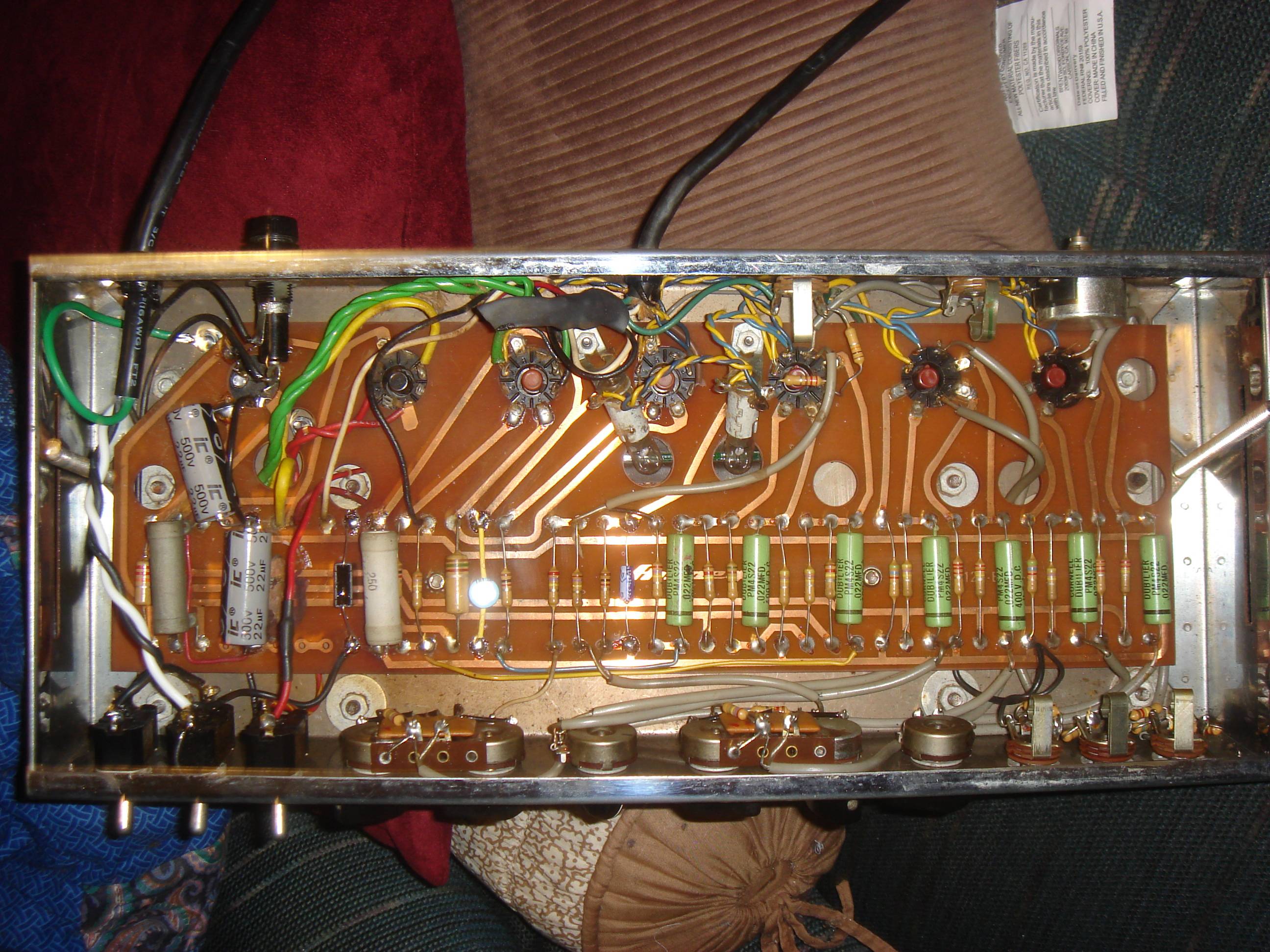
I will also second, or third, the recommendation of having this amp serviced by a pro. You want to identify what caused that resistor to fail and any other potentially damaged components. The amp looks very close to if not entirely stock. It likely has some other worn components. These aren’t difficult amps to service, but having someone who knows what they’re looking at will get you up and running quickly and smoothly.
The amp is an interesting/short lived transition model (though honestly you could say that about almost every revision of the B15 until 1969) in that it is PCB based but cathode biased. These were only made from early-mid 65, then there are some brief turret board B15NF amps before you see the PCB B15NF.
I had one with January 65 date codes, there are a few schematic revisions up to March 65 which still use the cathode bias design, then the fixed bias NF schematics dated April 65.
Schematics
Here is my old amp, resistor in the same location appears to be 22k/1w as mentioned.
I will also second, or third, the recommendation of having this amp serviced by a pro. You want to identify what caused that resistor to fail and any other potentially damaged components. The amp looks very close to if not entirely stock. It likely has some other worn components. These aren’t difficult amps to service, but having someone who knows what they’re looking at will get you up and running quickly and smoothly.
Last edited:

- Feb 12, 2006
- 61,045
- 5
- 220,996
- Disclosures
- Development Engineer-Mesa Boogie, Development Engineer-Genzler (pedals), Product Support-Genz Benz
That’s not the same layout, no way can you assume it’s 22k. In fact, there’s an intact 22k there already.
A tech needs to figure out what’s what without guessing. That means comparing the amp to the schematic to determine which resistor it really is.
THEN, it can be determined what causes the resistor to fail, they don’t fail on their own.
A tech needs to figure out what’s what without guessing. That means comparing the amp to the schematic to determine which resistor it really is.
THEN, it can be determined what causes the resistor to fail, they don’t fail on their own.
- Feb 12, 2006
- 61,045
- 5
- 220,996
- Disclosures
- Development Engineer-Mesa Boogie, Development Engineer-Genzler (pedals), Product Support-Genz Benz
That’s not generally the cause, but you need to know what the resistor does in the circuit before doing anything else. THEN, you can repair the root cause.Thanks man. I believe the resister failed because the ac cable was jury rigged to a crap ace hardware extension cord. I cut the old one loose but was waiting to replace the resister before I solder the new one.
That’s not the same layout, no way can you assume it’s 22k. In fact, there’s an intact 22k there already.
A tech needs to figure out what’s what without guessing. That means comparing the amp to the schematic to determine which resistor it really is.
THEN, it can be determined what causes the resistor to fail, they don’t fail on their own.
There are two on mine as well, the second is blocked by the 1k wire wound but you can see the solder pad. All three early 65 NC schematics as linked, and the 1/65 schematic in OPs post, show those two 22k/1w in the power supply.
I agree, as I already said, OP should have a pro look at and repair the amp.
- Feb 12, 2006
- 61,045
- 5
- 220,996
- Disclosures
- Development Engineer-Mesa Boogie, Development Engineer-Genzler (pedals), Product Support-Genz Benz
Ok, if there are two 22k resistors, they are RC filter elements for the B+ supply feeding the PI or preamp. When these resistors fail, it’s either because of a load fault, wiring fault or a failure of one of the caps in the RC filter network.

A beautiful amp! Congrats! Please take it to a competent tech. It really deserves it.
I try to be tolerant of other peoples beliefs. But looking at the schematic included with the post. There are no resistors associated with the primary power circuit. (AC cord and xmfr pri.) Unless the hot side of the AC cord came into contact with one side of that resistor while the amp was on, you're probably looking at some other cause.Thanks man. I believe the resister failed because the ac cable was jury rigged to a crap ace hardware extension cord. I cut the old one loose but was waiting to replace the resister before I solder the new one.
Unfortunately, you purchased the amp as we see it. We have no way to know what went on before.
FWIW... I believe that there is nothing inherently wrong with Ace hardware AC power cords. Ace doesn't manufacture these. They come from someone who makes power cables for a lot of equipment and this is simply re-branded with the Ace name. Any power cable can be installed poorly and cause problems.

I try to be tolerant of other peoples beliefs. But looking at the schematic included with the post. There are no resistors associated with the primary power circuit. (AC cord and xmfr pri.) Unless the hot side of the AC cord came into contact with one side of that resistor while the amp was on, you're probably looking at some other cause.
Unfortunately, you purchased the amp as we see it. We have no way to know what went on before.
FWIW... I believe that there is nothing inherently wrong with Ace hardware AC power cords. Ace doesn't manufacture these. They come from someone who makes power cables for a lot of equipment and this is simply re-branded with the Ace name. Any power cable can be installed poorly and cause problems.
- Feb 12, 2006
- 61,045
- 5
- 220,996
- Disclosures
- Development Engineer-Mesa Boogie, Development Engineer-Genzler (pedals), Product Support-Genz Benz
Those who try to fix things themselves and do not understand what they are doing often end up with bigger problems and a more expensive (sometimes much more) repair bill. The same applies to under qualified service techs.
Thanks man, I very much appreciate your knowledge and feedback. Those revisions came fast and furious in 65. Yours looks impeccable.As has been pointed out that’s a resistor. Should be 22k/1w.
The amp is an interesting/short lived transition model (though honestly you could say that about almost every revision of the B15 until 1969) in that it is PCB based but cathode biased. These were only made from early-mid 65, then there are some brief turret board B15NF amps before you see the PCB B15NF.
I had one with January 65 date codes, there are a few schematic revisions up to March 65 which still use the cathode bias design, then the fixed bias NF schematics dated April 65.
Schematics
Here is my old amp, resistor in the same location appears to be 22k/1w as mentioned.
I will also second, or third, the recommendation of having this amp serviced by a pro. You want to identify what caused that resistor to fail and any other potentially damaged components. The amp looks very close to if not entirely stock. It likely has some other worn components. These aren’t difficult amps to service, but having someone who knows what they’re looking at will get you up and running quickly and smoothly.

I'm all for people that know what they're doing fixing their own stuff, but if you can't tell a resistor from a capacitor, you're probably not in the "know what they're doing" camp on this particular fix. Not trying to be mean, but with amplifiers (especially tube ones), your safety is involved as well, so a bit of brutal honesty is good for you.
Resistors are simple, but very predictable devices - they don't work for decades, then suddenly burn up like that - wen you see that, something else in the circuit has changed drastically (which greatly increased the amount of current flowing through the resistor), and if you just replace it, although I won't guarantee it, my money would be on the replacement resistor burning up as well. That might be the only thing that happens, but it might not - other not so nice things might occur if you just change the resistor. Someone (who's got experience in these things) should find the root cause of why the resistor burned up, fix that, and then replace the resistor.
Resistors are simple, but very predictable devices - they don't work for decades, then suddenly burn up like that - wen you see that, something else in the circuit has changed drastically (which greatly increased the amount of current flowing through the resistor), and if you just replace it, although I won't guarantee it, my money would be on the replacement resistor burning up as well. That might be the only thing that happens, but it might not - other not so nice things might occur if you just change the resistor. Someone (who's got experience in these things) should find the root cause of why the resistor burned up, fix that, and then replace the resistor.
The black cord looks nasty. The extension cord looks like it's had better days.View attachment 4809973 I should have said highly problematic and dangerous ac situation. See photo. Look, 90% I’ll probably have to take it in but everyone here has taken a shot at trying to fix it themselves first. If we had to take in every piece of gear that we’ve modded or repaired we’d all be broke…by spending all our money in gear…in an endless quest of getting more gear…and better gear… I think I just had a breakthrough
No charge for those diagnostics.
Capt. Obvious Pool Cleaning and Amp Repair.

For what it's worth, I am a diehard DIY guy and trained as an electronics tech. I think it's worth the money to get an amp tech to diagnose/repair that amp.
I would probably install a new grounded power cord ahead of time and have it ready for the tech to connect inside the amp.
I would probably install a new grounded power cord ahead of time and have it ready for the tech to connect inside the amp.

I am all for the right to repair, but if one does not have the tools or skills then they should not attempt.
Nothing is worse for a repair person than fixing what the customer already took apart or further broke so a proper diagnoses in its original (pre attempted) state could not have been found.
Got to puzzle what they done before the diagnosis of the original problem is can be done.
Then the sadness of the person that attempted when it does not work or makes a bigger problem when more goes boom when the part was replaced but not the reason why, now there are five burned up items inside and the bill will be more than one will be willing to spend.
This is more than a solder iron repair. It needs to be hooked up to an oscilloscope, a multi meter, and a variac, then take measurements and understand them. Not knowing you were talking about a resistor leads us to believe these tools and skill are not their.
Nothing wrong with that.
Are you also able to clean up or repair that burnt trace successfully?
Part swaps in amps do not usually have the same results as a home improvement repair. There are underlining causes to the one you do see.
Nothing is worse for a repair person than fixing what the customer already took apart or further broke so a proper diagnoses in its original (pre attempted) state could not have been found.
Got to puzzle what they done before the diagnosis of the original problem is can be done.
Then the sadness of the person that attempted when it does not work or makes a bigger problem when more goes boom when the part was replaced but not the reason why, now there are five burned up items inside and the bill will be more than one will be willing to spend.
This is more than a solder iron repair. It needs to be hooked up to an oscilloscope, a multi meter, and a variac, then take measurements and understand them. Not knowing you were talking about a resistor leads us to believe these tools and skill are not their.
Nothing wrong with that.
Are you also able to clean up or repair that burnt trace successfully?
Part swaps in amps do not usually have the same results as a home improvement repair. There are underlining causes to the one you do see.


