

Enjoy the benefits of a premium membership!
Upgrade Account
-
TalkBass has been independent since 1998. Add your voice.
Create a free account to reply to discussions, view embedded media, and browse with fewer display ads.
Join free Log in
Want zero display ads or expanded classifieds tools? Compare plans.
You are using an out of date browser. It may not display this or other websites correctly.
You should upgrade or use an alternative browser.
You should upgrade or use an alternative browser.
Ampeg PF-50T Humbuster
- Thread starter mnats
- Start date
-
- Tags
- ampeg ampeg pf-50t pf-50t
More options
Who Replied?

realy bad to hear this.i assume they fixed this.looking to buy 50t but after this probaby i pass.pretty shame for this company
Hi all,
I wanted to report back. I received the repaired (humbuster modded) amp back from the vendor today. It was a frustrating adventure but I'm happy with the results. The amp is quiet as a mouse & sounds great. Thanks everyone for their input!
I wanted to report back. I received the repaired (humbuster modded) amp back from the vendor today. It was a frustrating adventure but I'm happy with the results. The amp is quiet as a mouse & sounds great. Thanks everyone for their input!
dispite all i read i make purche few days ago.good sound from 2 di, but when connecting to speacker bad hum and huge hiss, microfonic preamp tubes and ratlling output tubes.so i return amp, never again ampeg

realy bad to hear this.i assume they fixed this.looking to buy 50t but after this probaby i pass.pretty shame for this company
No they haven't , I read that they haven't changed a thing and fix if customer complains.
They still ship as they always have , no mod in place. If I'm wrong please correct me.
To clarify, I bought one week before last , messed with it for an entire day; faint high pitched noises and a moderate hum.No they haven't , I read that they haven't changed a thing and fix if customer complains.
They still ship as they always have , no mod in place. If I'm wrong please correct me.
returned it ,nope shouldn't ship like that, how hard would it have been to add a step into production. Maybe it would be, but geez man, let's hope no one notices.

scotch
It's not rocket science!
- Nov 12, 2006
- 6,944
- 2,083
- 51
- Disclosures
- Please see Profile for Endorsement disclosures
Having read through this thread again after a few years, is there a consensus on the best mod scheme to employ? I'd like to perform this myself in a couple weeks while I have some down time. I feel confident as I've modded tube amps before and have the tools at hand- I just could use some help pointing to which strategy to take and which components to acquire.
Thanks!
Thanks!

A situation other contributors have come close on, but not really hit head on. The original bias circuit is functionally almost identical to the circuit of the famous AB763 - a half-wave diode, a current limiting resistor, a single stage of filtering and an adjustment pot. Bias voltage, and any ripple superimposed on it, is applied to the output tubes common mode, and cancels in the output transformer, providing the tubes are matched and balanced! Putting a matched pair of tubes in every amp costs time and money. Random tubes, poor quality tubes much cheaper, some amps will hum, some won't. In the pre-CBS Fender days, the RCA tubes used all met specification and the amps didn't hum. When CBS cut corners on tubes, the bias circuit was redesigned to enable balancing of shtty tubes. The humbuster mod simply adds another stage of filtering, which masks, not corrects, the underlying problem.

Having read through this thread again after a few years, is there a consensus on the best mod scheme to employ? I'd like to perform this myself in a couple weeks while I have some down time. I feel confident as I've modded tube amps before and have the tools at hand- I just could use some help pointing to which strategy to take and which components to acquire.
Thanks!
I chose to do a variation of the Bertr mod.
Original circuit top and Bertr mod bottom:
Rather than adding a 3.3K (RT) I replaced R128 with 3.9K. I accidently soldered the 220uF capacitor in reverse polarity...It has been replaced.
Here is my post: https://www.talkbass.com/threads/ampeg-pf-50t-humbuster.1306043/page-17#post-27263431

I'm about to do the Bertr mod to a new PF-50t - seems they are supplied un-modded now - I have 100uf 63v or 220uf 450v caps available, any suggestion which would be better?

Got no idea but whatever Bert recommends is what I'd do.I'm about to do the Bertr mod to a new PF-50t - seems they are supplied un-modded now - I have 100uf 63v or 220uf 450v caps available, any suggestion which would be better?
I'm about to do the Bertr mod to a new PF-50t - seems they are supplied un-modded now - I have 100uf 63v or 220uf 450v caps available, any suggestion which would be better?
AFAIK the Bertr mod uses a 220uF 100V capacitor.
The uF rating relates to how much filtering the capacitor can provide, so AFAIK 100uF will be less effective.
The voltage rating relates to how much voltage the capacitor can handle. If the voltage in circuit exceeds the voltage rating of the capacitor, the capacitor will be damaged and eventually fail...this could result in the amp loosing bias, which could destroy the output tubes and transformers. The 63V rating may be sufficient, but possibly not.
A 220uF 450V capacitor is probably fairly large, but if it fits it will work fine. If it doesn't fit, buy another capacitor.

- Feb 12, 2006
- 61,085
- 5
- 221,195
- Disclosures
- Development Engineer-Mesa Boogie, Development Engineer-Genzler (pedals), Product Support-Genz Benz
I would use the 220uF/100V cap. At high line, 63V will not be even close to enough.
Got no idea but whatever Bert recommends is what I'd do.
I believe he used 220uf initially but said 100uf was fine. I'll go with the bigger one.
I believe he used 220uf initially but said 100uf was fine. I'll go with the bigger one.
Yes, in post 100 he recommended 100uF and 3.9K.
Ref: https://www.talkbass.com/threads/ampeg-pf-50t-humbuster.1306043/page-5#post-21338053
I agree with Agedhorse, the 63V rating is not sufficient.
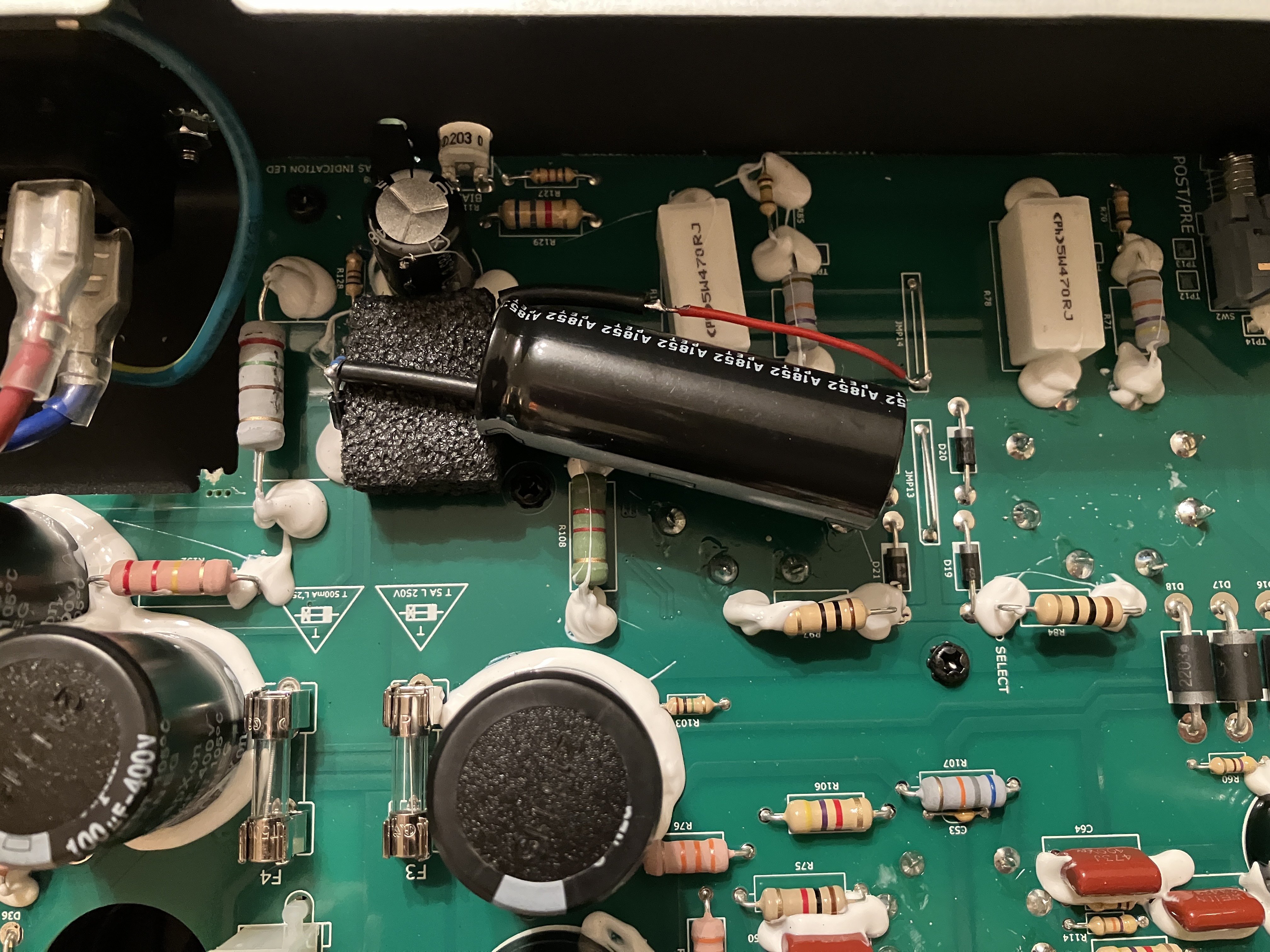
Probably I will replace this with an axial cap at some point for a neater solution, but this works. The cap is well above the board and the foam block keeps it stable (I hope). No more warranty, but also no more hum 
Last edited:
- Feb 12, 2006
- 61,085
- 5
- 221,195
- Disclosures
- Development Engineer-Mesa Boogie, Development Engineer-Genzler (pedals), Product Support-Genz Benz
Is that black foam conductive by chance?
I didn't think so, but in case it is I'll remove it.
[Edit] A quick google suggests it is. Thanks for spotting that


