
Enjoy the benefits of a premium membership!
Upgrade Account
-
TalkBass has been independent since 1998. Add your voice.
Create a free account to reply to discussions, view embedded media, and browse with fewer display ads.
Join free Log in
Want zero display ads or expanded classifieds tools? Compare plans.
You are using an out of date browser. It may not display this or other websites correctly.
You should upgrade or use an alternative browser.
You should upgrade or use an alternative browser.
Ampeg SVT 50th Anniversary Edtition
- Thread starter Clap Trap
- Start date
- Status
- Not open for further replies.
More options
Who Replied?



Really?
This is something new for 2019?
So the changes are going back to what was done in the 60's and 70's which IMO is mostly graphics and using tubes that are available.
I've never noticed that much difference between old and new SVT's and I'm willing to be that a standard CL would get really close to this "special 50th anniversary head".
Granted, there is probably not that much could be improved on the old platform.
I was hoping for a new original idea from Ampeg for 2019 as it's been awhile.
Thought that perhaps the Yamaha purchase had something to do with some new designs / ideas that Ampeg was working on.
Here's to hoping that this is the case and that something new will appear in the near future.
This is something new for 2019?
So the changes are going back to what was done in the 60's and 70's which IMO is mostly graphics and using tubes that are available.
I've never noticed that much difference between old and new SVT's and I'm willing to be that a standard CL would get really close to this "special 50th anniversary head".
Granted, there is probably not that much could be improved on the old platform.
I was hoping for a new original idea from Ampeg for 2019 as it's been awhile.
Thought that perhaps the Yamaha purchase had something to do with some new designs / ideas that Ampeg was working on.
Here's to hoping that this is the case and that something new will appear in the near future.
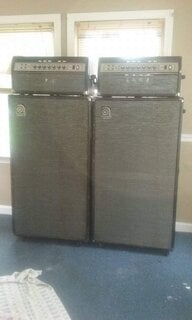
Sounds great especially with both channels jumped, 6146's are still very easy to get and are actually cheaper.
Call me old (which I am) and sentimental (which I am) and someone who no longer needs a heavy 300 watts tube amp (which I don't) but this just makes me drooooooooooooooollllllldrooldrooldrooldrooldrooldrooldrooldrool
Common sense tells me my Super Bassman or a CL will do the same job but I can't help but want it.
Common sense tells me my Super Bassman or a CL will do the same job but I can't help but want it.

Sounds great especially with both channels jumped, 6146's are still very easy to get and are actually cheaper.
From the digging I have done, the preferred tube would be the 6146B and a matched NOS set is almost impossible to find. 6146W are available, but I don't get the idea there is a bunch of NOS supplies left of those either. There are current production Chinese 6146Bs available, but reviews suggest low manufacturing quality and reliability problems.
Here are my notes:
6146B are 35W max plate dissipation. There is confusion on whether 6146W is 35W or 25W. Some claim that W's made after a certain time around 1964-65 were 6146B spec, and earlier tubes are 6146A spec. 6146W Information:. Others claim all varieties except 6146B are 25W; essentially all 6146Ws are just ruggedized 6146As.
The only datasheet I have found is for the RCA 6146W. It appears to be dated 9-65 and indicates 25W max plate dissipation (ICAS). No 6156W datasheets listing 35W have been located.
The only datasheet I have found is for the RCA 6146W. It appears to be dated 9-65 and indicates 25W max plate dissipation (ICAS). No 6156W datasheets listing 35W have been located.
Last edited:

Whoa! Can't wait to try this puppy out!

From the digging I have done, the preferred tube would be the 6146B and a matched NOS set is almost impossible to find. 6146W are available, but I don't get the idea there is a bunch of NOS supplies left of those either. There are current production Chinese 6146Bs available, but reviews suggest low manufacturing quality and reliability problems.
Here are my notes:
6146B are 35W max plate dissipation. There is confusion on whether 6146W is 35W or 25W. Some claim that W's made after a certain time around 1964-65 were 6146B spec, and earlier tubes are 6146A spec. 6146W Information:. Others claim all varieties except 6146B are 25W; essentially all 6146Ws are just ruggedized 6146As.
The only datasheet I have found is for the RCA 6146W. It appears to be dated 9-65 and indicates 25W max plate dissipation (ICAS). No 6156W datasheets listing 35W have been located.
I have 6293's in one of my transmitters, they're like ruggedized 6146's Supposedly, the 6146W's were supposed to be work in place of both As and B's but don't work well as a sub for A's.
http://www.worldtubecompany.com/mm5/merchant.mvc?Screen=TF-6883

Really?
This is something new for 2019?
So the changes are going back to what was done in the 60's and 70's which IMO is mostly graphics and using tubes that are available.
I've never noticed that much difference between old and new SVT's and I'm willing to be that a standard CL would get really close to this "special 50th anniversary head".
Granted, there is probably not that much could be improved on the old platform.
I was hoping for a new original idea from Ampeg for 2019 as it's been awhile.
Thought that perhaps the Yamaha purchase had something to do with some new designs / ideas that Ampeg was working on.
Here's to hoping that this is the case and that something new will appear in the near future.
The Japanese in general, and Yamaha in particular, have never shied away from new and interesting designs. They also place a very high importance on legacy.
I'm sure they are taking a second to figure out how to be mindful of both aspects moving forward. They won't just trash whatever got the Ampeg name where it is today (the past). But you can bet they will incorporate interesting twists soon.

I have 6293's in one of my transmitters, they're like ruggedized 6146's Supposedly, the 6146W's were supposed to be work in place of both As and B's but don't work well as a sub for A's.
http://www.worldtubecompany.com/mm5/merchant.mvc?Screen=TF-6883
Bob, given the limits of the sound recordings proffered in the clip -- any thoughts on the "dual voicing" strategy they took here? Sounds useful to me. But can we infer that they voiced channel one to break up earlier than it ordinarily would?
I love my V-4B but would love one of these for more clean headroom.
Thanks!
Where are they being built, when will they become available to the general public and is there any indication what the price will be?


Where are they being built, when will they become available to the general public and is there any indication what the price will be?
+1
Designed & Assembled in the USAWhere are they being built, when will they become available to the general public and is there any indication what the price will be?

Given that it’s the 50th anniversary of this monumental amplifier, it’s nice that they are recognizing it with this special revision. I bet that it does well.
It’s also impressive that 50 years down the road, there are still a lot of original SVT amps out there in service. I have a restored 1971 that’s better than new. My 1963 B15N is 56 years old and it too is in top shape. Both sound fantastic. A tribute to the designers.
Who would ever have thought that these amps would still be desirable, so many years later.
It’s also impressive that 50 years down the road, there are still a lot of original SVT amps out there in service. I have a restored 1971 that’s better than new. My 1963 B15N is 56 years old and it too is in top shape. Both sound fantastic. A tribute to the designers.
Who would ever have thought that these amps would still be desirable, so many years later.
Last edited:

BOOM!
BOOM, INDEED!
Can't wait to hear your thoughts on it too!Whoa! Can't wait to try this puppy out!
So a normal svt-vr is more like channel 2 of this 50th?
You might notice that Channel 2 has Volume, Bass, Treble. So what he says and what you get are a bit different. My guess is they voiced Channel 2 to be a bit more like a mid 70s Channel 1, but you still only have the functionality of Bass and Treble controls. Honestly I would rather have the original Channel 2 voicing as it is actually very cool. I believe it's like a B15.
In the original amps Channel 1 had three 12DW7 tubes and channel 2 had a single 12AX7. The SVT VR subs 12AX7 and 12AU7 for the 12DW7s in Channel 1. So you get the same gain structure.
Explanation. 12AX7, 12AU7, and 12DW7 are all dual triode tubes. With 12DW7, one triode is equivalent to 12AX7 and one triode is equivalent to 12AU7.
The vintage amps also used a 6C4 tube to blend Channel 1 and Channel 2. The 6C4 is a single triode tube equivalent to one side of a 12AU7.
Last edited:
- Status
- Not open for further replies.


