• TalkBass has been independent since 1998. Add your voice.
    Create a free account to reply to discussions, view embedded media, and browse with fewer display ads.
    Join freeLog in
    Want zero display ads or expanded classifieds tools? Compare plans.

Ampeg V-4B vs Fender Rumble 500: Perceived Loudness

Nov 11, 2008
835
1,132
I realize the tube vs solid state threads have run their course, but I am more interested in a direct comparison between these two specific amps. They both seem to be popular around here and I am seeking input from those who have played or own both. I might throw the class-D Bassman 500 in the comparison mix to the V-4B as it has the same power module as the Rumble, too.

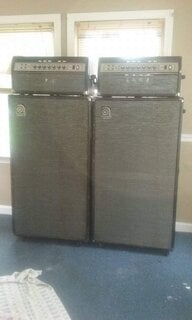
I have been gigging with a Rumble 500 v3 head successfully, but have a curiosity around tube heads (especially since recently acquiring a used Ampeg 8x10 cabinet). What attracts me to the V-4B is its simplicity and sound (based on the demos I have heard), yet it can run between 2 and 8 ohms and has a DI onboard.

How would a modern V-4B with the master at full volume and the input gain around half (slight breakup sound) compare to the output of a 500 watt Rumble with both the input gain and master at noon, if ran through the same cabinet with the same bass (let's say a passive P or J bass; that's what I use)? I typically "set and forget" my Rumble's master at noon on gigs, adjusting my cabinet choice to the venue (single 1x15, two 2x10; haven't gigged the 8x10 yet, but I presume I can set the volume lower with that....).

 
I can't give you a direct AB comparison with that setting on the Rumble, but while there are other factors besides mere watts that determine how loud an amp can get, watts is watts regardless of how they're created. So even though you will be able to get more than its 100w RMS rating if you push the V4B a little, don't expect miracles. For me, the V4B is plenty. YMMV.
 
I can't give you a direct AB comparison with that setting on the Rumble, but while there are other factors besides mere watts that determine how loud an amp can get, watts is watts regardless of how they're created. So even though you will be able to get more than its 100w RMS rating if you push the V4B a little, don't expect miracles. For me, the V4B is plenty. YMMV.

That has been my impression from what I've heard about the V4B. I love the concept of the amp, but have yet to play through one (unfortunately). On the upside, if I got one and it didn't work for me on bass, I also am a guitarist and could run it through my open back 2x12 cabinet for that!
 
  • Like
Reactions: JimmyM
How would a modern V-4B with the master at full volume and the input gain around half (slight breakup sound) compare to the output of a 500 watt Rumble with both the input gain and master at noon, if ran through the same cabinet with the same bass (let's say a passive P or J bass; that's what I use)? I typically "set and forget" my Rumble's master at noon on gigs, adjusting my cabinet choice to the venue (single 1x15, two 2x10; haven't gigged the 8x10 yet, but I presume I can set the volume lower with that....).

What you're not taking into consideration here is that if you run a valve/tube amp at full (master) volume, you will overdrive the power amp, which will give you a really nice, thick, and creamy distortion (pre-amp distortion is more coarse & spiky). It may be ideal if you're looking for that kind of sound, but if you're not, it may not be an ideal comparison.

I played guitar for some time, and did some "research" into how valve/toob amps sound at different levels, while I was trying to find "my sound" (needless to say, I went through a shed load of amps/cabs and pedals too!). Running a valve/toob power amp at full volume is not only very loud (very, very loud!), but the power amp distorts the signal. As I mentioned above, this distortion is more like the distortion you hear on the classic rock albums of the 60's/70's, when people actually turned their amps up full, and kept the gain stages low (if their amps HAD gain stages!). This is also why there is a proliferation of low wattage valve/toob amps available for our guitar playing friends, so they can turn them up loud and achieve creamy distortion.

A solid state or Class D power amp doesn't react like a valve/toob power amp, in that it won't distort the signal, though the speakers may start to distort it. So running the Rumble 500 at parity volume, it will have the cleaner signal compared to the V4B at the same volume level. If you ran, say something like an SVT-CL or another 300w valve/tube amp, against the Rumble, with similar cabs, at similar levels, it would be a far better comparison, as you won't be pushing the SVT as hard as you would the V4B against the Rumble.
 
What you're not taking into consideration here is that if you run a valve/tube amp at full (master) volume, you will overdrive the power amp, which will give you a really nice, thick, and creamy distortion (pre-amp distortion is more coarse & spiky). It may be ideal if you're looking for that kind of sound, but if you're not, it may not be an ideal comparison.

I played guitar for some time, and did some "research" into how valve/toob amps sound at different levels, while I was trying to find "my sound" (needless to say, I went through a shed load of amps/cabs and pedals too!). Running a valve/toob power amp at full volume is not only very loud (very, very loud!), but the power amp distorts the signal. As I mentioned above, this distortion is more like the distortion you hear on the classic rock albums of the 60's/70's, when people actually turned their amps up full, and kept the gain stages low (if their amps HAD gain stages!). This is also why there is a proliferation of low wattage valve/toob amps available for our guitar playing friends, so they can turn them up loud and achieve creamy distortion.

A solid state or Class D power amp doesn't react like a valve/toob power amp, in that it won't distort the signal, though the speakers may start to distort it. So running the Rumble 500 at parity volume, it will have the cleaner signal compared to the V4B at the same volume level. If you ran, say something like an SVT-CL or another 300w valve/tube amp, against the Rumble, with similar cabs, at similar levels, it would be a far better comparison, as you won't be pushing the SVT as hard as you would the V4B against the Rumble.

Incidentally toob is actually spelled tube, thought you'd want to know.
 
Incidentally toob is actually spelled tube, thought you'd want to know.

But pronounced as "toob". They are in fact Thermionic Valves, but commonly referred to as "tubes".

Not true unless the gain goes past a certain level

Not completely true either. On Master Volume only amps (i.e. Amps without a Gain control) distort quite nicely when the volume is turned up. The Gain control is simply a "pre-volume", boosting the signal prior to it going into the EQ, then boosted again through the Power Amp. There is a "rule of thumb" that if you use more volume, you turn the gain down. Using more gain will be more susceptible to feedback. If you want to push the volume of a Thermionic Valve driven Power Amp, you have to accept that it WILL distort, that's why valve amps are still popular.

Like I said previously, the solid state amp will not distort at high volumes, but the speakers will, which is far less desirable. Solid State amps were developed mainly because people wanted a clean sound, but at higher volumes. The downside of this, was that the speakers start to distort the sound before the power amp, producing not a very desirable sound. Valves distort when you push them, be they pre-amp valves, or power valves. This is the reason why we saw the development of "hybrid" amps, with pre-amp valves to not only give a bit of "valve warmth" into a "cold" signal, but also the fact that it will distort when the gain is pushed.

The main reason why low output valve amps were developed in recent years for our guitar playing brethren, was to allow them to push these smaller amps power sections into distortion at more reasonable volume levels. Also look at the development of attenuators, for exactly the same reason.

The characteristics of valve distortion are different as well. Pre-amp valve distortion (or "High Gain" if you will), is quite sharp and spiky, it almost sets your teeth on edge. Power Amp distortion on the other hand, is what you hear on these "classic albums", smooth, creamy and thick sounding (think of John Mayall's "Beano" album with Eric Clapton, where he turned his non-MV Marshall JTM up full blast to get the distorted sound).

Still, if the OP is willing to test his theory, pitting the V4B at full volume against the Rumble 500, then I only hope that he posts his results here. :)
 
I do not have the exact rumble, but I run a Rumble 200 combo on top of a Rumble 115, or run a V4B on top of 2 Rumble 115 cabs. I used to think Rumble for volume, v4b for tone, but since running the bass pot lower on the v4b and goosing some mids I'm pretty happy with the ampeg's volume. Also, I need less pedals/outboard gizmos to get my tone with the ampeg, toobs are where it's at in my book.
 
But pronounced as "toob". They are in fact Thermionic Valves, but commonly referred to as "tubes".


Not completely true either. On Master Volume only amps (i.e. Amps without a Gain control) distort quite nicely when the volume is turned up.
NOT ALL, DEPENDS ON HOW MUCH GAIN THE PREAMP HAS AND HOW MUCH SIGNAL THE BASS PUTS OUT.
The Gain control is simply a "pre-volume", boosting the signal prior to it going into the EQ, then boosted again through the Power Amp. There is a "rule of thumb" that if you use more volume, you turn the gain down. Using more gain will be more susceptible to feedback.
I HAVE NEVER EXPERIENCED THAT, UNLESS TURNING UP THE GAIN VS THE MASTER CHANGES THE FREQUENCY RESPONSE OF THE AMP AND IT SHOULDN'T.
If you want to push the volume of a Thermionic Valve driven Power Amp, you have to accept that it WILL distort, that's why valve amps are still popular.

Like I said previously, the solid state amp will not distort at high volumes, but the speakers will, which is far less desirable. Solid State amps were developed mainly because people wanted a clean sound, but at higher volumes.
ANY AMP WILL DISTORT IF PUSHED HARD ENOUGH, TUBE AMPS DISTORT WITH EVEN ORDER HARMONIC DISTORTION, SS AMPS DISTORT WITH SPURIOUS DISTORTION ALTHOUGH I HAVE HEARD SOME SS AMPS THAT DISTORT WITH A VERY PLEASING SOUND FOR EX THE OLD ACOUSTIC 361'S HAVE A NICE DISTORTED TONE.
The downside of this, was that the speakers start to distort the sound before the power amp, producing not a very desirable sound. Valves distort when you push them, be they pre-amp valves, or power valves. This is the reason why we saw the development of "hybrid" amps, with pre-amp valves to not only give a bit of "valve warmth" into a "cold" signal, but also the fact that it will distort when the gain is pushed.

The main reason why low output valve amps were developed in recent years for our guitar playing brethren, was to allow them to push these smaller amps power sections into distortion at more reasonable volume levels. Also look at the development of attenuators, for exactly the same reason.

The characteristics of valve distortion are different as well. Pre-amp valve distortion (or "High Gain" if you will), is quite sharp and spiky, it almost sets your teeth on edge.
THAT IS NOT NECESSARILY TRUE, I HAVE AN EBS TUBE DISTORTION BOX WITH ONE 12AX7 PREAMP TUBE IN IT AND IT, DEPENDING ON THE SETTINGS CAN SOUND VERY SMOOTH AND BIG IN FACT I USE IT WITH MY SVT AND IT MAKES IT SOUND THICKER.
Power Amp distortion on the other hand, is what you hear on these "classic albums", smooth, creamy and thick sounding (think of John Mayall's "Beano" album with Eric Clapton, where he turned his non-MV Marshall JTM up full blast to get the distorted sound).
I DO AGREE POWER TUBE DISTORTION CAN SOUND BETTER THAN PREAMP DISTORTION THOUGH.
Still, if the OP is willing to test his theory, pitting the V4B at full volume against the Rumble 500, then I only hope that he posts his results here. :)
 
FWIW for loud gig utility my vintage V-4B (w/ no master volume) seemed roughly toe to toe with my 500W micro-head (Markbass LMII). At greater volumes the micro-head would politely compress itself while the 100 watt tube head would feel more responsive and room-filling but start distorting conspicuously (and rather gloriously) beyond a certain point.
I'm no distortion connoisseur but IME the right tube power section well matched for the gig can be a thing of real beauty. No foot pedals, just dig in and fuzz out! :bassist:
(My 50 watt Sunn 200s seems even better for all-out distortion on solos but there is a greater risk of being underpowered and thus breaking up more often than wanted.)
 
But pronounced as "toob". They are in fact Thermionic Valves, but commonly referred to as "tubes".

Not completely true either. On Master Volume only amps (i.e. Amps without a Gain control) distort quite nicely when the volume is turned up. The Gain control is simply a "pre-volume", boosting the signal prior to it going into the EQ, then boosted again through the Power Amp. There is a "rule of thumb" that if you use more volume, you turn the gain down. Using more gain will be more susceptible to feedback. If you want to push the volume of a Thermionic Valve driven Power Amp, you have to accept that it WILL distort, that's why valve amps are still popular.

Like I said previously, the solid state amp will not distort at high volumes, but the speakers will, which is far less desirable. Solid State amps were developed mainly because people wanted a clean sound, but at higher volumes. The downside of this, was that the speakers start to distort the sound before the power amp, producing not a very desirable sound. Valves distort when you push them, be they pre-amp valves, or power valves. This is the reason why we saw the development of "hybrid" amps, with pre-amp valves to not only give a bit of "valve warmth" into a "cold" signal, but also the fact that it will distort when the gain is pushed.

The main reason why low output valve amps were developed in recent years for our guitar playing brethren, was to allow them to push these smaller amps power sections into distortion at more reasonable volume levels. Also look at the development of attenuators, for exactly the same reason.

The characteristics of valve distortion are different as well. Pre-amp valve distortion (or "High Gain" if you will), is quite sharp and spiky, it almost sets your teeth on edge. Power Amp distortion on the other hand, is what you hear on these "classic albums", smooth, creamy and thick sounding (think of John Mayall's "Beano" album with Eric Clapton, where he turned his non-MV Marshall JTM up full blast to get the distorted sound).

Still, if the OP is willing to test his theory, pitting the V4B at full volume against the Rumble 500, then I only hope that he posts his results here. :)
What Bob said would have been my reply.
 
ANY AMP WILL DISTORT IF PUSHED HARD ENOUGH, TUBE AMPS DISTORT WITH EVEN ORDER HARMONIC DISTORTION, SS AMPS DISTORT WITH SPURIOUS DISTORTION

This is the key argument.

The OP stated that he would run the V4B at full volume, and the Gain at half. Yes, the gain stage will distort and feed in to the power stage.

However, more importantly, the power stage will distort if run at full volume. If the OP is looking for a clean bass sound from the amp, he'll not find it by running the V4B at full tilt. If he is looking for a big fat distorted sound, then running the V4B at full tilt will deliver in spades. If he is looking for a clean sound with some headroom before the amp distorts, then the Rumble 500 would be a good choice.
 
This is the key argument.

The OP stated that he would run the V4B at full volume, and the Gain at half. Yes, the gain stage will distort and feed in to the power stage.

However, more importantly, the power stage will distort if run at full volume. If the OP is looking for a clean bass sound from the amp, he'll not find it by running the V4B at full tilt. If he is looking for a big fat distorted sound, then running the V4B at full tilt will deliver in spades. If he is looking for a clean sound with some headroom before the amp distorts, then the Rumble 500 would be a good choice.

I agree the Fender will probably be a lot louder than a V4-B if he's looking for loud clean volume, I would go with a 500 watt amp before a 100. Running a master volume amp with the master on full is like using a non-master volume amp, the output tubes will distort before the preamp will which is the way non-master volume amps work. I will say though that years ago I could make the preamp distort on my blueline SVT if I played hard enough, was not a good sound though but I think that was more to do with really pounding the bass itself than the preamp tubes distorting, I think actually I was overdriving the input tube to the preamp
 
This might be sort of helpful. I have a Rumble 500 head and I have a Ampeg pf-500 head. The big difference in these 2 heads (other than features) is voicing. The Rumble with all the tone controls at 12:00 sounds pretty flat to me. imho, there is no way to get the pf-500 to sound flat (other than to bypass the preamp) because of the baked in Ampeg tone stack. I would think that the v4b would have that same tone stack and comparing the v4b with the Rumble 500 within both amps clean power range would give similar results. The Rumble 500 should have at least 6 more db of clean headroom than the v4b @ 4 ohms.

This is just my opinion from my experience.
 
This might be sort of helpful. I have a Rumble 500 head and I have a Ampeg pf-500 head. The big difference in these 2 heads (other than features) is voicing. The Rumble with all the tone controls at 12:00 sounds pretty flat to me. imho, there is no way to get the pf-500 to sound flat (other than to bypass the preamp) because of the baked in Ampeg tone stack. I would think that the v4b would have that same tone stack and comparing the v4b with the Rumble 500 within both amps clean power range would give similar results. The Rumble 500 should have at least 6 more db of clean headroom than the v4b @ 4 ohms.

This is just my opinion from my experience.
I have not tried the Rumble 500 yet, but I have tried the little combos, and if what you say about the Rumble 500 is true, it's the opposite of the combos, because they all sounded juiced in the lows and highs with knobs at noon. And I have the PF800, which is basically the same sound as the 500, and it sounds fairly flat with knobs at noon to me. And yes, I have compared it with known flat gear.
 
I've played both. I used a V4B with the fridge in the 1970s. It is an awesome amp. I like it better than the SVT because in a club setting, you can crank it a bit more and get really nice sounds from it. I always ran all my EQ flat on it and I played a Fender Precision. Were it not for the weight and cost, I'd be playing that same rig now.
I ended up with the Rumble 500 because I needed something lighter than the lead sled I was using until about 3 years ago. I tried side by side the Rumble, the Markbass, and the Ampeg. I can't recall the model number on the Markbass or Ampeg, but they were the equivalent models. My criteria were tone, weight, price, and tone. I chose the Rumble for the tone. I can get closer to a tube sound with the Rumble than any other SS I've tried. Now, I also recently purchased a Fender Bassman 500 Hybrid and 2 1X15s to go with it. I did that because the tube pre does give even more of a tube like sound.
So if money and weight were no problem for me, I'd be playing the V4B. But, either the Rumble 500 or the Bassman 500 Hybird will do just fine. I'm really happy with the sound I get. If I weren't, I'd find a way to handle the Ampeg.
Hope that helps.
 

Latest posts