• TalkBass has been independent since 1998. Add your voice.
    Create a free account to reply to discussions, view embedded media, and browse with fewer display ads.
    Join freeLog in
    Want zero display ads or expanded classifieds tools? Compare plans.

Ampeg v4b volume 1 Potentiometer

Hi guys, I need to change the potentiometer on channel 1 of my 1975 V4b, but I'm not sure which one I should buy. I'm not an expert, and I do not want to affect the tone of the preamp, so someone suggested this one on the flip top website, the 1 meg linear taper D shaft pot.


Is this the correct replacement for the 75 79 era Ampeg V4B volume 1? What do you think, guys?
thanks
 
  • Like
Reactions: Adjectives
What is the original part? I don't think that's correct based on Ampeg's historical use of the part.

You will need the value, taper, mechanical type (component family), shaft type, length, bushing, mounting height off the PCB, etc.
 
basically i ve to pull it out from the amp otherwise I will never know what to buy.
No tech wants to see an amp come in partially disassembled. Let the tech do what he does best and don't make it harder for him (and more expensive for you).
 
Hi guys, I need to change the potentiometer on channel 1 of my 1975 V4b, but I'm not sure which one I should buy. I'm not an expert, and I do not want to affect the tone of the preamp, so someone suggested this one on the flip top website, the 1 meg linear taper D shaft pot.


Is this the correct replacement for the 75 79 era Ampeg V4B volume 1? What do you think, guys?
thanks

That will work in your amp, 1M linear for the volume pot. Tone pots are log. It’s a PCB mounted pot, the wire extensions allow you to more easily mount it. The original CTS make with the D-shaft is hard to find.

But before you replace it, make sure that the pot just doesn’t need cleaning. Also, cracks at the solder joints on the PCB are common. It can result in a crackling sound. Reflowing the solder joints is worth trying, even if they look good.
 
Last edited:
  • Like
Reactions: Sunnampeg
That will work in your amp, 1M linear for the volume pot. Tone pots are log. It’s a PCB mounted pot, the wire extensions allow you to more easily mount it. The original CTS make with the D-shaft is hard to find.

But before you replace it, make sure that the pot just doesn’t need cleaning. Also, cracks at the solder joints on the PCB are common. It can result in a crackling sound. Reflowing the solder joints is worth trying, even if they look good.
Are you sure? Most Ampeg designs I am familiar with use some version of A taper. That includes some of the V4B models.
 
I know this isn't the answer you're looking for, but if you need to ask these questions, I have a feeling that you probably shouldn't mess around inside an amp. You risk ending up with a significantly more expensive repair, and with this being a tube amp you also risk electrocuting yourself if you don't know what you're doing.

My advice: Bring it to an amp tech.

Please don't take this the wrong way, I'm genuinely trying to give you the best advice. If you DO have the required skills to properly diagnose and fix this amp yourself, by all means go ahead and do it.
 
Are you sure? Most Ampeg designs I am familiar with use some version of A taper. That includes some of the V4B models.

The 70s V4 and V4B non-distortion model schematics all call out a linear taper part for the volume controls


Distortion models are 1M and 500k depending on the channel
 
  • Like
Reactions: Wasnex
This is from the schematic for my 73
IMG_1523.png
 
Are you sure? Most Ampeg designs I am familiar with use some version of A taper. That includes some of the V4B models.

I know what you mean, you are correct. Schematics are inconsistent though.

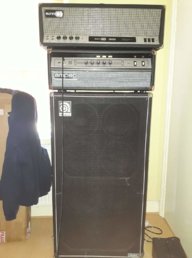
The user’s thumbnail shows a V4B with white rocker switches which indicates a 76-79 era. If this is indeed the revision. The question is to narrow it down, does the amp have a master volume or a distortion knob on the front panel?

At that time, schematics were drawn indicating log if it’s a log taper and no indication if it’s linear, just the ohm value. The distortion revision schematic doesn’t indicate a log volume pot. That being said, Ampeg’s B and V series schematics were all over the place in terms of the balistic type of pot used for volume pots. Bill Hughes has said that some schematics had errors and drafting mistakes were carried along without being corrected.

As found on the schematic, the part number for the distortion model channel 1 volume pot was 220663-18, that is a 1M LOG pot. Attached is a 1978 Ampeg parts list indicating a 1Meg -- log volume pot for part number 220663-18. For sure the tone circuit pots should be log.

1976 distortion revision:

Will the fliptops linear pot work in a distortion revision, yes and 1M linear is often used in these amps.

A tech can verify what is in there now, looking for the Ampeg part number as well as the manufacturer’s number. Techs will often substitute linear and log for the ch 1 volume pot to make it perform the way that they think is best. Also they maybe use the linear pot because the original D-shaft PCB mounted part is difficult to source. I’ve machined down a good number of round metal shaft pots for SVT’s and other Ampegs, it’s a lot of messy work.

Earlier V4 revisions used a linear volume pot as did the later 1977 master volume revision.

1977 master volume model used a 1M linear
 

Attachments

  • Like
Reactions: Wasnex
This is why I recommended that a qualified tech verify what part is actually used in the amp.

In general, Bill preferred log (A taper) pots for volume controls, but that may not be hard and fast. We had a discussion about this when I worked under him, things were pretty sloppy back in the day and mistakes got made, parts that were in stock got used in order to ship amps.
 
things were pretty sloppy back in the day and mistakes got made, parts that were in stock got used in order to ship amps.
I have a 1969 B-15NF that came from the factory with a PCB marked "B12" that does not match any schematic or record I can find and does not line up with any of the commercial B12 or B15 offerings recorded in the Ampeg book by Bill Moore and Gregg Hopkins. Interestingly, it ran a bias circuit that looked like it was ripped from a JTM45, with a pair of 10 uF caps.
 
Last edited:
  • Like
Reactions: agedhorse
I had to replace a defective one on my V4 (non-b). Unfortunately, even if the newer pot (from Fliptop) was 1 meg linear, the « linearity » vs the older one wasn’t the same (or the originals were log), thus not the same travel for the same gain. I had to replace the two pots and you want a tech doing it, unless you like colorized words go out your mouth when realigning the faceplate.

The defective one had missing sections (or worn-out?) of the carbon track…
 
I had to replace a defective one on my V4 (non-b). Unfortunately, even if the newer pot (from Fliptop) was 1 meg linear, the « linearity » vs the older one wasn’t the same (or the originals were log), thus not the same travel for the same gain. I had to replace the two pots and you want a tech doing it, unless you like colorized words go out your mouth when realigning the faceplate.

The defective one had missing sections (or worn-out?) of the carbon track…
This is not uncommon, almost certainly your original parts were lot (audio) taper.
 
Your hearing is logarithmic. It can be a matter of getting used to a linear pot taper in an amp, it’s just a different approach.

Some amps use a linear taper pot and fake a log effect with a resistor. See the taper section.

I should add that taper is used as a marketing tool. There are different log tapers ballistics. An amp can be made to sound louder at a lower volume in comparison to the competition.
 
Last edited:
I know this isn't the answer you're looking for, but if you need to ask these questions, I have a feeling that you probably shouldn't mess around inside an amp. You risk ending up with a significantly more expensive repair, and with this being a tube amp you also risk electrocuting yourself if you don't know what you're doing.

My advice: Bring it to an amp tech.

Please don't take this the wrong way, I'm genuinely trying to give you the best advice. If you DO have the required skills to properly diagnose and fix this amp yourself, by all means go ahead and do it.
Thanks, of course I've probably expressed myself badly, but when I say(I've to pull it out.. )i wasn't talking about me, it was more like to say the only way I've to see it is to pull it out.. I do not have this competence with such dangerous voltages.
 
So, presuming that I ve an A log taper in the amp, how is the log a taper and the 1 meg linear influence the gain structure when you turn the volume up.. I mean something like 1 will make the amp reach the crunch early, and another maybe later?? Or, for instance, what difference should I notice compared to what I've now on channel 1 when I turn the volume up?