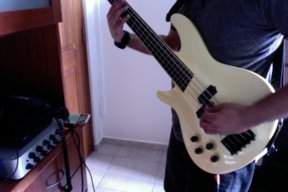
A low B is somewhere around 31Hz. The human ear can't even hear that low.
Wanna bet?
Dude- I believe you are well intentioned, but generally speaking, if you haven't the slightest idea what you're talking about, it's probably a good idea to qualify your statement with something like "I've been told..." or "Some people believe..."
There are two kinds of people: those with access to a sine wave generator, and those without. Nobody who's been within a mile of a sine wave generator would say something so easy to disprove.
For that matter, nobody who ever sat at a red light next to a car with a bodacious sound system playing hip-hop would ever say that either.
Where do these silly myths come from?
I'm aware that there are certain players who, as a matter of taste, prefer that the full range of their instrument not be reproduced, although they seem to have a hard time explaining why. That's all well and good.
But if you can't tell the difference between an open "B" string and the the B note an octave higher, you should probably get rid of your bass, your amp, and get yerself a Les Paul.
Back to the subject at hand, though, if the OP is hoping to reproduce the F# below "B," that's a frequency of 23 Hz, and will require a pretty large cab. Can 23 Hz be heard? Yes it can. I have a Sunfire subwoofer which will reproduce a fundamental of 18 Hz, and that's a little more questionable, but for a rig you have to haul around, 23 Hz is a tall order.
I don't think I really understand the OP's question, to tell you the truth. Is that really what he's after? If so, it CAN be done, but there is a question of diminishing returns involved.
Andy