The way I look at it, there are 3 main parts, with a not so technical vocabulary.
1.) The preamp, where your initial 'gain' or the amount of volume you allow to go into it. Also, the preamp is where you control and shape the sound by dialing in various forms of bass, high, and middle. Some preamps allow you to turn down these frequencies, others allow you to boost them. Most will allow you to do both.
2.) Second, you have a power amp, this is the section that amplifies your sound. Or what determines, what makes your sound loud. You are amble to control this with some type of knob called a master volume or output volume. All this does is allows you to control how much volume you are hearing.
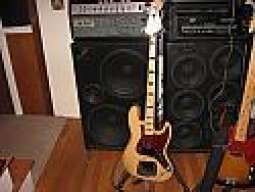
3.) Lastly you have your cabinet, which is a speaker enclosed in a wood box. This is the part that allows the amplified sound from the power amp and makes it so you can hear it. The speaker vibrates at the frequency of the note you are playing so you are able to hear it. Without speaker cabinets your amp sections are pointless.
Now some definitions of differents "amps" as you say in your thread title.
A.) Combo amps or combination amps are just that. It's all three parts put into one unit, so all you have to do is plug in and fiddle with a few knobs to play. However, since these are one set unit, you basically can't switch what preamp, poweramp, or cabinet that you have in your signal path for different sounds and volume levels.
[Generally, least common, or expensive, and least loudest]
B.) You have 3 peice setups or rigs, that still have all 3 parts, but each part of the rig is its own individual peice. These 3 separate parts are connected to togeather to do the same function as a combo amp. But, this route allows maximum flexibility since you can chage each piece to exactly what you want so you get exactly the tone and volume level you want.
[Generally, somewhat common, potentially loudest, and most expensive]
C.) This is the pairing of a head (a preamp and poweramp comined into one unit) and a cabinet. This route doesn't allow as much flexability as "B" but since you can swap heads and cabinets it still gives you much more flexability than combos. This is a nice happy medium between A and B.
[Generally, most common, middle of the road in price and volume levels]
Remember, these generalizations are just rough guides to help people with very little knowledge better get a feel for the differences between these types. I've seen many combos be much louder than a couple pre and power amp setups. It really depends on what pieces of gear are being compared.
Do keep in mind poeple have very big differences in what amps and cabinets work and sound best for them. Just use your ears, and keep in mind that experience and knowledge are your friends.
I really hope this helps!